Direct comparison between Parul University’s Lakshya 2047 Centre and centres at IITs and NITs is structurally misleading. The institutional models serve different student trajectories rather than competing for the same workforce profile. This article walks through where the differences are real and what they mean for student decision-making.
This article uses a structural rather than competitive framing because the question prospective students and parents are actually trying to answer is rarely “which is better” but “which fits my trajectory”. The Lakshya 2047 Centre for Future Skills at Parul University, inaugurated by Union Minister Dr. Jitendra Singh on 8 May 2026, has institutional design choices that differ from typical IIT and NIT research centre design.
The differences matter for some students more than others. The article treats five structural dimensions where the differences are concrete and operationally significant.
Structural dimension 1: Cross-faculty access model versus department-organised lab access
Most IIT and NIT research centres organise lab access primarily by academic department. Lakshya 2047 structurally inverts this with cross-faculty access by design.
In typical IIT and NIT structures, a research centre focused on robotics is accessed primarily by Mechanical Engineering, Mechatronics, and Electrical Engineering students. A centre focused on AI is accessed primarily by Computer Science and Electronics students. A centre focused on biomedical engineering is accessed primarily by Biotech and Biomedical Engineering students. Cross-department access exists but is the exception rather than the rule, typically requiring formal collaboration agreements or research project sponsorship.
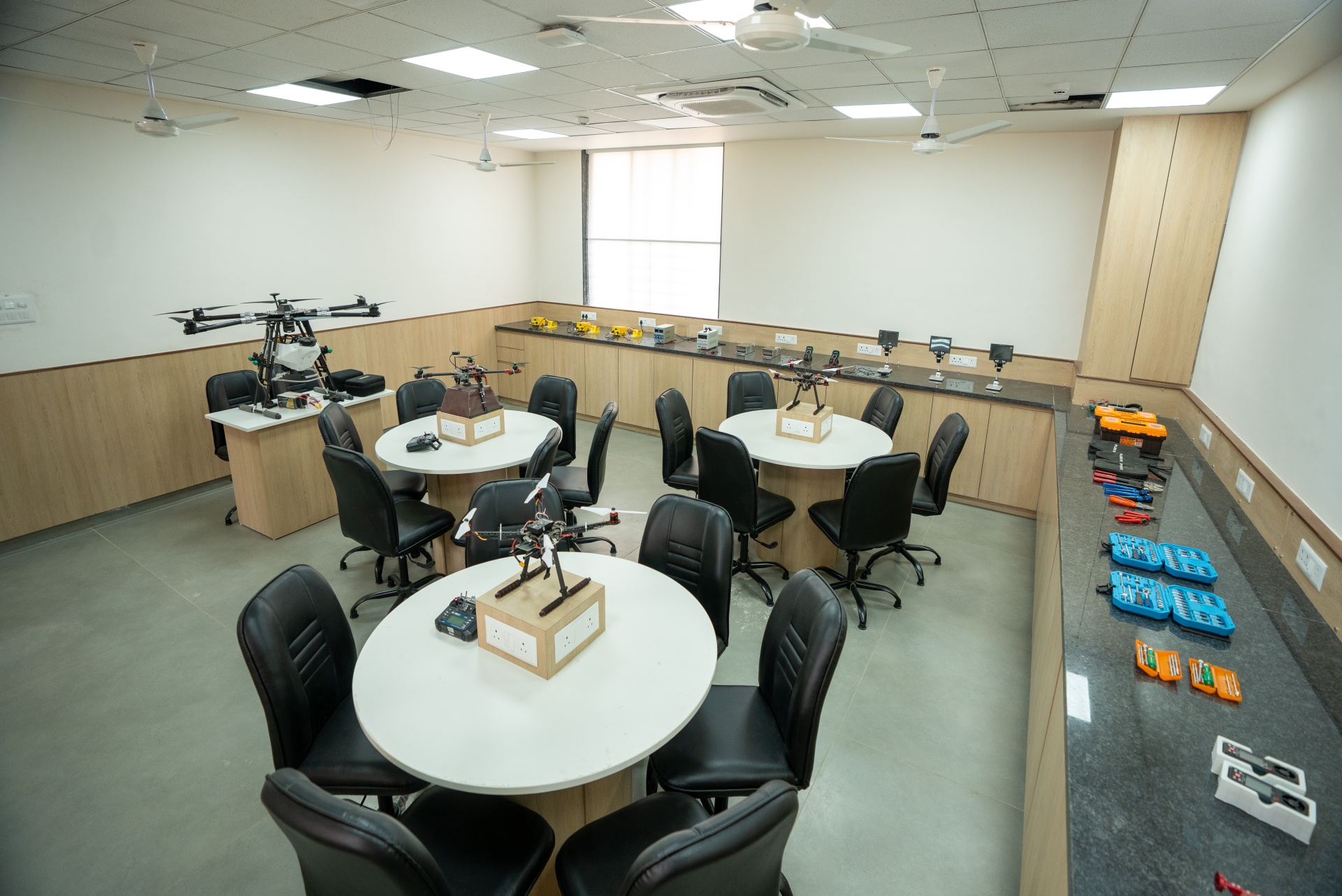
Lakshya 2047 is structurally designed for cross-faculty access. A Commerce student can engage the Mind Lab for Neurofinance research. A Design student can engage the Autodesk Lab for CAD work. A Medicine student can engage the AR/VR Lab for medical VR surgery training. An Agriculture student can engage the Drone Ecosystem for precision agriculture certification. The cross-faculty access is the default rather than the exception. The Course-to-Lab Mapping article provides the complete matrix.
Why this matters for some students. Students whose career trajectory benefits from cross-disciplinary credential portfolios find the Lakshya 2047 structure operationally better suited.
- A Computer Science student adding Neurofinance research from Mind Lab work.
- An Architecture student adding AR/VR walkthrough capability.
- A Commerce student adding Adobe creative credentials for digital marketing entrepreneurship.
The cross-credential trajectory is structurally easier under Lakshya 2047’s model than under the basic IIT/NIT department-organised access.
Why this matters less for some students. Students whose career trajectory is deeply single-disciplinary (pure semiconductor research, pure aerospace engineering, pure mathematical physics) may benefit more from the research depth that focused IIT and NIT department-centred access provides. The cross-faculty breadth Lakshya 2047 offers is less directly relevant for these students.
Structural dimension 2: Industry credentialing architecture versus research output orientation
IIT and NIT research centres orient primarily around research output (papers, patents, IP, sponsored research). Lakshya 2047 orients primarily around industry credentialing (25+ globally recognised certifications across 18 labs).
This is not a value judgment. Research orientation and industry credentialing orientation serve different student outcomes. Research orientation prepares graduates for academic careers, R&D roles at research-intensive employers, and the broader research economy. Industry credentialing orientation prepares graduates for direct workforce entry with portable third-party-verified credentials that employers recognise globally.
The credential architecture article treats the Lakshya 2047 credentialing architecture in detail. The certifications span Microsoft (AZ-900, AZ-204), AWS (Cloud Practitioner, Solutions Architect), NVIDIA (DLI, AI Developer), Cisco (CCNA, CCNP, CCIE), Apple (Swift, ACSP), Siemens (Drives and Automation), Schneider EcoXpert, ABB Advanced Robotics, Autodesk Certified Professional and Expert, Adobe ACP and ACE, Meta AR Developer, Synopsys VLSI, IEEE credentials, ASM International, ISA CCST and CAP, and DGCA-aligned RPTO drone pilot certification. NSDC alignment provides domestic NSQF recognition alongside global vendor recognition.
- Where IIT and NIT structures have research-depth advantages. Research-intensive IIT and NIT centres typically have stronger publication track records, deeper specialised research equipment in narrower domains, and stronger pathways into PhD programmes and academic careers. Students wanting research-track trajectories often benefit from this depth.
- Where Lakshya 2047 has industry-credential advantages. Industry-credentialed graduates carry portable third-party-verified credentials into hiring conversations. Microsoft, AWS, NVIDIA, Cisco, Adobe, and other major vendor credentials are verifiable globally through the vendor’s credential system, which is structurally different from research output as a hiring signal. Students wanting direct workforce entry often benefit from credential portability.
Structural dimension 3: PIERC entrepreneurship pipeline integration
Most IIT and NIT centres operate alongside separate entrepreneurship support units (incubators, technology transfer offices). Lakshya 2047 operates as part of an integrated entrepreneurship pipeline that includes PIERC.
The Parul Industrial Entrepreneurship Research Centre (PIERC) provides the institutional incubation pathway connecting Lakshya 2047 credential-backed competence to commercial ventures. PIERC operates with substantial entrepreneurship infrastructure across Parul University, with funding provided to startups, multiple startups incubated through the programme, and revenue generated by Parul University-supported ventures.
IITs and NITs have their own well-regarded incubation centres (IIT Bombay’s SINE, IIT Madras’s IITM Incubation Cell, IIT Delhi’s FITT, and parallel structures at other IITs and NITs). The structural difference is integration density: PIERC operates as part of an integrated pipeline with Lakshya 2047’s credential architecture, the broader Parul University faculty network, and the Industrial Entrepreneurship Research Centre framework. IIT and NIT incubation typically operates as a parallel structure that students engage selectively rather than as integrated infrastructure.
- Where integrated pipeline matters more. Students pursuing entrepreneurial pathways from the beginning of their academic trajectory benefit from integrated institutional infrastructure. The integration reduces the friction of moving from credential acquisition through prototype development through incubation through funding through commercial launch.
- Where parallel structures matter less or differently. Students whose entrepreneurial intent develops later in their academic trajectory (after research breakthroughs, late-stage discoveries, postgraduate insights) may find IIT and NIT parallel incubation structures equally serviceable. The integration density question matters most for early-trajectory entrepreneurial students.
Structural dimension 4: Multi-mission framework convergence
Lakshya 2047 operates inside three converging Government of India frameworks: AICTE IDEA Lab scheme, PM Internship Scheme (for top 500 Indian companies), and PMKVY under NSDC anchoring. The government scheme framework article treats the three-framework integration in detail.
IIT and NIT structures operate inside the IIT Council and NIT Council frameworks, respectively, which provide different regulatory infrastructure (research funding, institutional governance, academic standards). The structural difference is in the scheme infrastructure: Lakshya 2047 graduates carry NSDC alignment through PMKVY, structured access to top 500 company internships through the PM Internship Scheme, and AICTE IDEA Lab framework recognition for the Prototyping Zone.
IIT and NIT graduates carry institutional brand recognition through the IIT and NIT identity, with research-track regulatory infrastructure rather than skills-economy infrastructure.
- Where multi-mission convergence matters more. Students pursuing careers that benefit from formal Indian skills economy positioning (where NSQF alignment, NSDC recognition, and government scheme infrastructure matter operationally) benefit from the Lakshya 2047 multi-framework architecture. This includes students targeting public sector employment, government-supported industry sectors, and the broader Indian formal economy, where regulatory recognition is a hiring signal.
- Where IIT and NIT institutional brands matter more. Students pursuing careers where institutional brand recognition is the strongest hiring signal (consulting, investment banking, premium global technology firms, top-tier MBA admissions to international business schools) benefit from IIT and NIT brand recognition that has been built over decades.
Structural dimension 5: Multi-disciplinary breadth versus specialisation depth
Lakshya 2047 is structurally designed for multi-disciplinary breadth across 18 labs in nine future-technology domains. IIT and NIT centres are typically structured for specialisation depth within narrower technology domains.
Lakshya 2047 covers cloud computing, AI infrastructure, software ecosystem development, industrial automation, design and engineering simulation, immersive technology, semiconductor and materials engineering, cognitive sciences, drone technology, and hardware prototyping in a single integrated centre. This is structurally broader than typical IIT and NIT centre design, which tends to focus on specific specialisations (one IIT centre on robotics, another on AI, another on biotechnology, with depth rather than breadth as the design objective).
- Why breadth design matters. Students whose career trajectory benefits from understanding multiple emerging technology domains find the Lakshya 2047 breadth operationally useful. Modern technology careers increasingly cross traditional disciplinary boundaries (AI + hardware, robotics + computer vision, materials engineering + sensor IoT). Breadth design supports this kind of trajectory more naturally.
- Why depth design matters. Students pursuing deep technical specialisation in a single domain (pure semiconductor research, pure aerospace engineering, pure quantum computing, pure structural materials science) benefit from depth-focused centre design. Research-track careers often need depth rather than breadth as the foundational characteristic.
Honest summary of where each model serves students better
Both models have legitimate strengths. The question is which serves a specific student’s trajectory better, not which is universally superior.
- Lakshya 2047 serves students better when. Career trajectory benefits from cross-disciplinary credential portfolios. Direct workforce entry with industry-recognised credentials is the primary objective. Entrepreneurial pathways are part of the early-trajectory plan. Multiple emerging technology domains are part of the desired skill stack. Formal Indian skills economy positioning matters operationally.
- IIT and NIT centres serve students better when. Career trajectory benefits from deep specialisation in a narrower technical domain. Research-track careers (academic, R&D, advanced research roles) are the primary objective. Institutional brand recognition is the strongest hiring signal for target employers. Postgraduate and PhD pathways are part of the long-term plan. International business school admissions or premium consulting careers are part of the trajectory.
- Neither model is strictly superior. Both produce strong graduates pursuing different career trajectories. The choice depends on the specific student’s objectives, learning style, financial situation, and career planning horizon rather than on any universal ranking of institutional quality.
Practical considerations for prospective student decision-making
- Admissions accessibility. IIT and NIT admissions operate through JEE Advanced and JEE Main, respectively, which create accessibility constraints based on the competitive examination process. Parul University admissions operate through different criteria. Students for whom JEE-based admission is uncertain have more accessible pathways to Lakshya 2047 access through Parul University programmes.
- Geographic and cost considerations. Parul University’s Vadodara campus provides access to Lakshya 2047 with the broader Parul University ecosystem (medical hospital, residential infrastructure, integrated 250-acre campus). IIT and NIT geographic distribution varies, with cost structures that differ by institution. Family cost considerations matter for many students and parents.
- Programme breadth available. Parul University offers approximately 350 programmes across multiple faculties, providing cross-faculty access at unusual breadth for a single university campus. IIT and NIT programme structures differ, with typically narrower programme breadth focused on engineering, sciences, management, and related fields.
- International student infrastructure. Parul University hosts approximately 6,000 international students from 75+ countries, providing internationally diverse cohort access that complements the formal credential architecture. IIT and NIT international student infrastructure varies by institution.
FAQs
Is Lakshya 2047 a substitute for IIT or NIT for engineering education?
The question implies the two are competing for the same trajectory, which is structurally misleading. Lakshya 2047 and IIT/NIT centres serve different student trajectories. Students whose career trajectory benefits from cross-faculty credential portfolios, direct workforce entry with industry-recognised credentials, integrated entrepreneurship pipeline support, and broad multi-disciplinary engagement may find Lakshya 2047 better-suited. Students whose trajectory benefits from deep specialisation, research-track career preparation, institutional brand recognition for premium global employers, and postgraduate/PhD pathways may find IIT and NIT centres better-suited. The choice is trajectory-specific rather than universal.
Does Lakshya 2047 provide research depth comparable to that of IIT and NIT research centres?
In specific technical domains, IIT and NIT centres typically have stronger publication track records, deeper specialised research equipment, and stronger PhD programme integration. Lakshya 2047 is structurally designed for cross-faculty industry credentialing rather than narrow research depth. Within specific research areas where Lakshya 2047 has invested heavily, research depth is substantial (the Mind Lab's 24-channel dry EEG, fNIRS, Tobii eye tracking, and Level I PSG provide research-grade neural data collection at undergraduate level, which is unusual in Indian higher education; the Material Synthesis Zone's Techinstro Hydrothermal Autoclave, autoclave at 100 bars and 300 Celsius, and indigenous DC Plasma System provide substantial materials research capability). But the institutional orientation differs from the research-depth-first design.
Can Lakshya 2047 graduates compete with IIT and NIT graduates in hiring conversations?
In hiring conversations where credential portability and cross-faculty competence are the primary signals, Lakshya 2047 graduates compete strongly because they carry verifiable global vendor credentials (Microsoft, AWS, NVIDIA, Cisco, Apple, Adobe, and others) plus NSDC alignment. In hiring conversations where institutional brand is the primary screening signal (premium consulting firms, top-tier investment banking, certain global technology firms with very specific brand-recognition hiring patterns), IIT and NIT graduates may have brand advantages built over decades of institutional recognition. The competitive position depends on what specific employers prioritise in their screening processes.
What kinds of career outcomes does Parul University actually demonstrate from Lakshya 2047-adjacent training?
Parul University has been awarded Best University in Placements by ASSOCHAM for three consecutive years. The recruiter network includes 2,200+ prominent companies. The 2027 batch produced notable highlights, including Tanish Patel and Suraj Jagtap placed at Microsoft with a 60 LPA package, with an additional 45 LPA US-based MNC placements and Goldman Sachs and Bank of America placements across the broader cohort. Defence placements include Indian Navy officer selections. The recruiter ecosystem spans tier-1 technology employers, major Indian conglomerates, pharmaceutical companies, and a broader pool across multiple sectors. Specific Lakshya 2047 cohort outcomes will become clearer as the centre's first graduating cohorts complete their academic programmes.
Should prospective students who qualify for IIT or NIT choose Lakshya 2047 instead?
This is a trajectory-specific question rather than a universal one. Students who qualify for IIT or NIT and whose career trajectory benefits from deep specialisation, research-track preparation, premium institutional brand recognition, and PhD or international business school pathways should weigh IIT/NIT options carefully. Students who qualify for IIT or NIT but whose career trajectory benefits from cross-faculty credential portfolios, direct industry credentialing, entrepreneurial pathway integration, and multi-disciplinary breadth may find Lakshya 2047 structurally better-suited to their objectives. Some students will benefit most from the IIT/NIT option; others will benefit most from the Lakshya 2047 option; the difference is in trajectory fit rather than institutional ranking.