University hackathons produce two kinds of output. Concept work that demonstrates capability but stops short of deployment, and technically deeper work that addresses real problems with real datasets and is ready for the validation that turns student projects into adopted tools. The three winning projects from the Parul University Environment Hackathon 2026 belong to the second category.
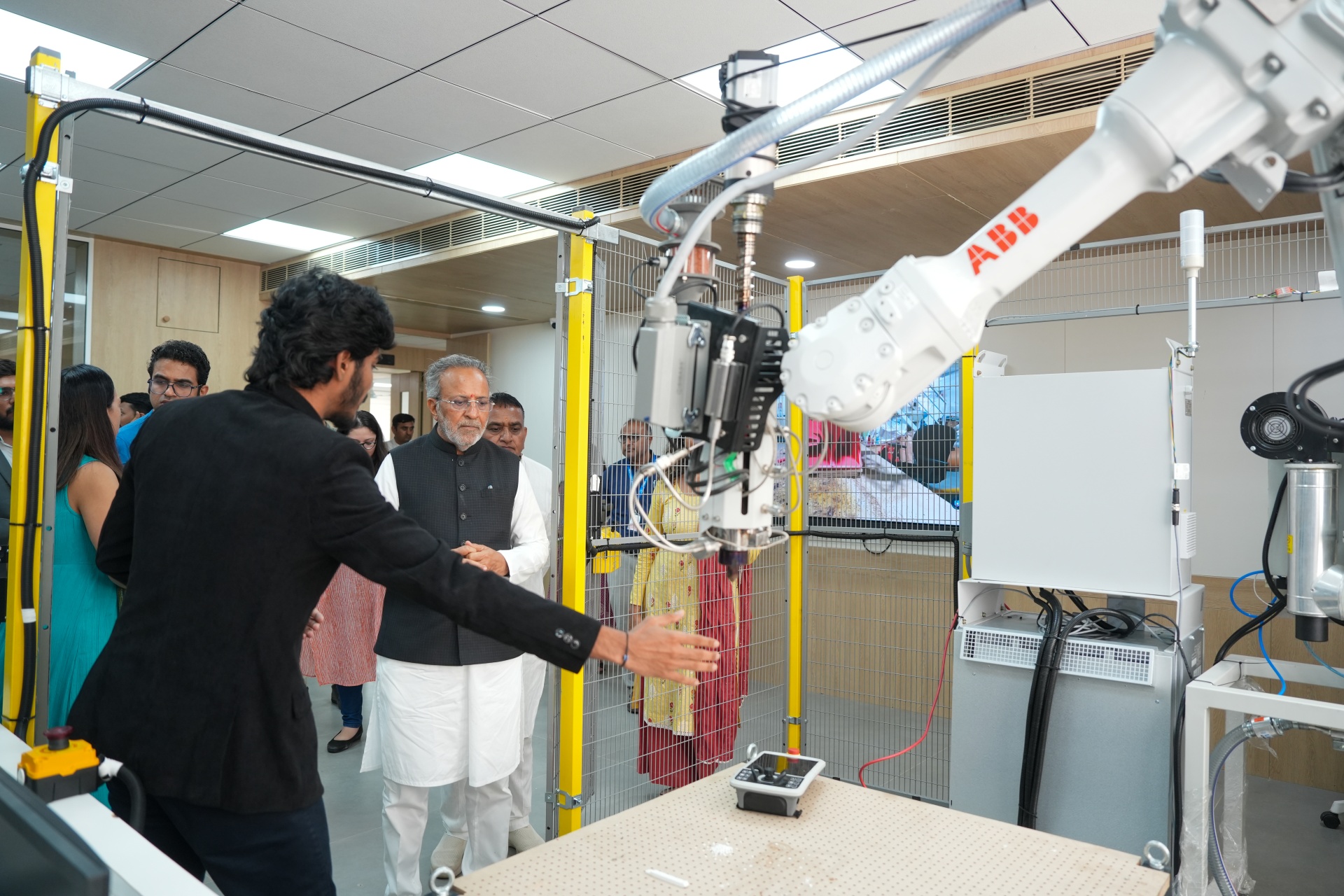
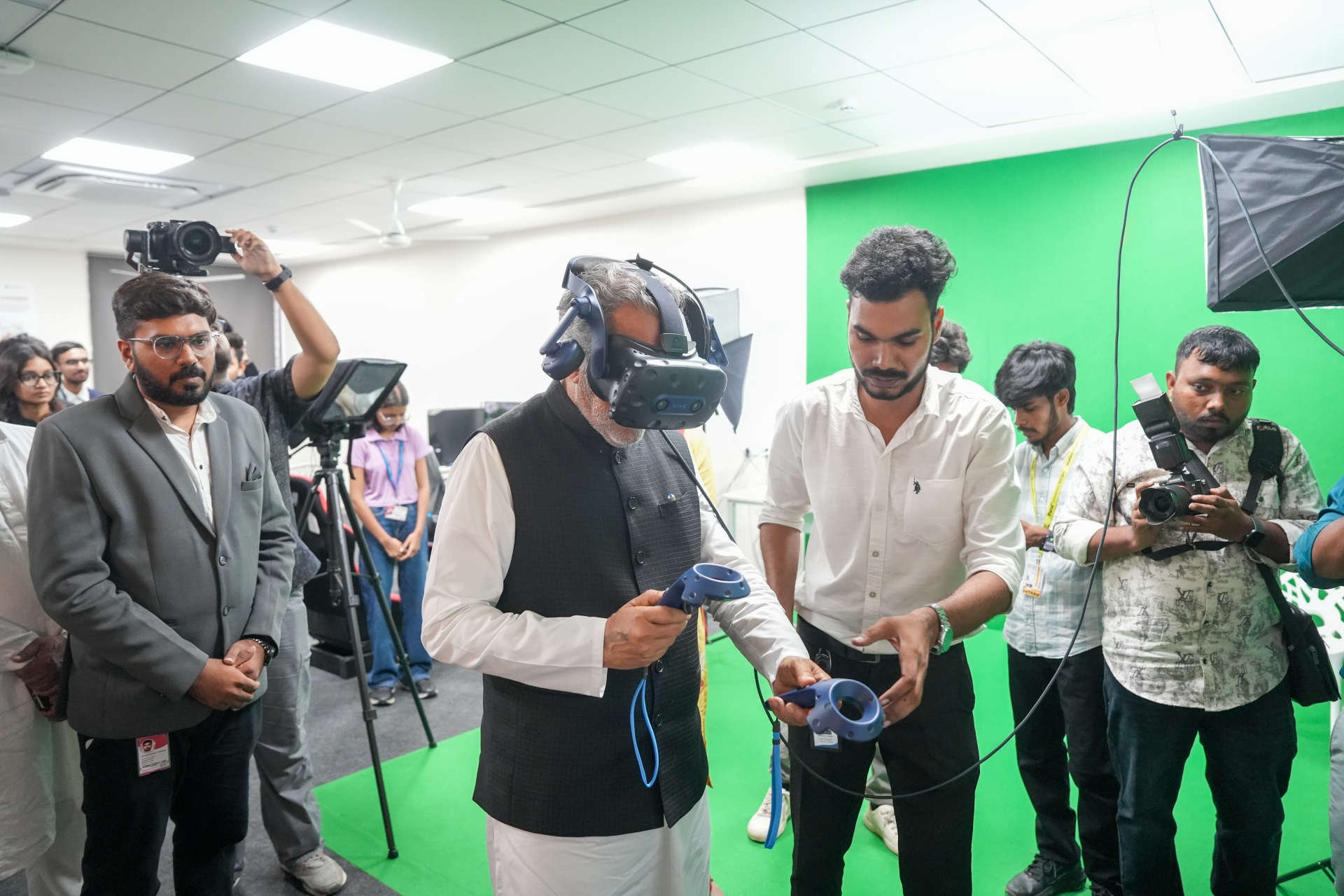
The proud momentum for Parul University is that the 3 winning teams showcased their work to the Honourable Shri Arjun Modhwadia Ji, the Cabinet Minister for Forests & Environment, Climate Change & Science & Technology. Hosted at the AR/VR Lab of Lakshya 2047 – Innovation Hub, he was very happy and proud to see such epic innovations happening at Parul University. He himself is trained as a mechanical engineer and has worked on datasets, methodology, and real-world deployment. The broader context of the visit is treated in the companion article on the Cabinet Minister’s visit , and the institutional sustainability framework these projects sit within is detailed in the Sustainable Campus 2047 article.
Why student-built AI for sustainability matters now
The strongest argument for student-built sustainability AI is that the problems are local enough to require local building. Crop disease detection on imported datasets misses Indian disease patterns. Urban mapping built for Western cities misses Indian campus navigation challenges. Healthcare forecasting on aggregated international data misses the epidemiology that drives Indian medicine and blood-bank requirements.
The three Environment Hackathon 2026 winners illustrate this directly. Each project identifies a real problem in the Indian context, builds its model on local data, and produces output calibrated to constraints that actually apply on the ground. The Cabinet Minister’s substantive engagement with the technical details suggests the proposition holds at the state government level.
AgroSense: AI crop disease detection trained on Indian datasets
AgroSense placed first runner-up at the Environment Hackathon 2026 and was developed by Team CropMatrix, comprising Gaurav Sharma and Eshant Bhardwaj, both students at the Faculty of Engineering and Technology at Parul University. The project is positioned as a multilingual AI-based platform that enables farmers to detect crop diseases through smartphone image analysis and monitor plant and soil health.
The workflow is straightforward. A farmer photographs a plant leaf, selects the crop type, and receives an AI assessment including the model’s confidence level, disease severity, associated risk, specific treatment recommendations, and relevant weather forecasts. The platform estimates recovery rates in the 50 to 60 per cent range over windows of 7 to 14 days, and includes a built-in AI assistant guiding farmers through treatment steps. AgroSense aligns with the United Nations Sustainable Development Goals for Zero Hunger, Responsible Consumption and Production, Climate Action, and Life on Land.
The Cabinet Minister’s questioning focused on the technical foundation. Asked what data had trained the model, Gaurav Sharma confirmed that the disease-detection ML model is trained on 54,000 images spanning three crop varieties, with new images uploaded daily to refine accuracy. The dataset is drawn specifically from Indian crop varieties, ensuring relevance to Indian farming conditions rather than borrowing from internationally trained models.
EcoSathi: GPS-based sustainable urban mapping
EcoSathi won the Best Design award at the Environment Hackathon 2026 and was developed by Team TheRebuilders, comprising Yagnik Patel and Deepak Jha, both students at the Faculty of Engineering and Technology. The project tagline, Survive the Climate, Heal it Too, frames the application’s dual purpose: practical navigation utility paired with environmental contribution mechanisms.
The core functionality is GPS-based mapping of community resources that allows users to locate critical services easily, particularly during severe weather events when standard wayfinding breaks down. Yagnik Patel illustrated this through the Parul University campus itself: a newcomer would have no easy way of identifying dining options, waste collection points, or washroom facilities without guided assistance. The application has been built around the University’s complete campus map as its working sample.
Beyond navigation, the application tracks the University’s sustainability initiatives in real time. Following recent tree plantation drives, EcoSathi allows users to identify where new trees have been planted and mark open spaces for further plantation, turning the application into a live tool for environmental stewardship. A built-in tree marketplace feature lets users contribute directly to tree-planting efforts. The project aligns with the Sustainable Development Goals for Good Health and Well-Being, Clean Water and Sanitation, Sustainable Cities and Communities, Climate Action, and Life on Land.
When the Minister asked what sample data the team used, Yagnik Patel pointed to the universal applicability that emerges from the design choice. Because locations can be mapped for any space, anyone navigating an unfamiliar campus or international city can use the application to orient themselves. The architectural choice converts a campus tool into a generally deployable platform without the need for redesign in each context.
Optiflow AI: climate-resilient healthcare logistics
Optiflow AI placed as a runner-up at the Environment Hackathon 2026 and was developed by Team Planetary Healers, comprising Dhruv Prajapati and Kuldeepsinh Parmar, both students in the Faculty of Medicine at Parul University. The project addresses a persistent operational problem in healthcare logistics that most discussions of healthcare reform either ignore or treat as secondary: the overstocking and understocking of blood units and essential medicines, both of which carry serious consequences in the form of shortages during demand surges or expired wasted stock during periods of overestimation.
The model is fed recent monthly data spanning platelet and blood bank reserves, rainfall patterns, dengue case counts, and mosquito density ratios to estimate near-term disease incidence rates. Equipped with this forecast, pharmacists and hospital administrators can anticipate which conditions will rise in incidence and place stock orders accordingly, minimising expiry risk while avoiding shortages. The team used data from Parul Sevashram Hospital as the working sample. Optiflow AI aligns with the Sustainable Development Goals for Good Health and Well-Being, Responsible Consumption and Production, and Climate Action.
The substantive interest of Optiflow AI is the deliberate connection between climate variables and healthcare logistics. Rainfall, mosquito density, and dengue incidence are environmental data points; blood and medicine forecasts are healthcare operations. Most existing models keep these separate. Optiflow AI integrates them on the proposition that climate signals are now sufficiently strong predictors of healthcare demand.
What the Cabinet Minister's questions revealed about each project
The Cabinet Minister’s questioning was consistent across all three teams and revealed how state-government engagement with university innovation works at the substantive level.
- Dataset provenance. With AgroSense, he immediately pressed on the training data origin. The question matters because models trained on borrowed international datasets often fail in deployment; the response (54,000 images from Indian crop varieties) addressed the relevance concern directly.
- Working sample selection. With EcoSathi, the Minister asked about demonstration data. The team identified the Parul University campus map as the working sample, with universal applicability following from the design choice.
- Deployment context. With Optiflow AI, working data was drawn from Parul Sevashram Hospital, anchoring the forecasting in a real operating healthcare context rather than synthetic test data.
The Minister’s engagement pattern across all three projects favoured questions that test the boundary between concept and deployment. This is the same boundary that separates student work that stops at the demonstration stage from student work that progresses toward institutional adoption. The Faculty of Engineering and Technology produced two of the three winning teams, and the Faculty of Medicine produced the third, suggesting that the institutional capability to build deployment-ready student work spans disciplines rather than being concentrated in a single faculty.
The institutional infrastructure that produced these teams
The Environment Hackathon 2026 winners did not emerge in isolation. They emerged from an institutional ecosystem that supports the specific capabilities each project required. Understanding this ecosystem is useful for prospective students evaluating where they would build similar work, and for institutional observers assessing how university-level innovation infrastructure actually operates.
The Lakshya 2047 Innovation Hub houses five laboratories supporting prototyping across digital and hardware domains. The AR/VR Lab, where the hackathon teams presented to the Minister, is one. Apple Lab supports Swift development; Praneel Pandey, a second-year B.Tech CSE student at Parul Institute of Technology, placed in the Top 350 of the global Swift Student Challenge 2026. Drone Lab, Sensor Lab, and IDEA Lab round out the hub with hardware-side capabilities.
The hackathon format itself is institutionally significant. Environment-themed hackathons that produce deployment-ready work require commitment beyond hosting a single event: lab access, dataset access, mentor engagement, and showcase platforms connecting student work to state government attention. A sitting Cabinet Minister engaging with hackathon winners signals that the commitment has been sustained at the required level.
FAQs
Define Parul University’s Hackathon 2026? Who were the winners?
This environment hackathon 2026 was held on campus, encouraging students to ideate and design tech-driven solutions for climate & sustainability issues. The 3 winning projects were AgroSense, they were the first-runner-up; it was developed by Team CropMatrix with Gaurav Sharma & Eshant Bhardwaj, and another one is an AI-driven platform for crop disease detection, which was trained on 54,000 images of Indian crop varieties, known as EcoSathi by Yagnik Patel & Deepak Jha, and the final project was a GPS-led mapping application for community resources and tracking, known as Optiflow AI by Dhruv Prajapati and Kuldeepsinh Parmar.
How does the AgroSense AI crop disease detection platform work?
AgroSense is a multilingual AI-based platform built by Team CropMatrix at Parul University that enables farmers to detect crop diseases through smartphone-based image analysis. The workflow requires a farmer to photograph a plant leaf and select the crop type, after which the system produces an AI-generated assessment including the model's confidence level, disease severity, associated risk, specific treatment recommendations, and relevant weather forecasts. The underlying machine learning model is trained on 54,000 images spanning three crop varieties drawn specifically from Indian crop varieties to ensure relevance to Indian farming conditions, with new images uploaded daily to refine accuracy. The platform estimates recovery rates in the 50 to 60 per cent range over windows of 7 to 14 days and includes a built-in AI assistant that guides farmers through subsequent treatment steps. AgroSense aligns with the United Nations Sustainable Development Goals for Zero Hunger, Responsible Consumption and Production, Climate Action, and Life on Land.
What does the EcoSathi application do and what makes it distinct?
EcoSathi is a GPS-based mapping application developed by Team TheRebuilders at Parul University that allows users to map and locate critical community services using GPS coordinates, particularly during severe weather events when standard wayfinding breaks down. The application tracks the University's sustainability initiatives in real time, allowing users to identify where new trees have been planted following plantation drives and mark open spaces where further plantation could take place. A built-in tree marketplace feature enables direct user contribution to tree-planting efforts. What makes EcoSathi distinct is its universal applicability: because locations and resources can be mapped for any space, the application is deployable beyond its original campus context to any neighbourhood, city, or international location without redesign. The project won the Best Design award at the Environment Hackathon 2026 and aligns with Sustainable Development Goals for Good Health and Well-Being, Clean Water and Sanitation, Sustainable Cities and Communities, Climate Action, and Life on Land.
What problem does Optiflow AI solve, and how does it integrate climate data with healthcare?
Optiflow AI, developed by Team Planetary Healers at Parul University's Faculty of Medicine, addresses the overstocking and understocking of blood units and essential medicines in healthcare logistics. Both problems carry serious consequences: shortages during demand surges or expired wasted stock during periods of overestimation. The model integrates climate variables (rainfall patterns, dengue case counts, mosquito density ratios) with healthcare operations data (platelet and blood bank reserves) to estimate near-term disease incidence rates. Equipped with this forecast, pharmacists and hospital administrators can anticipate which conditions are likely to rise in incidence and place stock orders in appropriate quantities in advance. The team used data from Parul Sevashram Hospital as the working sample for model building and testing. The project's distinctive contribution is the integration of climate signals with healthcare forecasting, on the proposition that climate variables are now sufficiently strong predictors of healthcare demand that ignoring them leaves significant forecasting accuracy on the table.