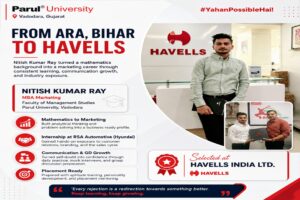
Reflecting on his own experience, Nitish urges students to begin preparing for placements early rather than waiting until the final semester. “Developing communication skills is as important as good academics, as your confidence and clarity while sharing ideas will stay with you throughout your placement process, during interviews and group discussions,” he says.
He also recommends that students make the most of every internship, as real industry exposure helps build confidence and prepares them for the job market. Finally, he advises students to treat rejection as a learning experience, believing that “you learn from every rejection.”
Also Read: How the Mavericks Programme at Parul University’s MBA programme prepares management students through intensive industry-led training, mentorship, and corporate evaluation before campus placements.
Why a Designer from the Northeast Chose Parul Institute of Design
Goirick Ghosh grew up in Shillong, in a creative and culturally rich environment. His interest in the arts was rooted in his family. His mother, a school principal, holds master’s degrees in fine arts and economics, and several relatives on her side work as videographers and cinematographers for major streaming platforms. In his hometown, choosing a creative path over the conventional engineering or medical routes was ordinary rather than unusual; classmates went into music, design, and other artistic careers.
That background shaped how he chose a college. Design education is demanding and expensive, and the decision was as much practical as creative. He chose Parul Institute of Design as a deliberate, industry-focused option that fit his family’s plans and timeline, in a city and campus environment his parents were comfortable with. Coming from an ICSE schooling background, he moved across the country to begin a design degree far from home.
Choosing a design school is a practical decision as much as a creative one. He treated it as both.
Adapting to a New Region, and Growing Into Product Design
Moving from the Northeast to western India was a genuine adjustment. The language, the daily rhythm, and the food were all different from what he had grown up with, and the early months were about learning to live in an unfamiliar place. That relocation, made at eighteen and sustained for four years, is itself part of the story, because resilience of that kind is not separate from design ability. It is what allows a designer to work anywhere, with anyone.
The academic shift was just as real. Coming from a creative family did not make Goirick a trained designer, and he is clear that he was not an expert when he began product design in 2022. What changed him, in his account, was a single discipline: he learned to observe more and to talk less. By his final year, that habit had turned him into a confident product designer, and he regards the move into product design as the turning point of his education.
The Design Studio Model: Four Years of Building Real Products
The curriculum at Parul Institute of Design is organised around a core subject called Design Studio, which runs through all four years while the surrounding subjects change each semester. Design Studio is where a student conceptualises, designs, and prototypes a physical product by the end of every term, and it is treated with the greatest seriousness of any subject in the programme.
- Fourth semester: a specialised toy designed for children between the ages of two and five.
- Fifth semester: a working humidifier, moving from a toy to a functional household device.
- Sixth semester: an intricate toy designed for adults aged eighteen and above, a deliberate shift in user and intent.
- Seventh semester: a group project with four other students, designing a complete set of smart furniture comprising a smart sofa and a living room table.
The progression matters more than any single object. Each term forced a different user, a different function, and a different constraint, which is how a designer learns to design for people other than themselves. By the seventh semester, the brief had grown from a single product into a coordinated system built by a team.
Read More: Design Exhibition by Architecture Students of Parul University.
The Software a Product Designer Learns at Parul Institute of Design
Building physical products to a professional standard means learning a range of software and learning which tool fits which task. Across his projects, Goirick worked with a full toolkit.
- Fusion 360 and SolidWorks: computer-aided design and mechanical modelling for functional products.
- KeyShot: photorealistic rendering, to show a product convincingly before it is built.
- Adobe Illustrator and Photoshop: vector work, graphics, and visual presentation.
- Figma: interface and layout design, and collaborative visual work.
The skill is not any single tool but the judgement of when to use which. Choosing the right software for a given project, depending on what is being made, is part of what separates a trained product designer from a hobbyist, and it is learned by building real projects rather than by reading a manual.
What Group Projects Teach That Solo Work Cannot
Goirick is direct about the value of working in a group: it makes a designer better, precisely because it is difficult. In a team, everyone arrives convinced their own idea is the strongest, and the real work is learning to compromise, to combine several ideas into one that everyone can support, and to accept that a designer is neither always right nor always wrong.
That lesson is hard to teach in a lecture and almost impossible to learn alone. The seventh-semester smart furniture project, built with four collaborators, was where it became concrete, turning five sets of opinions into one coherent design.
Three faculty members were central to that development. Goirick credits his mentors Sameer Bakshi, Shardul Phansalkar, and Deepak Vishwakarma as a support system across all four years, from his first year to his last. The presence of mentors who follow a student across the full length of a programme is one of the quieter advantages of the Parul Institute of Design studio model, and Goirick is explicit about his gratitude for it.
Inside the Internship at Kannan the Art Space
As he neared the end of his studies, Goirick set out to find real work experience, focusing with a friend on home and household products, lighting, and furniture. Through seniors who had interned there before, they learned about Kannan the Art Space, a design studio in Vadodara, and applied together.
He and his co-applicant, Saie, were invited to interview with the studio’s owner, Kannan Asher, who was impressed enough with their work to take them on as product design interns, with a one-month trial followed by a stipend of Rs 10,000 per month. The work was varied and hands-on.
- Wall murals: large-scale visual work for interior spaces.
- Custom furniture: one-off pieces designed to a brief.
- Lighting fixtures: functional and decorative lighting.
- Sculptures: three-dimensional art objects, often for corporate brand clients.
The internship taught Goirick how far the industry sits from the classroom. In college, he had worked at a desk among twenty students and one teacher, each with considerable creative freedom. In the studio, the client came first. A designer could not simply submit one finished product; clients expect several options, narrow them to a few, ask for changes, and then choose one. That reality made him work harder to meet expectations he did not fully control.
In college the designer’s idea comes first. In the studio the client’s does. Learning the difference is the internship.
The most demanding skill he learned was vendor management. Kannan the Art Space ran large projects on short timelines, and interns handled everything, designing, building a model, and delivering a finished product within a month. That meant coordinating several vendors at once, which was frequently stressful. Here one lesson from Parul Institute of Design proved directly useful: diplomacy. Learning to stand firm without upsetting people helped him manage a demanding brief, hold his ground with difficult vendors, and handle client expectations at the same time. It is a soft skill that turned out to be as decisive as any software.
Goirick Ghosh's Advice: Start Industry Experience Early
Asked what he would tell juniors, Goirick’s message is practical and specific: start looking for industry experience as early as possible, and do not wait until the final year.
- Use the vacations, especially the roughly thirty days after the second year, when a portfolio is usually strong enough to secure an entry-level position.
- Take internships even when they are short, twenty, thirty, or forty-five days, and even when they are unpaid; the experience is the point.
- Look locally for studios, which are within reach for most design students.
- Treat early industry experience as the clearest way to stand apart, because employers value proof of real work over a degree alone.
He also corrects a common misconception: that faculty discourage students from interning. In his experience, the opposite is true. As long as academics are not neglected, students are free to take up industry work. He encourages younger batches to make full use of how quickly the institution is growing and to focus on the resources it actually provides rather than on what an older institution might have. Parul Institute of Design is a young institution improving quickly, and Goirick’s advice is to leverage that momentum rather than overlook it.
“You should not stress about what you are doing at this moment. In the end, even if it does not work out, it is your life, and you will always figure something out.” – Goirick Ghosh
Frequently Asked Questions
What is it like to study product design at Parul Institute of Design?
Product design at Parul Institute of Design is organised around a core subject called Design Studio, which runs through all four years. Each term, students conceptualise, design and prototype a physical product, moving across different users and functions. Goirick Ghosh's projects ranged from a children's toy and a working humidifier to a group-built set of smart furniture, which is how students learn to design for people other than themselves.
What software do product design students learn at Parul University?
Product design students at Parul Institute of Design work with computer-aided design and modelling tools including Fusion 360 and SolidWorks, KeyShot for photorealistic rendering, Adobe Illustrator and Photoshop for graphics and presentation, and Figma for interface and collaborative work. The key skill is judgement: choosing the right software for each project rather than mastering only one.
Do Parul Institute of Design students do internships?
Yes. Design students are free to take up internships as long as their academics are not neglected, and many do so before their final year. Goirick Ghosh interned at Kannan the Art Space, a design studio in Vadodara, where he worked on wall murals, custom furniture, lighting and sculptures for corporate clients, with a stipend of Rs 10,000 per month after a one-month trial.
How important are internships for design students in India?
For design students, early industry experience is one of the clearest ways to stand apart, because employers value demonstrated real-world work alongside a degree. An internship also teaches what a classroom cannot, that the client's brief comes first, that projects need multiple options and iteration, and that skills such as vendor management and diplomacy are as decisive as software. Starting during vacations, even briefly, builds that edge early.
How do product design students build a portfolio for jobs?
A strong design portfolio combines coursework and real projects. At Parul Institute of Design, the Design Studio produces a prototyped product every term, and internships add client work to the record. Goirick Ghosh's portfolio spans studio projects and studio-industry work, published on his Behance profile, which for a designer is the single most useful place to make that work visible and verifiable.