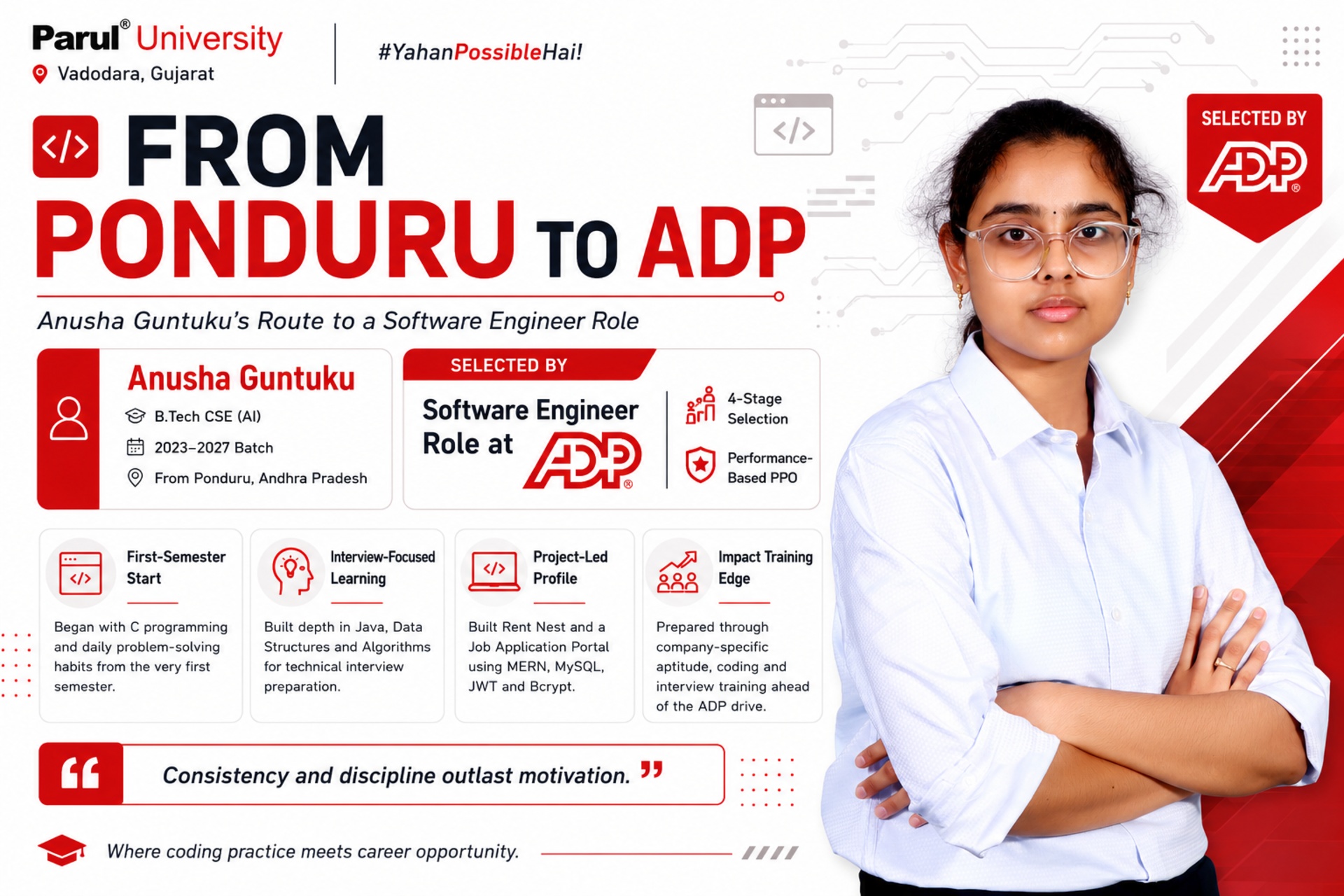
A Parul University placement in software engineering rarely begins on the day a company arrives on campus. For Anusha Guntuku, a B.Tech CSE student with a specialisation in Artificial Intelligence from the 2023 to 2027 batch, it began in her first semester, with a C compiler and a set of data structure problems she chose to work through on her own. It ended with a Software Engineer internship at ADP, a three-month position that carries a performance-based Pre-Placement Offer.
Her preparation can be traced semester by semester, from first-year fundamentals to full-stack projects to a four-stage selection process. There was no single decisive moment and no contact that opened a door. There was a sequence of decisions that a prospective student could read and follow.
Anusha comes from Ponduru, a town in the Srikakulam district of Andhra Pradesh. She reached ADP without a family background in software, without metropolitan schooling, and without a placement package quoted at the top of the story. What she had instead was a method, and the method is the useful part.
From Ponduru to a Computer Science Classroom
Anusha Guntuku completed her schooling from Class 1 to Class 10 at Narayana E.M. School and her higher secondary education with the Narayana Group of Colleges. Her interest in computing began earlier than any coursework. Several members of her family, relatives and cousins among them, worked in software, and their example turned a childhood curiosity into a decision about what to study.
She chose Parul University on the recommendation of friends and seniors who had studied there and spoke well of the experience. The choice of Computer Science Engineering followed from the analytical and problem-solving habits she had built at school, and from a clear intention to work in the software industry rather than a general wish to hold an engineering degree.
How the Preparation Was Built, Semester by Semester
The most transferable part of Anusha’s route is that it was gradual and self-directed. She treated classroom teaching as a floor rather than a ceiling and added skills in a deliberate order.
First year: fundamentals in C, and the habit of Data Structures and Algorithms
She began with the C programming language and, in parallel, Data Structures and Algorithms. This gave her the basic programming logic and analytical grounding on which everything later depended. The point of the first year, in her account, was not to finish a syllabus but to build the habit of solving problems in code every day.
Fourth semester: Java and the depth that interviews test
She moved her focus to Java and to a deeper study of Data Structures and Algorithms, spending most of her practice time on coding problems and on understanding how algorithms behave rather than only memorising them. She had recognised, correctly, that Data Structures and Algorithms in Java are the core of most technical interviews for software roles, and she prepared for that reality directly. If you’re a tech enthusiast, delay not and enrol on Parul University’s B.Tech in Information Technology programme as it ensures technology excellence + exposure!
Fifth semester: backend development and the full stack
She turned to backend development, learning MySQL and studying how scalable web applications are structured on the server side. Her interest widened into full-stack development, and she picked up the MERN stack, covering both front-end and back-end application development. The skills she chose to learn, in sequence, were the following.
- Data Structures and Algorithms in Java: the foundation for technical interview rounds.
- Database Management with MySQL: how data is modelled, stored, and queried in real applications.
- The MERN stack: MongoDB, Express.js, React, and Node.js, for building complete web applications end to end.
- Authentication and authorisation: session and token handling, password security, and access control.
“She did not wait for a company to teach her to build. She built first, then applied.”
The Projects That Became Interview Material
Anusha applied what she learned by building working software, and her projects later became the material her interviewers questioned her on. Her principal project is Rent Nest, a full-stack property listing platform modelled on modern accommodation booking sites.
Rent Nest was built with MongoDB, Express.js, Node.js, Tailwind CSS, JWT, Bcrypt, and EJS. Its features were not decorative; each maps to a skill a recruiter checks for.
- User authentication with JWT: Secure login and session handling using JSON Web Tokens.
- Password encryption with Bcrypt: Credentials are stored as hashes rather than plain text.
- Full CRUD for property listings: Create, read, update, and delete operations backed by the database.
- Server-side rendering with EJS: Pages assembled on the server for performance and structure.
- Live reviews and feedback system: User-generated content written to and read from the database in real time.
A second project, a Job Application Portal with an authentication feature, reinforced the same competencies. Between them, the two projects gave her direct experience of full-stack architecture, database work, the authentication and authorisation layer, and the software development life cycle. That experience is what allowed her to answer design questions in an interview rather than only recite definitions.
Inside the ADP Selection Process
ADP, formerly Automatic Data Processing, is a global technology company that builds human capital management, payroll, and workforce software used by employers worldwide. Its selection process for Anusha ran in four stages, and this was the first placement interview she had ever attended.
- Stage 1, Resume shortlisting: candidates were filtered on the strength of their resumes before any assessment.
- Stage 2, Online assessment: a test of programming ability, logical thinking, and problem-solving.
- Stage 3, Technical interviews: two rounds covering Data Structures and Algorithms, programming, software development, and a detailed examination of her projects, including Rent Nest. Interviewers pressed on design decisions, database management, authentication, and implementation, not only on whether the code ran.
- Stage 4, HR interview: communication, professional attitude, career goals, and cultural fit.
She cleared every stage. Her own reaction to the result, by her account, was disbelief before it settled into the satisfaction of seeing sustained effort produce an outcome. She is now working at ADP as an intern and is preparing to convert the internship into a Pre-Placement Offer on the strength of her performance.
“A resume is a promise. Every line on it is a question the candidate has agreed to answer.”
That last point is one Anusha makes deliberately. Companies prefer candidates with demonstrable, practical experience, and interviewers ask about everything a resume claims. Her advice to students is to write nothing on a resume that they cannot explain and defend under questioning.
The Role of Impact Training in the Parul University Placement Process
Anusha attributes part of her result to the Impact Training programme at Parul University, which ran alongside her own preparation. Ahead of the ADP drive, the university organised a dedicated, company-specific training programme that gave students a week to prepare across the exact areas the recruiter would test.
- Aptitude and reasoning: the quantitative and logical sections that gate the Online Assessment.
- Coding practice: structured problem-solving under time pressure.
- Interview technique: how to reason aloud, structure an answer, and handle project questions.
- Company-specific requirements: what ADP in particular screens for at each stage.
The Training and Placement function at Parul University, led by Director Mr. Gurcharan Singh, runs this company-specific model across recruiters rather than offering a single generic session. The intent is that a student walks into a particular company’s process having rehearsed that company’s process. Anusha’s outcome is one instance of it. For a fuller view of how the model works across a cohort, see How Impact Training Works at Parul University and the placement film on the university’s channel.
→ Parul University placements: student accounts on video
A single internship is a selective outcome, and selective outcomes need their context. The same Training and Placement infrastructure that prepared Anusha serves a recruiter base of more than 2,200 companies, and Parul University has been recognised by ASSOCHAM as the Best University in Placements for three consecutive years. The highest package the university reports, 60 LPA, was secured by Tanish Patel and Suraj Jagtap of the B.Tech Computer Science and Engineering programme, placed at Microsoft. Anusha’s route and theirs run through the same preparation system at different points in its range.
→ Tanish Patel: 7.04 CGPA to 60 LPA at Microsoft
→ Placement Day at Parul University: the offers, the multi-offer students, the full season
→ Pranshu Kumar: a Computer Science placement at a US-based MNC!
Why Building Comes Before Placement at Parul University
There is a detail in Anusha’s story that is easy to pass over. Before any company assessed her, she had already built two working products that solved defined problems, a property listing platform and a job application portal. She was not waiting to be taught to build. That instinct, to notice a problem and construct a solution, is the same instinct the university’s entrepreneurship ecosystem is designed to catch.
Through the Parul Innovation and Entrepreneurship Research Centre, the university reports 254 startups incubated and supported, more than Rs 20 crore in funding provided to student ventures, and more than Rs 40 crore in revenue generated by those ventures. The centre runs start-up studios across Vadodara, Surat, Ahmedabad, and Rajkot, and hosts the Vadodara Startup Festival, which connects student founders with investors. Some students take the placement route, as Anusha has. Others take the same building instinct and turn it into a company. The preparation overlaps more than the two paths suggest, which is why a search for placement at Parul University leads quickly into its startup and PIERC ecosystem.
→ PIERC: 254 startups built from problems students noticed
→ Solnce Energy on Shark Tank India: from a PU idea to Rs 1 crore of investment
Anusha's Advice for Students Preparing for Placements
Asked what she would tell students who want a software role, Anusha returns to method rather than motivation. Her route was very consistent, as she says:
- Discipline is more important than motivation.
- Kickstart learning Data Structures and prioritise Java for technical interviews.
- Explore different technologies and study Database Management Systems and Operating Systems.
- Build projects that work, practise on LeetCode, and keep an honest resume so that you can confidently explain every skill you list.
For students at the start of preparation, she adds a point about focus. The syllabus can feel unmanageable at first, and the instinct is to compare oneself with others. Her counsel is to build strong fundamentals, keep coding, and work on projects rather than race the person in the next seat. Continuous learning, practical application, and steady work are, in her view, what compound over a software career.
Consistency and discipline outlast motivation. That is the whole method, stated plainly.
FAQs
Does Parul University help students prepare for specific company placements?
Yes. Alongside general placement preparation, Parul University runs company-specific Impact Training. Ahead of the ADP drive, students received a dedicated week covering aptitude, coding, interview technique and ADP's specific selection requirements, in addition to their own preparation. The model is run across recruiters by the Training and Placement function rather than as a single generic session.
Do you need a high CGPA to get placed from Parul University?
The selection Anusha cleared weighted an Online Assessment, two technical interviews on Data Structures and Algorithms and project design, and an HR round, rather than a CGPA figure alone. Her preparation ran on self-directed study, Data Structures and Algorithms in Java, and two full-stack projects she could defend under questioning. For software roles, demonstrable coding ability and project depth carry substantial weight in the interview itself.
What is a Pre-Placement Offer and how does an internship convert into one?
A Pre-Placement Offer, or PPO, is a full-time offer extended to an intern on the basis of performance during the internship. Anusha's ADP internship runs for three months and carries a performance-based PPO, meaning the internship is the assessment period for a permanent role.
What projects should a computer science student build for placements?
Full-stack projects that exercise the skills recruiters check. Anusha's Rent Nest, a property listing platform built on MongoDB, Express.js, Node.js, EJS and Tailwind CSS, included JWT authentication, Bcrypt password encryption, full database CRUD, server-side rendering and a live reviews system. Each feature gave her a concrete answer to a likely interview question, which is the point of building rather than only studying.
Which companies recruit software engineers from Parul University?
Parul University reports a recruiter base of more than 2,200 companies and has been recognised by ASSOCHAM as the best university in placements for three consecutive years. Recent Computer Science outcomes include Anusha's Software Engineer internship at ADP and the university's highest reported package of 60 LPA, secured by Tanish Patel and Suraj Jagtap at Microsoft.