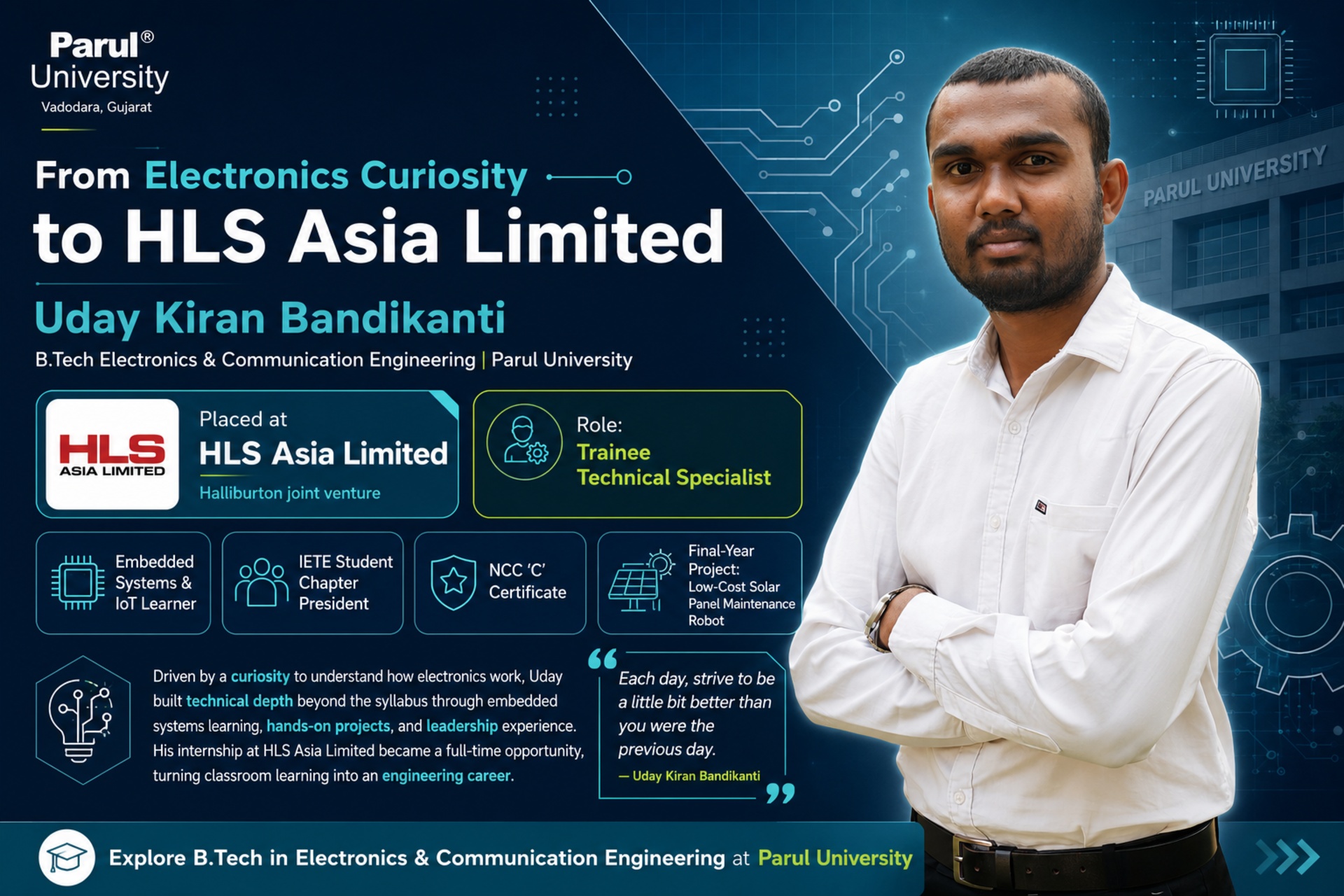
As a child in Hyderabad, Uday Kiran Bandikanti was not content to use electronics. He was curious how it works, and wanted to find out the distinction between the user and the mechanism of how it works. It is the whole of his story, and it is worth holding onto because it explains everything that followed. It is the whole of his story, and it is worth holding onto because it explains everything that followed.
It carried him into a B.Tech in Electronics and Communication Engineering at Parul University, through a self-taught obsession with embedded systems, and eventually into a full-time role at HLS Asia Limited, a joint venture with the oilfield-services giant Halliburton, where he converted an internship into a permanent position as a Trainee Technical Specialist in maintenance.
This Parul University ECE placement is more usefully read as an account of how one habit of mind, asking why something works rather than memorising that it does, turns an engineering degree into a career. Here is how it happened.
Leadership: IETE President and the NCC 'C' Certificate
Uday’s time at university was not only technical, and he is clear that the non-technical part is what set him apart in the placement process. Two roles stand out.
He served as President of the IETE Student Chapter, the campus branch of the Institution of Electronics and Telecommunication Engineers, where he organised technical events, coordinated student activities and worked with faculty to encourage technical innovation. Leading a professional student body is a genuine test, and it built his communication, decision-making and event-organisation skills in a way coursework cannot.
He also earned the NCC ‘C’ Certificate, the highest certificate in the National Cadet Corps programme, which developed discipline, self-confidence, teamwork and a sense of responsibility. The combination is unusual and valuable: a technically capable engineer who has also led a professional chapter and been through the discipline of the NCC presents very differently in an interview from one who has only studied.
Uday credits exactly this combination, his IETE leadership and his NCC discipline, with giving him an edge over other candidates. That is a specific, believable claim, because it describes capabilities that a recruiter can see in an interview rather than only on a transcript.
Also Read: Top Recruiters That Visit for B.Tech Placement at Parul University.
The Habit That Made the Difference: Asking Why
Ask Uday what he credits above everything else, and the answer is a single disposition: the desire to know more. He did not try to memorise everything. He tried to understand things conceptually, and to learn something new every day.
The practical expression of that was a refusal to leave a doubt unresolved. When he hit a problem or a concept he did not know, he asked, without hesitation and without embarrassment. During his internship, he went further than the task in front of him, putting deliberate effort into finding out why particular technical faults occurred and how experienced engineers had solved them. That is how he closed the gap between what he had learned in a classroom and what industry actually required.
His own advice to students turns this into a rule, and he puts it in his own words.
“Koi question galat nahi hota, answers galat ho sakte hain, lekin questions kabhi galat nahi hote.” – Uday Kiran Bandikanti
No question is wrong; answers can be wrong, but questions never are. His reasoning is that asking a question means a person wants to learn something new, which he regards as the defining instinct of an engineer. It is also, not coincidentally, the instinct that got him hired.
Inside the Internship at HLS Asia Limited
The pivot of Uday’s early career was his internship at HLS Asia Limited, which he joined as a trainee technical specialist intern in the maintenance category. HLS Asia is a serious environment for a young electronics engineer: a joint venture with Halliburton, it provides wireline logging, perforation and related services to oil and gas exploration companies, which means high-specification instrumentation operating in demanding field conditions. Maintenance and troubleshooting there is not routine, and it put his electronics background to a real test.
The start was not effortless, and he does not pretend otherwise. Adjusting to industrial tools, techniques, documentation and troubleshooting methods took time. What he built over the internship was a set of concrete, industry-grade skills.
- Preventive maintenance: servicing equipment before it fails rather than after.
- Electronics troubleshooting and fault finding: diagnosing what has gone wrong and why, systematically.
- Physical inspection of tools and equipment: hands-on checking of the hardware itself.
- Maintenance documentation: recording work properly, which in a technical field is part of the work, not an afterthought.
- Systematic problem-solving: working through faults by method rather than by guesswork.
Working close to experienced engineers taught him the value of systematic troubleshooting and disciplined documentation, and he managed the genuine difficulty of running an industrial internship alongside a final-year project and examinations through planning rather than luck. That is its own kind of engineering.
The Parul University ECE Placement Structure That Prepared Him
Uday is specific about what the university’s placement process did for him, and it is worth recording precisely because it is the part prospective students most want to understand.
The recruitment process was structured and communicated in good time. Students were informed in advance about company visits, eligibility requirements, interviews, recruitment drives and training sessions, which let them prepare in an orderly way rather than scrambling. Alongside the technical preparation, the university worked on personality and professional conduct, the softer half of employability that often decides interviews.
Mock interviews were, in his account, among the most useful parts of the whole preparation. Like most students, he was nervous fielding interview questions at first. Repeated practice and specific feedback changed that, until he could discuss his academic work, his technical projects and his internship comfortably. By the time he sat in front of HLS Asia, the real interview was not the first one he had faced.
By the time he sat in front of a real recruiter, it was not the first interview he had faced. That is what mock interviews are for.
The People Who Backed Him
Uday is careful to name the people who helped, which is worth doing properly.
He credits the Training and Placement Cell with guiding, motivating and supporting him throughout, keeping students informed about opportunities, interview preparation and specific company requirements, and steadying their confidence through the process. Within the cell, he singles out Mr. Hitesh Dave, whose consistent support and guidance through the recruitment process he credits with building his confidence directly.
He also thanks his faculty mentor, Anuradha P. Gharge, who he says was encouraging and approachable from his first day at the university, and whose confidence in him helped him move in a positive direction throughout his studies. Mentorship of that kind rarely appears on a placement record, but by his own account it was part of what produced this one.
From Intern to Full-Time Trainee Technical Specialist
The offer from HLS Asia Limited was, in Uday’s description, one of the most memorable moments of his life, the result of everything the academic study and the technical learning had been building toward. The conversion from intern to full-time Trainee Technical Specialist is the achievement he is proudest of, and he is precise about why.
It was not only about technical skill. It was about a professional approach, adaptability and a willingness to keep learning, the same disposition that runs through the entire story. An internship converts to a permanent role when a company decides the person is worth keeping, and that decision is made on how someone works, not only on what they know.
Looking ahead, Uday intends to deepen his expertise in technical maintenance, electronics troubleshooting, embedded systems and field engineering, and to keep updating his skills toward more senior technical and leadership positions. It is a grounded ambition from someone who has already shown he does the work. His route, from an electronics degree through embedded self-study and industry exposure to a technical career, is one the Faculty of Engineering and Technology at Parul University is built to support, and it connects to the wider placement record at Parul University.
Uday's Advice to Future Engineers
His counsel to aspiring engineers is consistent with how he actually operated, which is the only real test of advice.
- Do not confine yourself to examination-driven study. Aim for conceptual clarity and practical expertise instead of marks alone.
- Be active about internships and hands-on projects, because industry readiness is built through doing.
- Work on communication skills, so you can present what you know confidently when it matters.
- Keep learning continuously, since the field moves faster than any syllabus.
- Do not compare yourself with others; everyone is different, and comparison only creates pressure.
- Never hesitate to ask questions, because asking is how you learn.
The disposition underneath it all is one he keeps as a personal rule, and it is a good note to end on.
“Each day, strive to be a little bit better than you were the previous day.” – Uday Kiran Bandikanti
Success, in his view, does not arrive overnight. It is built through continuous improvement and learning from every experience, which is exactly what his own route from a curious child in Hyderabad to a technical specialist at a Halliburton joint venture describes.
Frequently Asked Questions
Where did Uday Kiran Bandikanti get placed after Parul University?
Uday Kiran Bandikanti, a B.Tech Electronics and Communication Engineering graduate of Parul University from the 2022 to 2026 batch, was placed at HLS Asia Limited. He joined as a trainee technical specialist intern in the maintenance category and converted the internship into a full-time role as a Trainee Technical Specialist. HLS Asia Limited is a joint venture with Halliburton providing wireline logging and related services to oil and gas exploration companies.
What is a Trainee Technical Specialist in maintenance?
It is an early-career technical role focused on maintaining and troubleshooting equipment. In Uday Kiran Bandikanti's case at HLS Asia Limited, the work covered preventive maintenance, electronics troubleshooting and fault finding, physical inspection of tools and equipment, maintenance documentation and systematic problem-solving, applied to high-specification oilfield instrumentation.
What skills helped an ECE student get placed?
For Uday Kiran Bandikanti, a combination of technical and non-technical strengths. On the technical side, self-taught depth in embedded systems, covering microcontrollers, ARM processors, ESP8266 chips and IoT, alongside his degree. On the non-technical side, leadership as President of the IETE Student Chapter and the discipline of the NCC 'C' Certificate. He credits this combination, plus a habit of asking why things work, with giving him an edge in interviews.
How does Parul University's placement process work?
According to Uday Kiran Bandikanti, the process is structured and communicated in advance. Students are informed ahead of time about company visits, eligibility requirements, interviews, recruitment drives and training sessions, and the university runs personality development and professional conduct training alongside technical preparation. Mock interviews with feedback from the Training and Placement Cell are, in his account, among the most useful parts of the preparation.
Is Electronics and Communication Engineering a good branch for placements?
Electronics and Communication Engineering opens routes into embedded systems, electronics maintenance, field engineering and related technical roles, as Uday Kiran Bandikanti's placement at HLS Asia Limited illustrates. His experience suggests the branch rewards students who build practical, hands-on capability, particularly in embedded systems and troubleshooting, beyond the core syllabus, and who develop communication and leadership alongside the technical work.
What was Uday Kiran Bandikanti's final-year project?
His final-year project was a low-cost robot for cleaning and maintaining residential solar panels, aimed at automating a task that is otherwise awkward and expensive at scale. The project combined electronics, automation and mechanical design, and developed his teamwork and project-management skills alongside the technical content.