Most students apply for internships. Abha Kalode decided that the normal application process was not the fastest route to the one she wanted, so she contacted the management of Raymond’s Chhindwara plant directly, explained a research idea she believed would create value for the company, and asked for the opportunity on the strength of it. It worked.
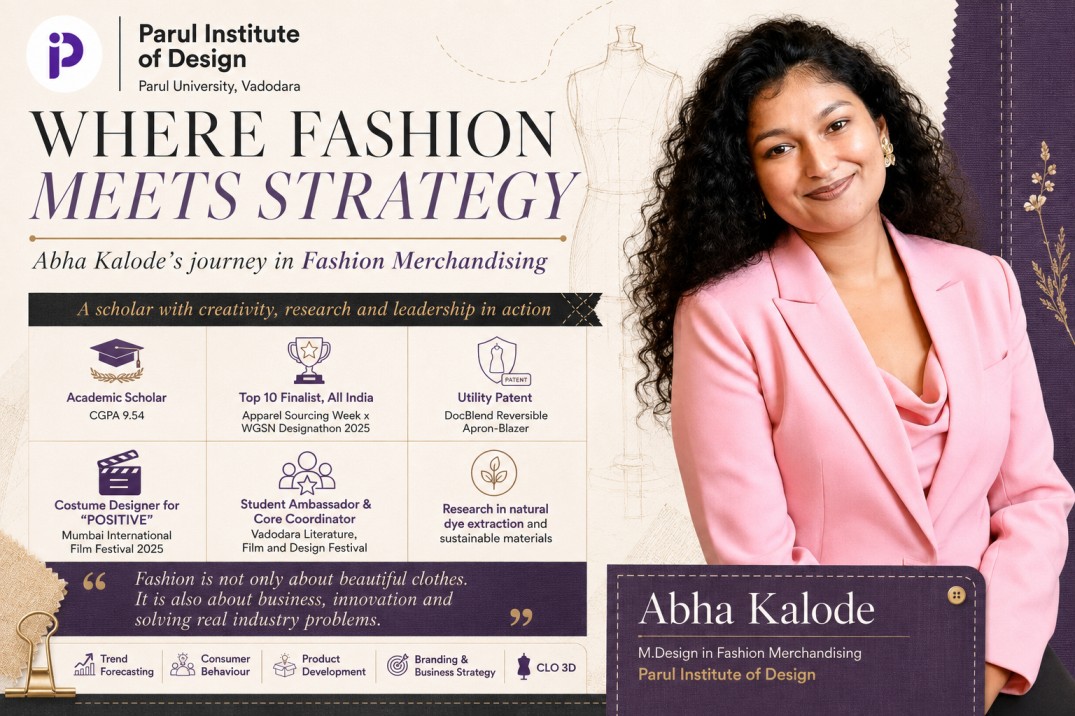
That is a useful introduction to how she operates, because the same instinct runs through her Master’s in Fashion Merchandising at Parul Institute of Design, which she completed as an Academic Scholar with a CGPA of 9.54 while collecting a national designathon placing, a costume design credit at an international film festival and a set of leadership roles.
Her governing idea is simple and slightly unfashionable for a design school: fashion is not only about making beautiful clothes. It is a business, and she wanted to understand all of it.
Why She Chose Fashion Merchandising at Parul University
Abha’s undergraduate degree was in fashion design, which she completed as university topper with a CGPA of 9.71. Those years gave her the creative foundation: garment construction, fabrics, design thinking. They also left her with a question. She had learned to make the product. She had not learned the business that decides whether the product succeeds.
So she chose a master’s in fashion merchandising rather than a deeper design qualification, in order to understand product development, consumer behaviour, manufacturing, retail, branding and business strategy. Her reasoning was that fashion needs an understanding of the customer, market trends and business decisions as much as it needs an eye, and her master’s was where those pieces connected.
She chose Parul Institute of Design for a specific reason: she wanted practical exposure alongside academics rather than classroom learning alone. What she found were industry projects, research work, design festivals, competitions and access to working professionals, and she describes the decision as one of the best of her career.
Leadership Roles at Parul Institute of Design
Abha treated the two years as more than a qualification, taking on responsibilities alongside her studies that had nothing to do with her grade.
- Student Ambassador: Representing the institute and working directly with students across activities.
- Member, Centre for International Relations and Research: Work that gave her an understanding of international collaboration and student engagement.
- Core coordinator, Vadodara Literature, Film and Design Festival: Hands-on experience of organising a large event, coordinating multiple teams and working under real pressure.
Her assessment of these roles is that they were as important as the classroom, because they built the communication, leadership and teamwork that make it possible to work with different kinds of professionals. That is a claim her internship would go on to test.
Creative Work Beyond the Classroom
Alongside the merchandising work, Abha kept a creative practice running.
She worked as Costume Designer on the short film POSITIVE, which was officially selected at the Mumbai International Film Festival in 2025. She found that costume design for film demanded a different way of thinking: not simply making clothes, but understanding character, story and visual presentation, and dressing a person to serve all three.
Earlier, her undergraduate graduation project, created with the Sejal Kamdar Label, was showcased at Lakme Fashion Week in 2024. That work belongs to her bachelor’s degree rather than her time at Parul University, but it explains something about the person who arrived: someone whose work was already reaching significant platforms, and who came looking for the business knowledge to go with it.
The Raymond Internship She Pitched For Herself
The centrepiece of her master’s was an internship at Raymond Ltd.’s Chhindwara plant, and how she got it is the lesson.
Rather than following the standard application route, she approached the plant management directly, presented her research idea, and made the case for how it could create value for the company. Preparation and confidence, rather than a form, secured the position. She joined as a Textile Research and Product Development Intern.
She did not apply. She found the people who could decide and showed them why the research mattered.
What a Textile Research and Product Development Intern Does
The internship was not about designing garments. It was about understanding the entire manufacturing process behind premium menswear, and she worked across three distinct business units to see it.
- Ceremonial wear: with its own customer, requirements and production methods.
- Suiting collections: a different set of demands again.
- Pure wool jacketing collections: different once more, in customer and construction.
Working across all three showed her how a product travels from an idea to the market, which is difficult to learn from any single department. Her research project was a framework for premium menswear product development, built by studying how different fabric behaviours drive structural decisions in a garment.
The work required detailed research, market analysis, product development planning and close interaction with teams across the company, alongside competitive benchmarking and customer requirements feeding into product planning. By her account, the work contributed to reducing the overall product development cycle by around 20 per cent, which she considers the biggest achievement of the internship. India’s textile and apparel sector, within which Raymond operates, is overseen at the national level by the Ministry of Textiles.
The Learning Curve: Worsted Wool and the Limits of a Design Education
Abha is candid that the start was hard, and the reason is instructive for any design student who assumes a creative education transfers cleanly into a factory.
Her training was in fashion design and merchandising. Raymond’s manufacturing environment ran on advanced textile engineering, and much of it, the terminology, the production methods, and the worsted wool process, was entirely new. Understanding worsted wool manufacturing takes time, because every production stage carries its own technical detail: fibre selection, yarn preparation, weaving, finishing, quality inspection and product development.
Her response was unglamorous and effective. For the first several weeks, she watched production, asked questions, took notes and learned from experienced professionals. The Raymond team supported her throughout, explaining processes step by step without expecting her to arrive knowing everything, and that support let her build confidence faster than she expected.
The difficulty at the start, in her assessment, became the biggest learning of the whole internship, precisely because it forced her outside what she already knew. By the end, she understood textile manufacturing considerably better than she had thought possible.
Recognition: Designathon, Patent and Research
Abha’s master’s years produced a set of recognitions beyond the classroom.
- Top 10 Finalist, All India, at the Apparel Sourcing Week and WGSN Designathon 2025: a competition that put her ideas in front of experienced industry leaders and taught her what the industry expects.
- A published utility patent for an innovation she calls the DocBlend Reversible Apron-Blazer.
- Academic research on natural dye extraction contributes to work on sustainable materials.
Her conclusion from these is the point worth taking: fashion is not only about designing garments. It is also about innovation, research, sustainability and solving practical industry problems. Every competition and research project, in her account, improved how she thinks, teaching her to use research to build practical solutions rather than to view fashion only through a creative lens. Patents in India are granted and published by the Patent Office, Intellectual Property India.
The Faculty and Mentors Who Backed Her
Abha is specific about who helped, which is unusual enough to record properly.
At Parul Institute of Design, she credits Prof. Dhara Parmar and Prof. Anand Bhargava with supporting her research throughout the master’s. Her project needed continuous improvement, discussion and industry validation, and they guided her at every stage, helping her structure the research and connect academic concepts to real industrial practice. That guidance is what turned the research into a practical framework the industry itself found useful.
At Raymond, she credits her industrial mentor, Mr. Sandesh Lohakare, who taught her every stage of textile manufacturing from the basics, patiently enough that concepts entirely new to her became comprehensible.
Her view is that mentors from both academia and industry made the difference, and that good mentors do more than transfer technical knowledge: they build confidence, independent thinking and the ability to solve real problems.
Fashion as a Business, Not Just a Garment
Abha never wanted to be only a fashion designer. She wanted to understand every part of the fashion business, with the view that the industry now needs professionals who hold creativity and business strategy at once.
So she pursued consumer behaviour, market research, product development, branding, trend forecasting, manufacturing, merchandising and marketing, and the point of the breadth was to see how the departments interlock. Every fashion product, as she describes it, is the result of designers, merchandisers, production, marketing and business people working together, and knowing what each does made her more confident in industry projects.
The skills she developed reflect that span: advanced CLO 3D for garment visualisation and digital product development, trend forecasting, audience segmentation, consumer behaviour, AI-assisted marketing strategy, textile manufacturing, product development, market research, competitive analysis and business strategy. She summarises that a designer should understand manufacturing cost, customer needs, market trends and business performance as well as understand a garment.
Her ambition is to work in marketing and brand strategy for global luxury fashion brands, connecting product development to commercial decisions rather than focusing on the product alone. That business-first orientation is the same instinct that runs through the startup and entrepreneurship ecosystem at PIERC, Parul University, whether a student is building a company or building a career inside one.
Abha Kalode's Advice to Fashion Students
The advice is consistent with how she has actually operated, which is the only real test of career advice. She did not wait for the Raymond process to open. She went and made the case.
FAQs
What is fashion merchandising, and how is it different from fashion design?
Fashion design is concerned with creating the garment; fashion merchandising is concerned with the business that surrounds it, including product development, consumer behaviour, manufacturing, retail, branding and business strategy. Abha Kalode moved from an undergraduate fashion design degree to a Master's in Fashion Merchandising at Parul Institute of Design precisely to learn the commercial side, on the view that fashion needs an understanding of the customer, market and business decisions as much as it needs design ability.
What does a textile research and product development intern do?
The role covers the manufacturing process behind a garment rather than its design. During her internship at Raymond Ltd.'s Chhindwara plant, Abha Kalode worked across ceremonial wear, suiting and pure wool jacketing business units, researching how different fabric behaviours influence structural decisions, and contributing to market analysis, competitive benchmarking and product development planning.
How do students get internships at major companies?
Sometimes by not using the normal process. Abha Kalode secured her internship at Raymond Ltd. by approaching the plant management directly and presenting a research idea she believed would create value for the company, rather than applying through standard recruitment. Her advice to students is not to accept rejection quickly and to present their work directly if they genuinely believe in it.
What skills does the fashion industry expect beyond design?
Business strategy, technology, research, marketing, consumer psychology and data analysis, according to Abha Kalode, whose own skill set spans CLO 3D for digital product development, trend forecasting, audience segmentation, consumer behaviour, textile manufacturing, market research and competitive analysis. Her view is that a designer should understand manufacturing cost, customer needs, market trends and business performance alongside garment construction.
What is an Academic Scholar at Parul Institute of Design?
Academic Scholar is a recognition of sustained academic performance. Abha Kalode completed her Master's in Fashion Merchandising at Parul Institute of Design as an Academic Scholar with a CGPA of 9.54, alongside leadership roles as Student Ambassador, a member of the Centre for International Relations and Research, and a core coordinator of the Vadodara Literature, Film and Design Festival.