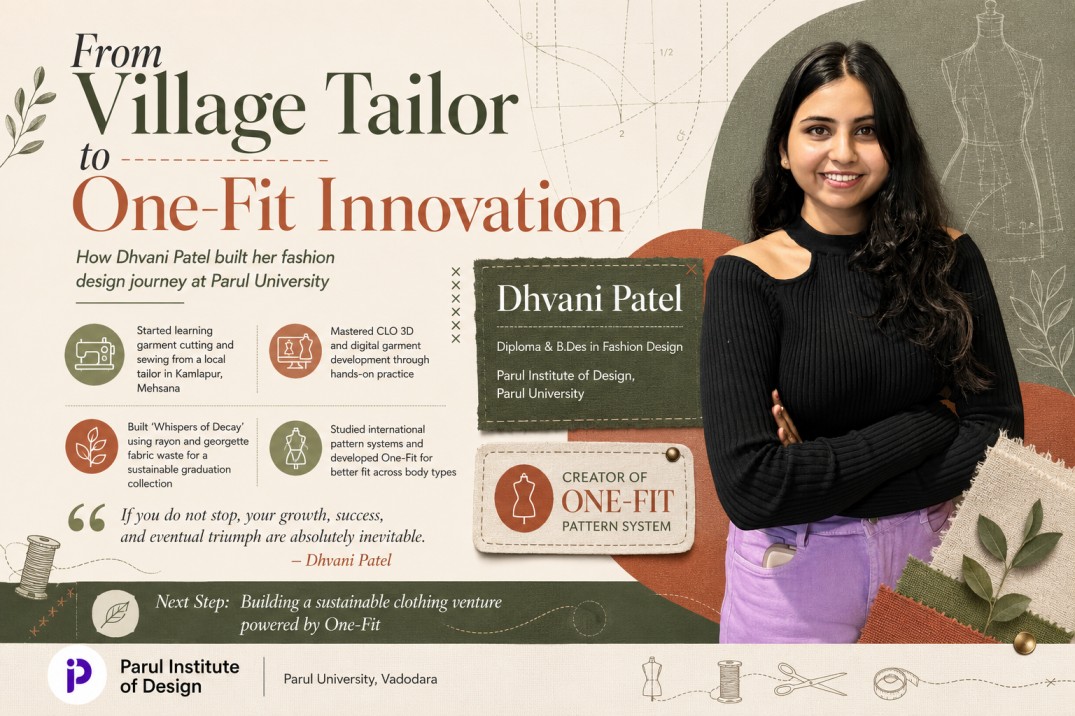
In Kamlapur, the village in Mehsana where Dhvani Patel grew up, fashion design was not a career anyone discussed. People knew clothes, and they knew the local tailor. Fashion shows and international trends were not part of the conversation, because there was no reason for them to be.
So when Dhvani decided she wanted to build a career out of the drawings she had been making since childhood, she did the only sensible thing available to her: she went to the village tailor and asked him to teach her to sew and cut.
Six years of fashion design at Parul University later, she had conquered the software she was afraid of, invented her own pattern-making system, and built a graduation collection out of fabric waste she had to persuade ten factories to give her. This is how that happened.
The Village Where Nobody Knew What a Fashion Designer Was
Dhvani always drew. Given paper and a pencil, she drew shapes and clothes, and it was the thing she enjoyed most. After school, she realised she wanted that to be the work rather than the hobby, which raised an immediate practical problem: there were no fashion designers or big stores in Kamlapur to learn from.
Her solution was the tailor. She asked him to teach her the basics, how a garment is sewn and cut, and she started there.
“Learning from a local tailor was a very humbling experience. It taught me the grassroots reality of how garments are put together.” – Dhvani Patel
That is a more valuable education than it sounds. A designer who has watched a garment assembled by hand understands construction in a way that no rendering teaches, and it gives her the confidence to want the formal version. In 2020, she enrolled in the three-year Diploma in Fashion Design at Parul University in Vadodara.
Studying a Diploma in Fashion Design at Parul University
Arriving on a university campus from a small village was intimidating, and Dhvani Patel was nervous. She was also unusually serious from the first year, for a specific reason: she came from a place where good education is not easy to come by, and she was not prepared to waste any of it.
Many students treat college as the time to relax and skip the occasional class. Dhvani made herself a promise not to. She loves to travel and see places, and she did not let it interfere. She attended every class, every practical session and every workshop she could, because the point was to become good at design rather than to be present for it.
She began taking part in fashion shows during this period, and they taught her what a classroom cannot: what a drawing looks like when it walks, how deadlines feel when they are real, and how to hold your nerve in the chaos backstage.
The Surat Reality Check and the Decision to Come Back
With the diploma finished, Dhvani wanted to see the real thing and moved to Surat, the centre of India’s textile industry, expecting it to be her route into the business.
It was a wake-up call. The scale of production was far beyond what she had pictured, and she came to an uncomfortable realisation: she did not know as much as she had thought. She wanted a deeper command of design detail, pattern making and garment construction. The diploma had started her; it had not finished her.
So she went back. She returned to Vadodara and enrolled at Parul University for a Bachelor of Design, a further three years, which is a harder decision than it looks for someone who had already entered the industry.
The timing was difficult. A period of serious strain at home ran alongside her return to study, and there were days she considered stopping. In many families, a creative field is treated as a risk, and the pressure toward a stable job is heavy. Hers was not like that. Even through the hardest stretch, her family backed her completely, and she is emotional about what that meant. It gave her the strength to finish.
The diploma had started her. Surat showed her it had not finished her.
Conquering the Digital Barrier: Learning CLO 3D
As the degree got harder, Dhvani ran into her own limitation. She is a maker. She loves the fabric in her hands, cutting patterns on paper, and the sewing machine. Sitting at a screen using software, or attending a technology lecture, bored her, and for a while she avoided it.
Meeting more people working in the industry ended that. It became obvious that a career in fashion without digital skills would not keep up, however good her hands were. So she went at the thing she disliked directly, and lived in the college computer labs, practising every day.
Eventually, she started to enjoy it, which is how these things usually go. She is now fluent in CLO 3D, the digital garment software used across the industry.
“Even if someone wakes me up in the middle of the night, I can seamlessly navigate the software and draft a 3D garment.” – Dhvani Patel
She counts it among her biggest personal victories, and it is worth noticing what actually happened: she identified the gap between what she liked doing and what the career required, and closed it on purpose.
Inventing One-Fit: A Pattern System of Her Own!
With the software mastered, Dhvani aimed at something considerably more ambitious than a project. She had noticed two connected problems in the industry: clothes routinely do not fit people properly, and the waste that results is substantial. Her answer was One-Fit, a system for garments that fit across body shapes and sizes without giving up style or fit.
Doing that required going beyond standard pattern making. She spent months studying pattern-making systems from around the world, including the Metric system and the precise German Muller and Sohn system, with the intention of taking what worked from each and building something new.
The process was exactly as unglamorous as real development is. She drafted patterns in software, made prototypes, tested them on different body types, and discarded draft after draft. What came out at the end was her own pattern block, the foundation on which every One-Fit garment is built.
The Jury That Rejected Six Months of Work
Asked about failure, Dhvani goes straight to her diploma jury. She had worked on a project for six months. Two days before submission, her faculty and internal panel reviewed it and rejected it over a technical flaw.
It broke her, briefly. Hearing that six months of work had failed within sight of the finish line is a hard thing to absorb. Then she made a decision: she gathered fresh materials and worked through the night to rebuild the project from nothing.
When she presented the recreated work the next day, the jury was startled by it. The incident taught her something she had not known about herself, which is that she was capable of considerably more than she had assumed. It also taught her a rule she still repeats: it does not matter how slow or modest the start is; if the dedication holds, the growth follows.
It is worth noting what that story says about education as well as the student. The panel held a standard and did not soften it two days out. That is what a jury is for, and it is the reason the recreated work was better.
Ten Doors, Nine Rejections: Sourcing Whispers of Decay
Dhvani’s projects never stayed on paper. Across the diploma and the degree, they pushed her into the business of manufacturing, including semester work that required her to go into the market alone to research and source her own materials.
Her graduation collection, Whispers of Decay, was built around sustainable design, and specifically around recycling discarded cloth. She chose the hard version: rayon and georgette scraps, which are notoriously difficult to recycle. Getting them in quantity meant going to the large textile mills of Surat and Vadodara. So she packed her bags, rehearsed what she was going to say, and walked up to the doors of enormous factories as a student with no introduction.
The business world, she discovered quickly, is not as accommodating as a campus. She approached ten companies, explained what she was trying to do, and asked for help. Nine said no.
At that point, the shortcut was obvious and available: buy new fabric, call it sustainable, and let nobody check. She refused it, which is the part of this story that matters most, because sustainability that collapses the moment it becomes inconvenient was never sustainability. She kept going, and the tenth company saw how hard she was working and let her tour the factory and take the fabric waste she needed.
Those nine rejections taught her the industry properly: that a designer needs to communicate, persist and stay professional when doors close. She now knows how to walk into a manufacturer and get something done, which is precisely the skill her One-Fit venture will require.
“Nine factories said no. Buying new fabric and calling it sustainable was always the easy option. She refused it.”
What the University Gave Her
Dhvani is direct that she would not be where she is without the six years at Parul University. Her Head of Department and her faculty backed her ideas from the beginning. When she was struggling with fashion software, they worked with her one-to-one, which is how the CLO 3D fluency she is proud of actually came about. The university also put her in front of audiences, through fashion shows and design competitions, and gave her the flexibility to concentrate on Whispers of Decay and the One-Fit research when the work demanded it. Her account describes the Parul Institute of Design studio model doing what it is supposed to do.
The One-Fit Venture, and What Comes Next
Dhvani is now preparing to build a sustainable clothing venture on the One-Fit system, carrying three things into it: the patience of the village, the technical skill from Parul University, and the toughness Surat and nine closed doors gave her. A student turning a graduation research project into a company is the pattern the startup and entrepreneurship ecosystem at Parul University exists for, where PIERC has incubated and supported 254 ventures with over Rs 20 crore in funding and start-up studios across Vadodara, Surat, Ahmedabad and Rajkot.
“If you do not stop, your growth, success, and eventual triumph are absolutely inevitable.” – Dhvani Patel
Frequently Asked Questions
Can you study fashion design without any background in it?
Yes. Dhvani Patel came from Kamlapur, a village in Mehsana where fashion design was not a known career, and began by asking the local tailor to teach her to sew and cut. She then enrolled in the three-year Diploma in Fashion Design at Parul University in 2020 and later returned for a Bachelor of Design. She describes the tailor's workshop as a humbling grounding in the grassroots reality of how garments are put together.
What is the difference between a diploma and a degree in fashion design?
A diploma provides a shorter, practical foundation, while a degree goes deeper into design detail, pattern making and construction. Dhvani Patel completed a three-year diploma at Parul University, worked in the Surat textile industry, and found the gap between what she knew and what the industry demanded significant enough to return for a three-year Bachelor of Design. Her experience suggests the diploma starts a career and the degree deepens it.
What software do fashion design students need to learn?
CLO 3D, the digital garment and 3D visualisation software used across the industry, is central. Dhvani Patel initially avoided software because she preferred working by hand, then realised a fashion career without digital skills could not keep pace, and practised daily in the college computer labs until she became fluent. Digital pattern drafting also underpinned the development of her One-Fit pattern system.
What is pattern making in fashion design?
Pattern making is the discipline of creating the templates from which garment pieces are cut, and it determines how a garment fits. Dhvani Patel studied international pattern-making systems, including the Metric system and the German Muller and Sohn system, before developing One-Fit, her own pattern block designed to fit across body shapes and sizes, built through repeated prototyping and testing on different body types.
How do fashion students source materials for sustainable collections?
Often by approaching manufacturers directly, and often unsuccessfully at first. For her graduation collection, Whispers of Decay, Dhvani Patel sought rayon and georgette waste, which is difficult to recycle, from textile mills in Surat and Vadodara. Nine of the ten companies she approached refused. The tenth granted her a factory tour and the material she needed, an experience she credits with teaching her how to communicate and persist with manufacturers.