India’s employability rate increased from 54.81% in 2025 to 56.35% in 2026, according to the India Skills Report 2026. The report also shows a growing focus on skills related to AI, data, cloud computing and cybersecurity. This tells students one clear thing: having a degree is important, but knowing how to use that knowledge is also necessary. (Indian Express)
An engineering student does not start college by building a large robot or a complete mobile application. The learning happens slowly. Every year, students study new subjects, enter labs, make mistakes and improve their work. By the final year, many of them can turn a small idea into a working project.
What Do Students Build in the First Year?
The first year is usually about learning the basics. Students from different engineering programs study common subjects such as mathematics, physics, basic electrical systems, engineering drawing and computer programming.
At this stage, projects are generally small. Students may make a basic electrical circuit, write a simple computer program or prepare a model using workshop tools. They may also learn how to use measuring instruments, drawing software and basic machines.
These activities may look simple, but they teach important habits. Students learn how to measure correctly, follow safety rules, maintain records and work with a team. A wrong wire connection or a small mistake in a drawing can affect the full result. This helps students understand why accuracy matters in engineering.
How Do Projects Change in the Second and Third Years?
From the second year, students start working more deeply in their selected branch. Their projects become more connected to real machines, software and daily-life problems.
The type of work depends on the specialisation:
- B.Tech Computer Science Engineering students may build websites, applications, databases or small AI models.
- B.Tech Mechanical Engineering students may create machine parts, working mechanisms or design models.
- B.Tech Civil Engineering students may prepare building plans, survey maps or structure models.
- B.Tech Electrical Engineering students may make circuits, control systems or energy-related projects.
- B.Tech Electronics Engineering students may work with sensors, embedded systems and communication devices.
- B.Tech Robotics and Automation Engineering students may build automated machines or small moving robots.
- B.Tech Automobile Engineering students may study engines, vehicle parts and electric mobility systems.
During these years, students also learn that a project is not only about making something work. They must explain why they selected the idea, what materials they used, how much it may cost and what problem it solves.
Do Engineering Students Work on Real Problems?
Yes, many engineering projects begin with a simple problem seen around us.
For example:
- Water may be getting wasted from a tank.
- A farmer may need an easier way to check soil conditions.
- A factory may want to reduce unsafe manual work.
Students can study such problems and try to create a useful answer. They may build a water-level alarm, soil-checking device, automatic waste separator or safety monitoring system.
Not every project becomes a market-ready product. Some models may work only at a small level. However, the learning is still useful. Students understand testing, failure, repair and improvement.
A project that fails during the first test can teach more than a ready-made model. Students must find the reason for the failure instead of only copying an answer.
Get Complete Details From Expert
Request a CallWhy Are Labs Important for Building Projects?
Engineering cannot be learned only by reading books. A student may understand the meaning of a motor from a chapter, but the lab shows how it actually runs, heats up or stops working.
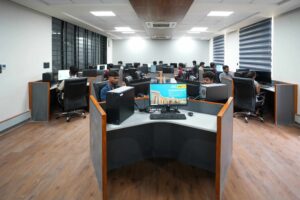
Labs give students access to machines, software, components and testing tools. They can make designs, prepare parts, connect circuits and check their results.
A computer lab helps students test code. A fabrication lab helps them turn a digital drawing into a physical model. A robotics lab allows them to work with sensors and controllers. A civil engineering lab helps them test soil, concrete and construction materials.
Lab work also teaches students to handle equipment carefully. They understand that safety, correct settings and proper testing are part of good engineering.
What Happens During the Final-Year Project?
The final-year project is usually the largest work completed during B.Tech. Students generally work in a group and select a problem from their branch.
The process may include:
- Finding a practical problem
- Studying existing solutions
- Preparing the design
- Selecting parts or software
- Building the first model
- Testing and correcting errors
- Preparing the report
- Presenting the final project
A computer engineering group may create a cybersecurity tool or an AI-based system. A mechanical group may build an automated machine. Civil engineering students may design a sustainable structure, while electronics students may make a smart monitoring device.
The final project tests both technical and personal skills. Students must manage time, divide work, solve disagreements and explain their project before teachers or experts.
What Can B.Tech Students Build at Parul University?
Parul University offers B.Tech programmes in Computer Science and Engineering, AI and Machine Learning, and many more. The university offers facilities and programmes that can help students move from an idea written on paper to a model that they can test and improve.
What Does a Student Carry Forward After Four Years of B.Tech?
By the last semester, the project may be complete, but the learning does not stop there. One student may continue improving an application. Another may take a machine design into an internship. Someone else may use a final-year project as the starting point for research or a business idea.
The most useful result of four years is not always the model kept on a display table. It is the habit of looking at a problem, asking why it happens and trying to build a better answer.
FAQs
Is JEE compulsory for every B.Tech admission?
Admission rules can differ, so students should check the current requirements of their selected programme.
Can diploma students enter B.Tech directly?
Eligible diploma holders may apply for lateral entry according to the applicable admission rules.
Can engineering students study a foreign language?
Yes, learning a foreign language can support communication and some international career opportunities.