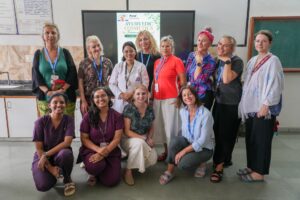
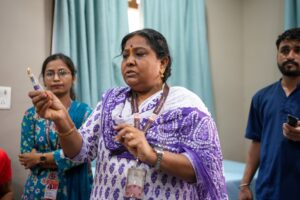
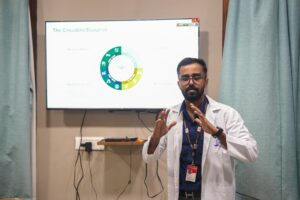
Among the delegation of practitioners from Poland who studied at Parul University’s Ayurveda Practitioner Program were people from strikingly different walks of life. What united them was a decision to learn Ayurveda where it began, and hands-on, rather than from afar. Their journeys say a great deal about why Ayurveda is drawing professionals worldwide, and what an immersion at its source offers.
From the Courtroom to Ayurveda: Karolina
For nearly fifteen years, Karolina built a demanding career as a lawyer in Poland, until the pressure left her deeply drained. Stepping back, she came to India and first experienced Panchakarma not as a student but as someone seeking peace, and the calm that stayed with her afterward sparked a curiosity about the knowledge behind it. That personal search became a new profession: she trained in yoga in Rishikesh, studied Ayurveda, and now works as a yoga teacher, Ayurvedic therapist, and breathwork instructor. She returned to India, this time to Parul University, to deepen that knowledge through direct practice. What drew her was exactly what home could not offer: hands-on exposure to preparations and procedures that, she noted, carry specific professional and legal requirements in Poland, learned here in a full practical setting.
Sports Science Meets Ayurveda: Zbigniew
Zbigniew Jezak came from a very different background: a graduate of Poland’s Academy of Physical Education, he had spent decades in sport, understanding the body through biomechanics, endurance, and recovery, with a long personal practice of yoga. He arrived, by his own account almost by coincidence (invited by friends), expecting to focus narrowly on massage techniques. What he found reshaped his view entirely. The Ayurvedic approach, with its oils and holistic focus, differed markedly from the deep-tissue European massage he knew, and the deepest lesson, he said, came from simply watching how Ayurvedic principles lived in people’s daily lifestyles. Moved by the experience and the warmth of his hosts, he made a spontaneous decision: he changed his flights and extended his stay by a week, moving from the shorter program into the fuller one to build relationships with the Ayurvedic doctors.
I had no idea I would be welcomed so warmly. I learned far more than massage techniques, I saw Ayurveda actually lived, every day.
– Zbigniew Jezak, on his time at Parul University (paraphrased from his interview)
A Holistic Therapist’s Deep Dive: Monika
Monika arrived with a master’s degree in public health and a practice as a holistic therapist in Poland, where she treats clients through movement, viewing physical pain as connected to nutrition, stress, and the whole system rather than an isolated symptom. That philosophy made Ayurveda, which treats the whole person rather than isolated complaints, a natural fit. Like several others, she heard about the program through the delegation’s network rather than an online search, and, she said, arrived deliberately without fixed expectations, wanting to experience the learning directly. For a practitioner already thinking in whole-body terms, the immersion offered a structured, classical grounding for an approach she had arrived at through her own work.
A Teacher Who Loves Ayurveda: Ilona
Ilona Focht, a primary-school teacher from Wrzesnia near Poznan, teaches children foreign languages, runs kids’ yoga classes, and works as an Ayurvedic therapist, a blend of education, movement, and traditional wellness. Her reason for coming was disarmingly simple: she loves Ayurveda, and had concluded that the best place to deepen her understanding was at its source in India. She came not as a beginner but as a seasoned practitioner seeking to elevate an already established holistic career, exactly the kind of motivated, self-directed learner these programs attract. Her post on Facebook describes about the session too.
What Their Stories Share
Across four very different careers, the same threads run through every account. Each came seeking authentic, hands-on knowledge that their home countries, where Ayurveda is growing but still limited, could not fully provide. Each was struck less by any single lecture than by the warmth of the people and the sense of Ayurveda as a lived, everyday philosophy. And each left intending to carry the knowledge back into their own practice. As one delegate observed, with Traditional Chinese Medicine and yoga already established in Europe, Ayurveda may well follow, and programs like this are part of how that knowledge travels. For Parul University, welcoming such practitioners is a genuine two-way exchange: sharing India’s traditional knowledge with the world, while giving its own students a global classroom at home.
Frequently Asked Questions
Why do international professionals come to India to learn Ayurveda?
Professionals from around the world come to India to learn Ayurveda at its source, through authentic, hands-on practice they often cannot access at home, where the tradition may be growing but limited by scope or regulation. Many, like the practitioners at Parul University’s program, are drawn by the chance to observe real procedures, learn from experienced faculty, and experience Ayurveda as a lived philosophy.
Who can join Parul University’s Ayurveda programs for international practitioners?
Parul University’s international Ayurveda programs, such as the Ayurveda Practitioner Program (APP) and Panchakarma Immersion Program (PIP), attract a wide range of participants: practising therapists, yoga teachers, healthcare professionals, and others with a serious interest in Ayurveda. Participants in one recent cohort included a former lawyer, a sports scientist, a public-health therapist, and a teacher, all from Poland.
What do international practitioners gain from studying Ayurveda in India?
They gain hands-on exposure to Ayurvedic preparations and procedures, observation of clinical practice, and direct learning from experienced faculty, often things restricted or unavailable at home. Just as importantly, many describe gaining a deeper understanding of Ayurveda as a holistic, lived philosophy, and knowledge they can carry back into their own professional practice.