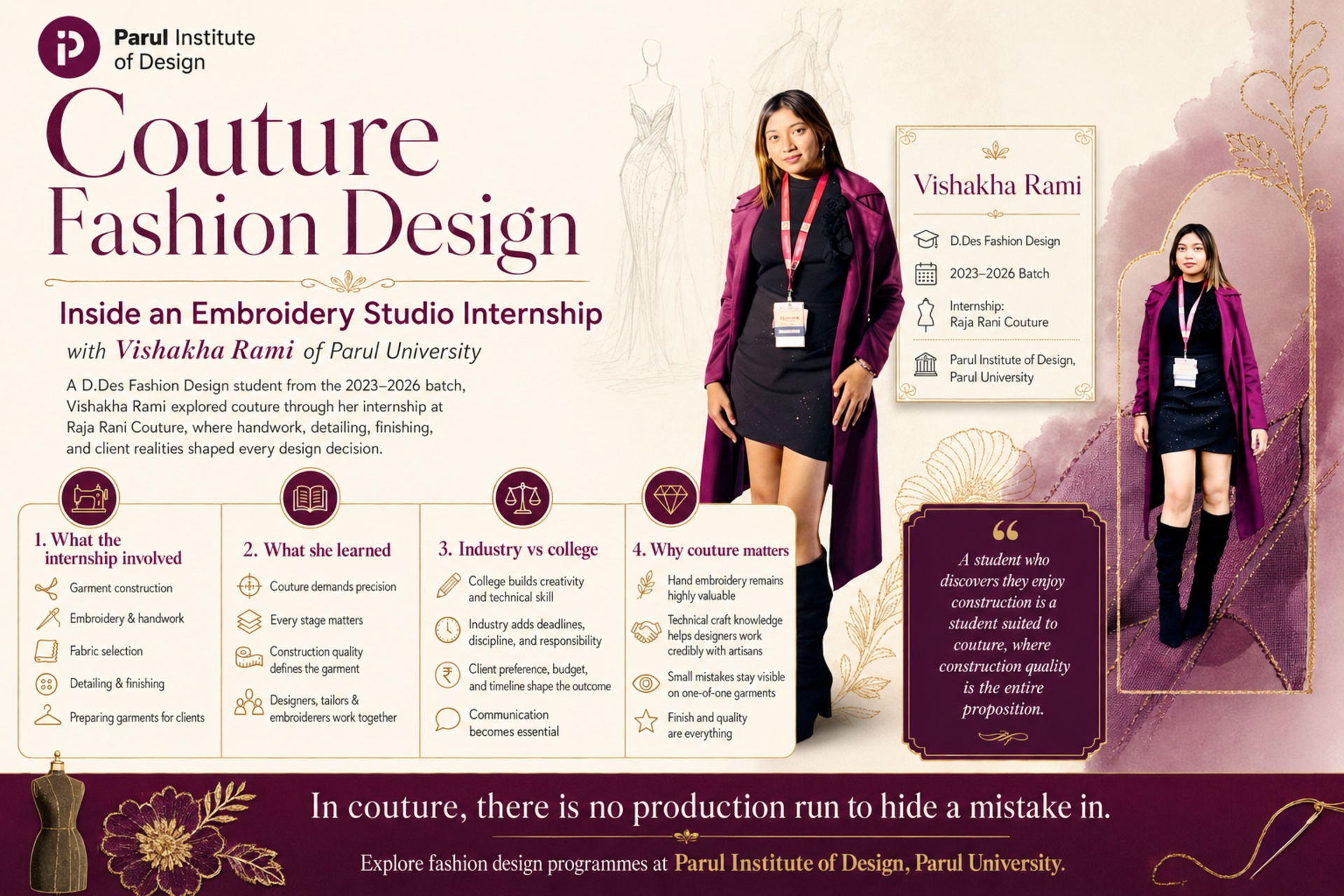
Couture occupies a particular position in fashion. It is where garments are made individually rather than in runs; where hand embroidery and finishing are done at a standard that mass production cannot reach; and where a single mistake is not absorbed by a batch but is visible on the only piece.
Vishakha Rami, a D.Des Fashion Design student of the 2023 to 2026 batch at Parul Institute of Design, chose that segment deliberately for her internship at a couture studio, Raja Rani Couture. She had been drawn to couture, embroidery and handmade garments throughout her course. Her account of what she found there is a useful description of what couture work actually consists of and of the gap between a design studio and a classroom. Her portfolio is on her LinkedIn profile.
Where the Interest Came From
Vishakha is from Surat, and her route into design began at home rather than in a classroom. Her family runs a business in fresh flower gajras, flower jewellery and floral decoration for weddings, festivals and functions, so she grew up surrounded by arrangements, colour and ornaments being composed daily.
She traces her interest in colour, pattern and composition directly to watching that work. It is a good illustration of something design educators observe constantly: the eye is trained long before the technique is, and students who arrive having spent years looking at made things carefully tend to arrive with something already in place.
The decision itself was not sudden. She had settled on fashion design by the eighth standard. During the tenth, when the pandemic moved schooling online and left more time, she took a local fashion design course in Surat, which taught her the basics and, more usefully, showed her the limits of basics. What she wanted next was practical training and structured guidance, which is what took her to D.Des Fashion Design at Parul Institute of Design.
What She Learned, and What She Chose to Specialise in
Across the three-year diploma she worked through fashion illustration, garment construction, fabric knowledge and design research, taught largely through practical projects rather than theory.
Garment construction became her subject. She describes enjoying the full sequence, from initial idea through sketch, pattern-making, fabric selection and stitching to a finished garment, and it was that subject that changed how she understood the discipline. Fashion, she concluded, is not only creative. It is technical, and the technical part determines whether the creative part survives contact with fabric.
That conclusion is worth pausing on because it explains her subsequent direction. A student who discovers they enjoy construction is a student well suited to couture, where construction quality is the entire proposition.
Her graduation project, a collection titled The Bloodline Pack, is the work she considers her biggest achievement of the course, taking her from research through to final presentation and giving her the complete design process end to end. That progression, from concept to finished collection, is the capstone of a fashion education and the piece of work most employers examine first, as set out in the guide to careers in fashion design.
A student who discovers they enjoy construction is a student suited to couture, where construction quality is the entire proposition.
Fashion Week and Festival: Learning How Shows Are Actually Made
Vishakha worked on Vadodara Fashion Week 4.0 and the Vadodara Film and Design Festival 2.0 and describes both as the point at which fashion stopped being a classroom subject.
At the fashion week she worked alongside designers, backstage teams and other professionals, preparing garments, managing backstage operations and handling the tasks that precede models reaching the ramp. What she took from it was less about design than about logistics: a show depends on many people completing interlocking work on time, and the visible event is the small part that rests on all of it.
At the design festival she observed exhibitions and how designers present work and talk to visitors, which she credits with improving her own communication. Both experiences gave her something the curriculum could not: proximity to professionals and an accurate sense of the tempo and coordination that fashion production runs on.
Inside the Couture Studio
Her internship at Raja Rani Couture put her into the design team, working across garment construction, embroidery, fabric selection, detailing and finishing, and assisting as garments were prepared for clients.
The first thing she describes learning is the weight of small things. In couture, where a single garment is the deliverable, an error in detailing or finishing is not diluted across a production run. It is the garment. That standard is what distinguishes the segment and it is also what makes it demanding to work in.
The moment she marks as her high point is specific: one of her design ideas was selected for a client presentation. For an intern, having work reach a real client rather than a critique panel is the point at which the training becomes visibly real, and she describes not having expected it.
She also came away with a clear view of how a garment is actually produced. Designers, tailors, embroiderers and finishers all contribute, and the process is only as sound as its weakest stage. And she encountered the constraint that most surprises design students entering industry: a designer’s own preference is one input among several, because client choice, budget and timeline all shape what is ultimately made.
Why Handwork Skills Are Worth Building
One reason a couture internship is valuable early is that it exposes a student to a skill set that is becoming rarer while remaining in demand.
Hand embroidery, detailed finishing and the craft techniques associated with Indian couture require years to develop and cannot be automated in the way pattern cutting or grading increasingly can. A designer who understands what these techniques involve, even without being an expert practitioner, is able to specify work realistically, judge quality accurately, and communicate with the artisans who carry it out.
That last point is the practical one. A designer who does not understand embroidery will specify things that cannot be executed, misjudge how long work takes, and be unable to assess whether what comes back is good. The result is friction with the people doing the work and garments that miss their standard. Vishakha describes learning that every stage matters and that the process is only as sound as its weakest contributor, which is the same observation from the other direction.
For students considering where to specialise, the relevant conclusion is that technical craft knowledge is not a traditionalist detour from contemporary design practice. It is what allows a designer to work credibly with the people who actually make garments.
College Versus Industry, in Her Words
Vishakha is precise about the difference, and her account matches what almost every design graduate reports.
In college, students have latitude. Ideas can be attempted, mistakes are instructive, faculty explain what went wrong, and the objective is developing creativity. Teachers actively push students away from copying and toward original work.
In a studio, work exists for a client. A design has to accommodate preference, budget, deadline and production feasibility, and it has to be right rather than interesting. Communication becomes disproportionately important, because a designer is coordinating with clients, tailors and embroidery teams, and an instruction that is unclear becomes a garment that is wrong. Time management stops being a personal virtue and becomes a shared dependency.
Her conclusion is that the two environments teach different and complementary things. College builds creative and technical capability; industry teaches discipline, responsibility and how the work is actually done. A graduate needs both, and the second cannot be simulated.
Where She Is Heading
The internship settled her direction rather than opening it. She intends to build her career in couture specifically, deepening her technical skills and working toward collections known for finish and quality.
Her stated plan is to work with established fashion brands first, learning from experienced designers, and to start her own label once she has sufficient industry experience behind her. That sequencing, learning inside an established business and then building independently, is the route most successful independent designers actually take, and it aligns with the entrepreneurship support available through Parul University’s PIERC ecosystem.
Her advice to juniors is consistent with how she worked. Build a portfolio from the beginning, treating every assignment as an entry rather than a task. Develop communication alongside technical skill, since explaining a design well is part of designing. Take part in competitions, workshops, exhibitions and fashion events, and seek internships independently rather than waiting for them to be offered. Asked what she would change about her own course, she said she would have entered more competitions and events, which is the answer nearly every graduate gives.
Frequently Asked Questions
What does couture fashion design work involve?
Producing individual garments to a very high standard of finish, typically involving hand embroidery, detailed construction and precise finishing for a specific client. Vishakha Rami's internship at a couture studio covered garment construction, embroidery, fabric selection, detailing and finishing, and preparing garments for clients. Because each piece is individual rather than part of a production run, errors are visible on the only garment, which sets the standard of precision the segment requires.
What is the difference between studying fashion design and working in it?
In college students can experiment, mistakes are instructive and faculty guide correction, with creative development as the objective. In industry the work is for clients, so designs must accommodate client preference, budget, deadline and production feasibility. Communication becomes central because designers coordinate with clients, tailors and embroidery teams, and deadlines are shared dependencies rather than personal targets.
Which fashion design subject is most useful for a career in couture?
Garment construction, since construction and finish quality are what couture is judged on. Vishakha Rami identifies it as her strongest subject and credits it with preparing her for the internship, describing the complete sequence from idea through sketch, pattern making and fabric selection to finished garment. Fashion illustration and fabric knowledge support it, but construction is the core technical competence.
How does a fashion student get an internship?
Through a combination of institutional connections and independent approach. Vishakha Rami's advice is that students should actively seek internships and industry exposure themselves rather than waiting for opportunities to be offered, alongside participating in competitions, workshops, exhibitions and fashion events. A portfolio built from the first semester is what makes an approach credible.
What do students learn from working at a fashion week?
Primarily how a production actually functions. Vishakha Rami worked on Vadodara Fashion Week 4.0 preparing garments and managing backstage operations, and describes learning that a show depends on many people completing interlocking tasks to schedule, with the visible event resting on all of it. Students also gain proximity to working professionals and an accurate sense of industry tempo, which classroom teaching cannot provide.