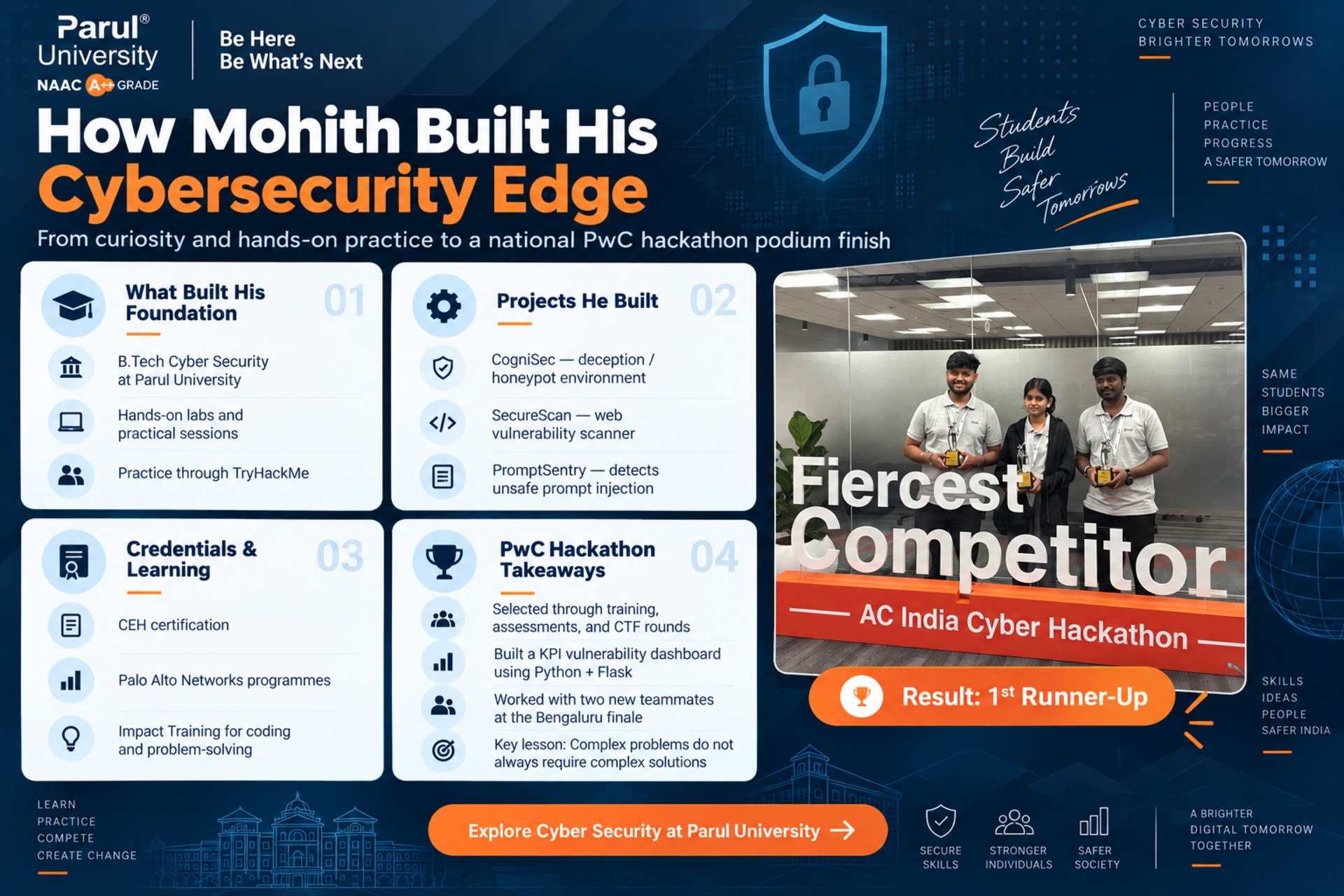
Some people discover their calling through a single question. Curiosity always leads you to answer and stick to something consistently. Mohit Neravati had many such questions. Questions such as how do attackers get inside the systems, and how can one stop them? He is from Andhra Pradesh and joined Parul University. He took B.Tech Cyber Security and his dedication led him to the national final of PwC Acceleration Center India Fiercest Competitor 2026 Cyber & Risk Hackathon. The team got the position of 1st Runners-up.
Choosing Parul University
Vadodara was more than a thousand kilometres from home, but Parul University was already familiar to Mohith’s family, his sister had studied there before him. He become confident of selecting the college and course due to the cyber security curriculum and facilities. He was impressed with the extra activities being offered and the lab facilities. He took B. Tech Cyber Security.
Any worries about cultural or linguistic change quickly faded: he found a multicultural campus with students from across the country, including many from his own region, and settled in fast through academics, events, and student activities.
Turning Curiosity Into a Specialisation
Mohith’s interest was in understanding both sides of digital security, how vulnerabilities are discovered and exploited, and how professionals defend against them. As he explored the field through his curriculum, practical sessions, projects, and online platforms, that interest sharpened into a focus on Vulnerability Assessment and Penetration Testing (VAPT). Crucially, he did not stop at theory. From his early semesters he practised on platforms like TryHackMe, working through hands-on labs and simulated environments.
Cybersecurity cannot be understood through theory alone. You need to work with systems, encounter errors, and see how security behaves in real situations.
– Mohith Neravati (in summary)
That hands-on philosophy is one he now recommends to every junior, and one we unpack in our guide to learning cybersecurity hands-on.
Building Real Cybersecurity Solutions
Mohith learned by building. Three of his projects show his range across the security landscape:
- CogniSec, a deception environment that uses a large number of virtual ports to divert suspicious activity away from the real system, letting security teams safely study an attempted intrusion (a defensive technique known as a honeypot).
- SecureScan, a web-based vulnerability scanner that checks IP addresses, URLs, and domains for weaknesses and, importantly, suggests remediation rather than just flagging problems.
- PromptSentry, an engine that analyses prompts to detect potentially unsafe or malicious instructions, tackling prompt injection, an emerging AI-security threat.
Certifications and Practical Learning
Mohith backed his hands-on work with recognised credentials. A major milestone was the Certified Ethical Hacker (CEH) certification from EC-Council, which exposed him to scenario-based problems and deepened his grasp of ethical hacking concepts. He also learned through Palo Alto Networks programmes and structured TryHackMe paths, and used Parul University’s Impact Training to revisit programming fundamentals, problem-solving, and data structures, foundations that proved useful both for placements and for building solutions under competition pressure.
The Road to the PwC Hackathon
Mohith’s route to the national stage came through Parul University’s placement initiatives, and it was a gauntlet. Students first cleared a selection for PwC’s Advisory Launchpad Programme, then underwent months of training in areas including Artificial Intelligence and cybersecurity, then faced scenario-based assessments and a Capture the Flag (CTF) challenge. Only after all of that did he earn a place among the finalists, selected from a competition PwC ran across thousands of students and dozens of campuses.
Strangers at the Start, a Team by the End
At the Bengaluru finale, there was a twist: participants could not team up with friends. Mohith was paired with two people he had never met, Nishant Rajput and Purvi Pal. But there was reassurance in the format, everyone in the room had cleared the same rigorous selection, so he trusted that his new teammates brought real skill. They introduced themselves, mapped each other’s strengths, and got to work.
A Real Challenge, and a Lesson in Simplicity
Their task was to build a KPI dashboard displaying vulnerability findings from a Docker-based environment. The catch: the team was unfamiliar with the exact dashboard type expected. With time short, they faced a choice, spend precious hours learning a new technology, or build an effective solution with tools they already knew well. They chose the latter, creating a clean web-based dashboard using Python and Flask. It became Mohith’s biggest takeaway from the competition.
Complex problems do not always require complex solutions.
– A key lesson from the hackathon
Understanding the problem clearly, deciding what can realistically be built in the time, and executing it well often matters more than reaching for the most sophisticated tool. Along the way, PwC-assigned mentors, including their mentor Prakhyat and buddy Tanveer Ahmed Neor, helped the team through setup and access-permission issues.
Building Without AI
One rule made the finale a genuine test of ability: no AI-powered coding tools. For a generation used to AI assistants, this was revealing. Mohith discovered he could build an entire functional web application under intense time pressure, relying on his own understanding of programming, cybersecurity, problem-solving, and his teammates.
AI can be valuable, but understanding how and why a system works remains essential.
– Mohith Neravati
Facing the Stage, and the Result
One challenge remained that none of them had prepared for: presenting their solution to senior PwC leaders, judges, and fellow participants. Public speaking did not come naturally to any of the three first-time competitors, so they did the sensible thing, divided the presentation, stood together, and each explained a part. When the results were announced, they had achieved something they never expected walking in: 1st Runner-Up. The first person Mohith called was his mother, whose pride made the moment unforgettable, and he later shared the news with Ankit Sir from the university’s placement team, who had supported the students throughout.
Also Read: The PwC post of Hackathon and What Students Achieved.
Frequently Asked Questions
What did Mohith Neravati achieve at the PwC hackathon?
Neravati Mohith, a B.Tech Cyber Security student at Parul University, and his team finished 1st Runner-Up at the PwC Acceleration Center India Fiercest Competitor 2026 Cyber & Risk Hackathon, a national competition involving thousands of students across many campuses. It was his first-ever hackathon.
What was his path for making a career in cyber security?
It is always how you utilise the resources and knowledge gained. He took admission in Parul University. Made sure to use the course knowledge and keep it updated with practice. He practiced through platforms like TryHackMe, earned the Certified Ethical Hacker (CEH) certification, learned through Palo Alto Networks programs. He took this seriously and worked on to making thr real projects. Worked on projects such as CogniSec, SecureScan, and PromptSentry. The projects and practice trained him with deception, vulnerability scanning and AI security.
What are the takeaways from hackathons?
Every test, competition has something to offer. Either you win or lose but there always something to learn. The learnings here are, that complicated problems not always require complex solutions. He understood the assignment. He and his team worked on to making a dashboard using tools such as Python and Flask. Instead of using completely unknown tools, or learning new tools, the team used the ones already they knew.