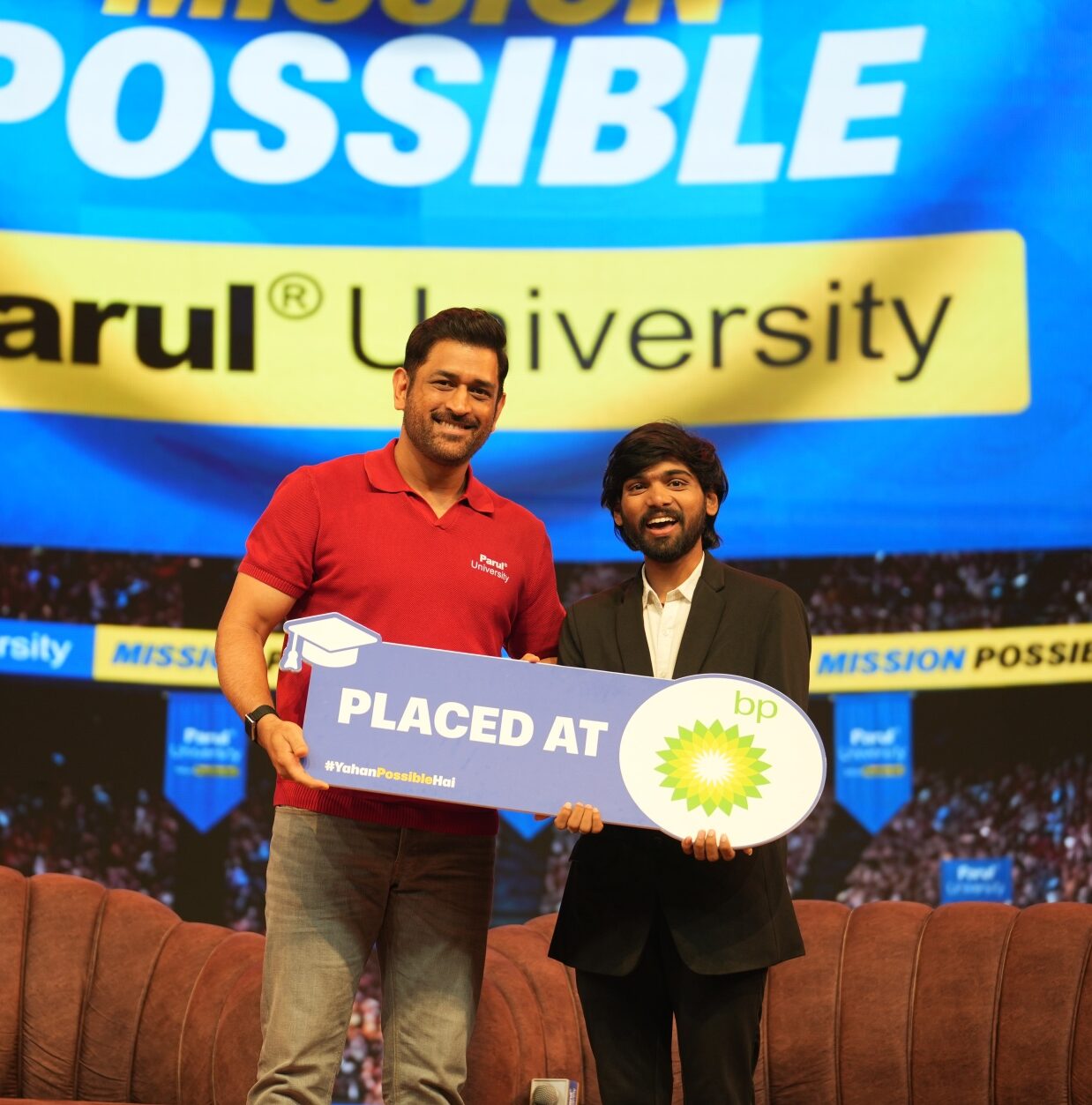
Kondapalli Shanmukha Sai Ram hails from Dammapeta in the Bhadradri Kothagudem of Telangana. He completed his diploma at Sai Spurthi Institute of Engineering & Technology before joining B.Tech in ECE at Parul University under the D2D pathway. He has successfully championed a college placement at BP – British Petroleum by winning ₹1.25 lakh in project funding for a Patient Service Robot, built on ROS2 & SLAM. Besides this, he has served as a Production & Testing Engineer at Incredible Advanced Technologies Pvt Ltd, and developed a LoRa-based traffic clearance system for emergency vehicles. This was his final-year project as well!
D2D Pathway - Diploma To Degree - British Petroleum
The D2D pathway, also known as the Diploma-to-Degree Pathway at Parul University, allows students who have completed a 3-year diploma in engineering to enter directly into the 2nd year of the related B.Tech Program. For him, the Diploma in Electronic & Communication Engineering track and B.Tech ECE programmes were quite aligned, and hence that allowed him to master perfection in electronics, communication, and embedded engineering. After multiple queries and counselling, he finally chose Parul University after analysing placement records, industrial exposure, infrastructure, and faculty support. The sheer presence of international recruiters on campus, structured placement preparations and supportive teaching staff were the 3 factors he majorly considered before applying here!
Industry internship: Production and Testing Engineer at Incredible Advanced Technologies that led him to BP
Sai Ram served as a Production and Testing Engineer at Incredible Advanced Technologies Pvt Ltd, where he gained hands-on industry exposure to antenna testing, RF systems testing, and industrial testing methodology aligned to specific client specifications. The internship taught him precision in technical measurement, adherence to client specification documents, team collaboration with senior engineers, and the gap between academic problem-solving and industry problem-solving, where the problem is partially specified, and the answer must satisfy multiple stakeholders rather than a textbook key.
The Patient Service Robot: ROS2, SLAM, and ₹1.25 lakh in project funding
Sai Ram’s first serious project at Parul University was a robot. Not a concept, not a proposal. An actual working robot built for ICU environments specifically. The technical stack behind it was not simple. ROS2 as the operating framework, SLAM algorithms handling autonomous navigation so the robot could move through a hospital ward without human guidance and usage of OpenCV for computer vision. The robot’s job was to carry medication, supplies, and patient care materials between points inside the ICU, doing the routine logistical work that pulls nursing staff away from patients twenty, thirty, forty times a shift.
Then came the funding of Rs. 1.25 lakh, external, secured on the merit of the project itself. He is clear about what that meant to him, and it is worth taking seriously. Anyone can build something for a grade. External funding is a different category of recognition entirely, as it means people outside the university, people with no obligation to be encouraging, looked at the work and decided it was worth backing. That does not happen with generic capstone projects. It happens when something has genuine technical credibility and a realistic use case, and this had both.
He calls it one of the most important milestones of his time at Parul University. Given what it took to get there, that is not an overstatement. This even indicates that Parul University’s PIERC inspires student founders to thrive at all levels; they’ve successfully incubated 254 startups.
LoRa Traffic Clearance System for emergency vehicles
This was his final-year project: the LoRa-based Traffic Clearance System for Emergency Vehicles uses LoRa (Long Range) wireless communication technology to allow ambulances, police vehicles, and fire emergency units to communicate with traffic signals in real time and request prioritised passage through congested intersections. The system combines embedded microcontrollers in emergency vehicles with LoRa receivers integrated into traffic signal controllers, switching the signal into emergency-priority mode within seconds of detecting an authenticated emergency vehicle approach.
LoRa was chosen over WiFi and cellular alternatives because of its multi-kilometre range, low power consumption, and immunity to the cellular network congestion that often occurs precisely when emergency response is most critical. The system is designed to minimise the time emergency vehicles lose at urban traffic signals, a routine cause of preventable delay in critical response timelines.
Placement Preparation for British Petroleum!
Diploma years, an industry internship, two major projects and a final destination of placement at BP. What came out the other side was not just experience in the vague sense that word usually gets used. Sai Ram built something specific, a solid technical stack that sits across hardware and software both, which is rarer than it sounds because most engineers drift toward one side fairly early. These skills helped him land a job at British Petroleum – one of the world’s five “supermajor” oil and gas entities.
- On the hardware side, he has worked with Raspberry Pi, Arduino, and ESP32, alongside encoder-supported DC motors, motor drivers, antenna systems, and RF testing equipment. Not as isolated exercises but as working components inside actual projects with actual constraints.
- The wireless and communication side covers LoRa modules, RF system testing, IoT communication protocols, and wireless control mechanisms. This came largely through the internship at the antenna testing facility, where the work was real, and the tolerances mattered.
- Robotics and computer vision is where the ICU robot sits. ROS2-based system development, SLAM-based autonomous navigation, OpenCV for image processing. Each of these required learning that went well beyond what any classroom schedule would have covered.
- Then embedded and IoT development running underneath all of it: automation using Raspberry Pi, ESP32-based device communication, and the kind of real-time troubleshooting that only happens when hardware and software are both live and one of them is not cooperating. That last part is difficult to teach. It tends to be learned the hard way, and he has learned it.
Placement preparation for BP: 4 interviews before one final offer!
Sai Ram began structured placement preparation during his third year of B.Tech. The lone factor he identifies as the most important contributor to his placement outcome is repeated via interview practice and training. Before achieving his final placement, he sat through 3 to 4 placement drive interviews, each of which prepared him for the final show. All the placement drives prepared him with enhanced body language, communication skills, corporate expectations and technically refreshed capabilities!
Failure is a part of life, not the end of life.
– Kondapalli Shanmukha Sai Ram
The placement preparation infrastructure at Parul University is structured around exactly this kind of repeated exposure. The Training and Placement Cell runs aptitude training, mock interview sessions, professional grooming workshops, and the Impact Training programme covering DSA, operating systems, DBMS, OOP, and career mentorship.
Mock interviews, in his case, are the single component of placement preparation that has helped him majorly. Repeated mock interview practice closed the gap between technical capability and interview performance – structured answer construction, confidence calibration under evaluative pressure, professional communication discipline, and self-correction of repeated mistakes, including filler words and incomplete answers.
Advice for juniors: plan early, fail forward, build real things
Sai Ram’s advice to junior B.Tech students, particularly D2D entrants and final-year aspirants, centres on three operational principles. First, plan. Placement preparation begun in the final semester is structurally late. The technical projects, the industry internships, and the mock interview exposure all require months to compound. Second, fail forward. Failed interviews and unconverted placement drives are not terminal signals; they carry specific learning that converts into improved performance on the next attempt. Third, build real things. A funded ₹1.25 lakh project that addresses an actual clinical workflow carries interview weight that a generic capstone project cannot.
Motivation is not something that happens consistently every single day. Focus on the process of working rather than waiting to feel motivated.
Kondapalli Shanmukha Sai Ram
FAQs
Who is Kondapalli Shanmukha Sai Ram?
He is a B.Tech Electronics & Communication Engineering student at Parul Institute of Engineering & Technology (Class of 2026). Hailing from the village of Dammapeta in Telangana, he completed his diploma at Sai Spurthi Institute of Engineering & Technology before joining Parul University, under the D2D Pathway. He has secured a full-time campus placement and has built two major projects: a patient service robot for ICU settings, which has received funding of 1.25 Lakhs, and another one is a LoRa-based traffic clearance system for emergency vehicles. These were his final-year projects as well!
Define D2D - Diploma to Degree pathway at Parul University?
The D2D, also known as the Diploma to Degree Pathway at Parul University, allows students who have completed a 3-year diploma in engineering to transition into the 2nd year of the corresponding B.Tech program. This pathway is recognised under the AICTE lateral entry framework and is available via multiple engineering branches of Parul University, including B.Tech Electronics, B.Tech Computer Science Engineering, and B.Tech Mechanical Engineering. D2D students retain the hands-on foundation from their diploma year and then participate in campus placement drives as freshly graduated B.Tech Students.
What was the Patient Service Robot project?
The Patient Service Robot was Kondapalli Shanmukha Sai Ram's major academic project at Parul University, designed for use in Intensive Care Unit (ICU) settings. The robot was built using ROS2 (Robot Operating System 2), Simultaneous Localisation and Mapping (SLAM) algorithms for autonomous navigation, and OpenCV for computer vision processing. This robot was ideated and designed to support hospitals with medication, supplies and care materials amidst ICU environments. It has even raised 1.25 Lakhs in a funding round!
What is the LoRa Traffic Clearance System?
It’s for emergency vehicles, as a final-year B.Tech ECE project at Parul University. The system uses LoRa (long range) wireless communication technology to allow ambulances, police vehicles and fire emergency units to communicate with traffic signals in real time and can easily request clearance via congested urban intersections. To be precise, LoRa was chosen over WiFi & different alternatives because of its multi-km range, power consumption and network congestion issues.
Where did Kondapalli Shanmukha Sai Ram complete his industry internship?
Kondapalli Shanmukha Sai Ram served as a Production and Testing Engineer at Incredible Advanced Technologies Pvt Ltd during his B.Tech ECE years at Parul University. The role provided hands-on industry exposure to antenna testing, RF systems testing, and industrial testing methodology aligned to client specifications. The internship gave him practical experience in precision measurement, client-specification documentation, team collaboration with senior engineers, and the operational reality of professional engineering work outside the academic environment.
How does Parul University support D2D and ECE students for campus placement?
Parul University supports D2D and ECE students for campus placement through several integrated mechanisms. The Training and Placement Cell runs the Impact Training programme covering DSA, operating systems, DBMS, OOP, aptitude, and career mentorship, alongside mock interview sessions, professional grooming workshops, and behavioural coaching. The Faculty of Engineering & Technology extends project supervision and access to specialised laboratory infrastructure, including the VLSI Lab, the Centre of Excellence in Sensor Technology and the Lakshya 2047. 15 labs are operational, as inaugurated in May 2026. Over 2,200 recruiting companies participate in PU’s campus drives, and the university has been awarded the Best University in Placements by ASSOCHAM for 3 consecutive years!