India’s creative economy is opening up new kinds of work. The Union Budget 2026–27 noted that the AVGC sector alone may need nearly 2 million professionals by 2030, according to the Press Information Bureau (PIB). The government has also said India’s design industry is expanding rapidly, with growing demand for skilled design professionals.
But if you want to study design and have never made a portfolio before, this growth can feel far away. You may be thinking, “What will I even put inside it?” The good part is that a beginner’s portfolio is not expected to look like the work of an experienced designer
What Does a B.Des Admission Portfolio Actually Need to Show?
A design portfolio is a collection of selected work that gives an idea of how you think creatively. For a Bdes applicant, the process behind an idea can be as important as the finished result.
Portfolios are not evaluated only on how attractive they look. They can also show how a student thinks, observes, asks questions and solves problems.
So do not fill every page with perfect-looking posters. If you noticed a problem, tried three solutions and realised why two did not work, that journey can reveal more about you as a beginner designer.
What Can You Put in Your Portfolio without Design Experience?
You can start with work you already have and create a few small projects around everyday life.
- Sketches and drawings: Include observation sketches, objects, people, spaces or ideas.
- Problem-solving projects: Redesign a confusing menu, school notice, water bottle, desk or everyday object.
- Photography: Use photographs that show composition, colour, people, spaces or a small visual story.
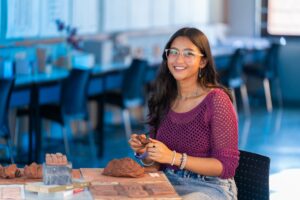
- Craft or model work: Include paper models, handmade objects, clothing experiments or material exploration.
- Digital work: Posters, illustrations, interface ideas or basic layouts can be added if they genuinely show your thinking.
Do not add something only because it looks impressive. Be ready to explain why you made it and what you learned.
How Can You Create Your First Design Project from Nothing?
Start with one small irritation around you.
Maybe your grandparents find a medicine box difficult to read. Perhaps your study table becomes messy because cables have nowhere to go. Or the signs in your neighbourhood are confusing.
First, photograph or sketch the problem. Then write down who faces it and why. Make several rough ideas instead of jumping to the final answer. Choose one idea, develop it and show what you would change after testing it.
Suddenly, you have a design project. This approach also connects with what design aptitude looks for.
How Should You Arrange Your B.Des Portfolio?
Once you have enough work, editing becomes important.
- Start strong: Put one of your better projects near the beginning.
- Show variety: Mix sketches, problem-solving, visual work and experiments where relevant.
- Show the process: Add rough ideas, trials and improvements before the final result.
- Write short explanations: Tell the reader what the problem was, what you tried and what you learned.
- Keep the layout clean: Your portfolio should be easy to follow without too much decoration.
- Remove weaker work: A smaller set of thoughtful projects can work better than many random pieces.
The goal is not to make every page look the same. It is to make your thinking easy to understand.
What Mistakes Should First-time Applicants Avoid?
One common mistake is copying portfolio styles seen online. Inspiration is fine, but your portfolio should still feel like your work.
Another mistake is showing only finished designs. If reviewers see only the final poster or product sketch, they may not understand how you reached that idea.
Also, do not hide every failed experiment. Design involves changing your mind. A rough idea that became better after testing can show learning and honesty.
How Does the Portfolio Fit into B.Des Admission at Parul University?
At Parul University, the current B.Des selection process includes the PU-DAT followed by a portfolio round. After completing the Design Aptitude Test, applicants submit their portfolio through the provided process.
Parul University’s design programmes include areas such as Product Design, Communication Design, Fashion Design, Interior and Furniture Design, and User Experience and Interaction Design. So your portfolio does not need to prove that you have already become one type of designer. It should help show the curiosity and thinking from which those skills can grow.
Start today with one problem sitting right in front of you. Draw it, question it and try changing it. That first imperfect page may become the beginning of your B.Des portfolio, and possibly the first time you start seeing everyday life like a designer.
FAQs
Do I need expensive design software to make a B.Des portfolio?
No, beginners can use sketches, photographs, physical models and simple digital tools.
Should I include school artwork in my portfolio?
Yes, if it reflects your creativity, observation or way of developing an idea.
Can my B.Des portfolio contain unfinished projects?
Yes, unfinished experiments can be useful when they clearly show your process and learning.