From Humanities to Law: Nibidita Roy’s Classic Start at Parul University!
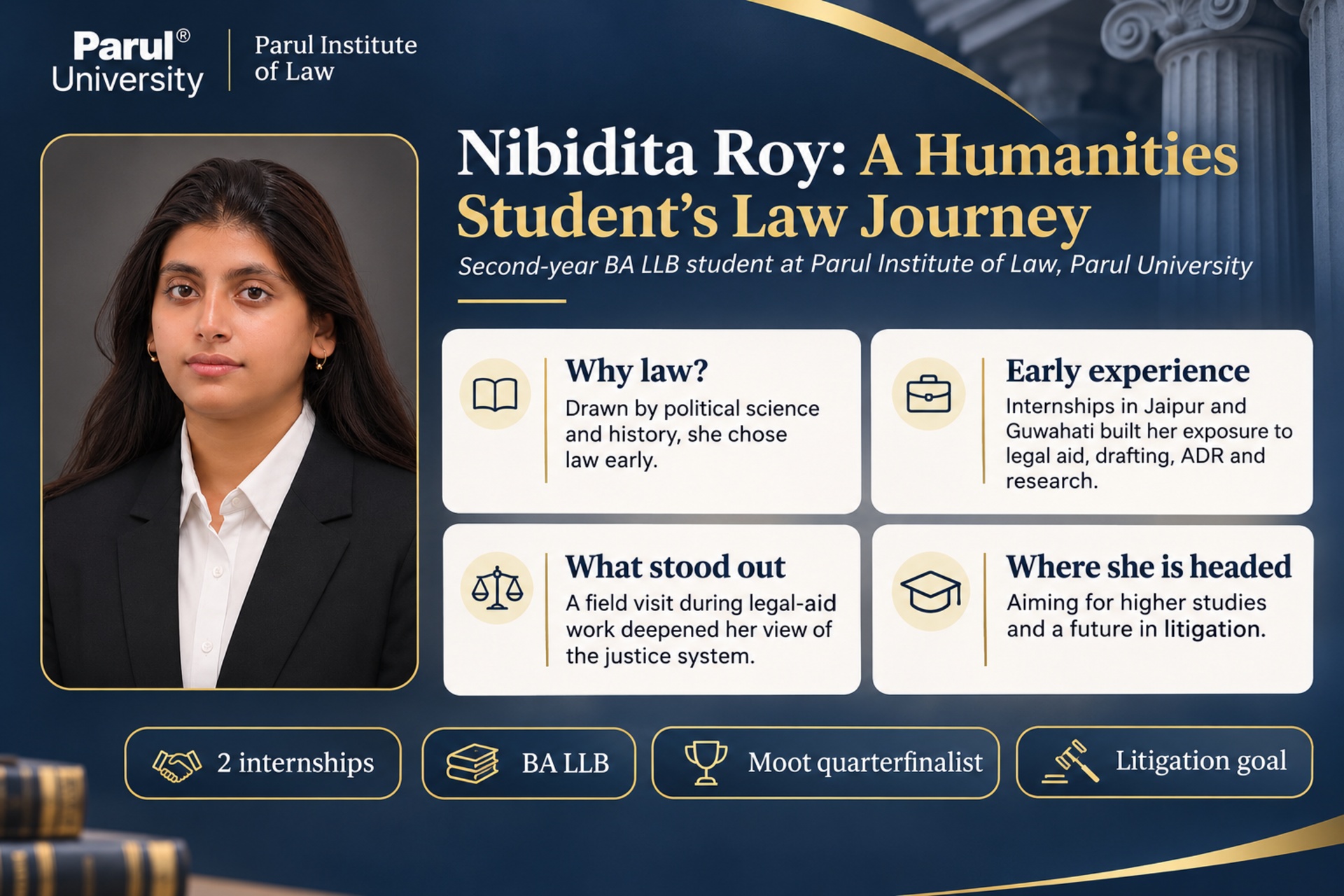
- • Chose law straight from the humanities after Class 10, drawn by political science and history.
- • Two internships: the Rajasthan State Legal Services Authority in Jaipur and SJ Law Plus in Guwahati, Assam.
- • A rehabilitation-home field visit during the Jaipur internship reshaped how she sees the justice system.
- • Quarterfinalist in an induction moot court and a member of the Training and Placement executive team; aiming at litigation.
Student:
Nibidita Roy, BA LLB, second year
University:
Parul Institute of Law, Parul University, Vadodara
Background:
Humanities stream; from West Bengal, based in Dimapur, Nagaland
Internships:
Two: Rajasthan State Legal Services Authority (Jaipur) and SJ Law Plus (Guwahati)
Career goal:
A master's degree, then litigation
Her first step in law!
The notion that “law” is for “science and commerce” students is a common and quick misconception. Nibidita Roy‘s experience is truly unforgettable. She is a second-year student of the BA LLB program directly from the humanities and has taken LLB as her early subject without a second thought and has two internships completed, a moot court quarterfinal and a stint on the Training and Placement executive committee at her institute under her belt. That early start time is helpful if you’re a humanities student thinking of going for the law.
Nibidita hails from the beautiful state of West Bengal, residing in Dimapur, Nagaland. She studied law after Class 10, not because she wanted to study something else, she said, adding that the reason for her choice is the subjects she liked. Her understanding of the law has been influenced by political science and history, and she considers the law to be a history, rather than a set of articles and sections, that is linked to the history of politics and the development of societies and systems.
The initial clarity is the reason she chose this domain. The law becomes more challenging as you go, and if you understand the reason for studying it, you will be more likely to continue with it when it is hard. However, she tells it like it is when it’s challenging for a humanities student: “Law and Economics, a part of the course, but not law, is a challenge for a humanities student who never did economics in Class 10, and it’s not hiding the truth of that.
Her life on the campus of Parul University!
Nibidita explains, “I chose Parul University because of the range and accessibility. The institute gave her greater choice than a lot of institutes she had visited, and having access to advocates, judges, and practitioners early on was very unusual from what she saw. Being a law student, gaining entry to the profession as soon as possible is the toughest thing she has managed to arrange for herself, and that’s what brought her to the law institute. She says studying law is stressful, with so much reading here and there, and the campus is where she finds more peace. She is also optimistic about the faculty members, who have been found to be friendly and open to holding a second meeting to resolve doubts when they are free, and the library of the institute, which she has found to be better than the lecture notes and slides on the e-learning portal for presenting a topic from more than one perspective. She is also very interested in history and politics, and therefore her favourite subjects are the Bharatiya Nyaya Sanhita and constitutional law.
Two internships and that visit, which got her the idea!
Nibidita has completed two internships; both internships had a strong impact on her. This was with the Rajasthan State Legal Services Authority in Jaipur, and when asked about what influenced her thinking on the justice system, she always refers back to the field visit to a rehabilitation home for children. Interacting with the kids there gave her a sense that there’s an environment that’s more coarse and more complicated than she had initially envisioned and that the system of justice is for them.
The second internship was a month-long summer internship at SJ Law Plus, Guwahati, Assam, which was more practical. The advocate she worked under did not assume anything but started from scratch and helped her with alternative dispute resolution, making applications, and drafting legal notices. She says many advocates don’t do this when they take on interns. A lot of the day was spent doing legal research, and as a second-year student, she did a lot of that at home. She had a supervisor who had a tick next to all of her work and a cross if it was incorrect, so that she knew where she was so she could know what she needed to improve.
| Internship | Place and focus |
|---|---|
| Rajasthan State Legal Services Authority | Jaipur: legal aid, including a field visit to a children’s rehabilitation home |
| SJ Law Plus | Guwahati, Assam: a hands-on month on ADR, applications, legal notices, and research |
Source: Student interview, Parul Institute of Law
The skills she’s developing.
The internships have changed the way she works. Her biggest early mistake, she says, was treating legal research as a quick search and writing down whatever she got, and the internships have taught her to do it properly. They’ve also taught her the things you don’t learn in class, like how to speak to senior people, show respect, and do the basics of office etiquette.
When asked which practical skill she’s most confident in now, she says communication and makes a sharp point. Many students are good on the technical side, she says, but if a student can’t communicate, it undermines all of that and makes it look like they know less than they do. She’s also realistic about what courts are actually like, compared to the shouting matches of films and web series. Real proceedings are watchable but much less dramatic, and they make little sense unless you know the case behind them, which is why context is more important than theatre.
Her future plans and aspirations!
Nibidita is two years into a five-year degree, and she’s open about having a long way to go. She plans to do a master’s after the BA LLB and go into litigation, and the two internships, moot court quarterfinal, and her place on the Training and Placement executive team are the early steps towards that. Her advice to juniors is simple and practical: listen to teachers, who have the experience; take a professional course seriously from the first day, not the first year; and give every teacher a fair hearing, because the students who skip classes or don’t like a teacher are the ones who learn the least. Inspired already? Bring the change you wish to drive by pursuing BA LLB and B.Com. LL.B. (Hons.) from Parul University!