Journey of A Student From Commerce to the Law Field.
- • Who S. Anand is, and the commerce and taxation background that shaped his law path.
- • His two internships, a Delhi High Court courtroom and a SAIL corporate office.
- • His methodical, worth-copying approach to using AI on long judgments.
- • His views on legal ethics, and his advice for students who want corporate work.
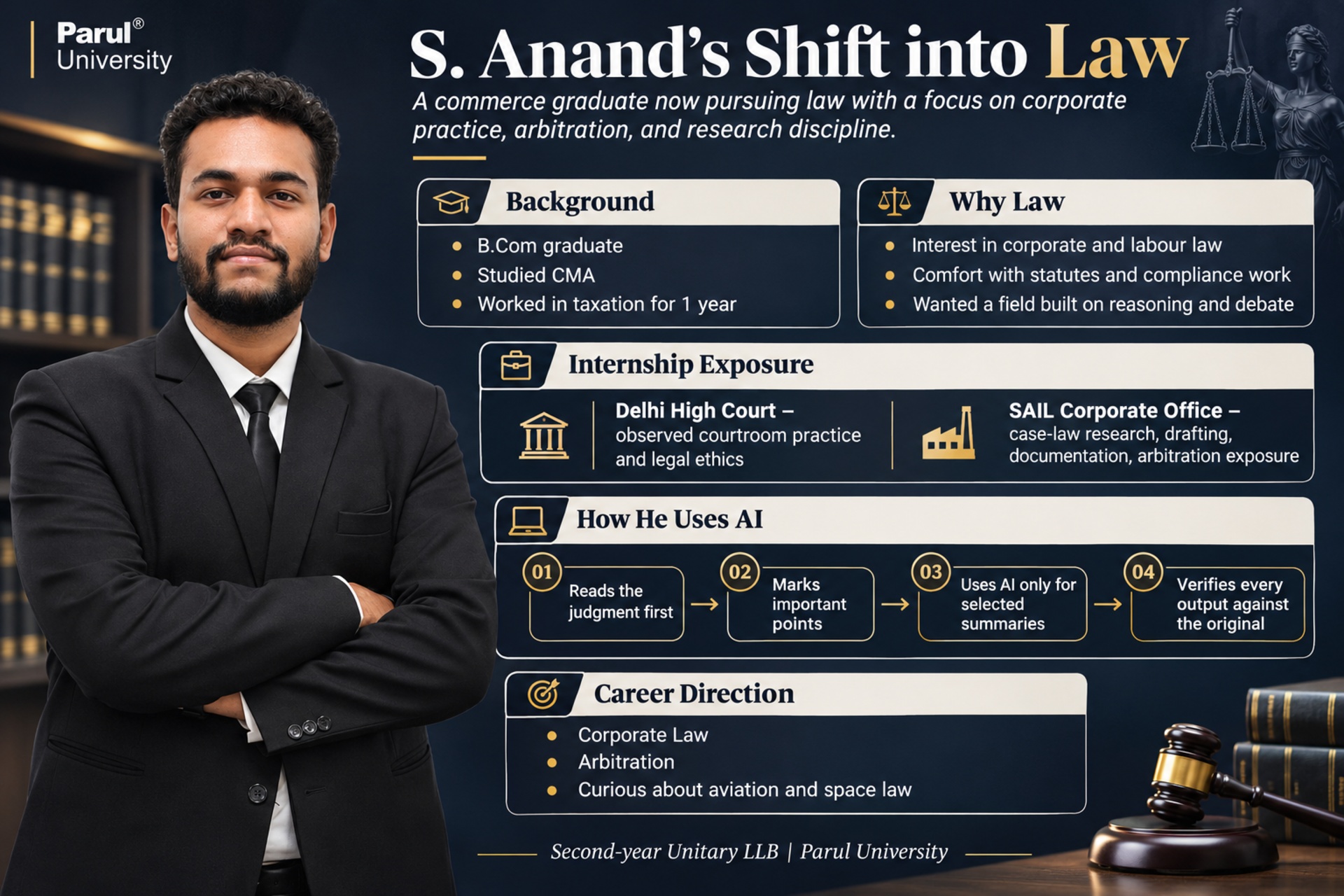
Second-year unitary LLB
After a B.Com, CMA studies and a year in taxation
Corporate law and arbitration
His direction; also curious about aviation and space law
Two internships
Delhi High Court (criminal litigation) and SAIL (corporate research)
Who S. Anand is
S.Anand is Parul University student studying in the second year, LLB programme. He completed B.Com and studied for Cost Management Accountancy. With this he has also worked in the taxation at the CA firm for an year. During this time he got an opportunity to work with actual clients, real cases, how tax compliance works. This influenced his interest towards learning more about the law and how corporate law works.
With this experience he was already prepared for the LLB programmes. He came with the experience of filling GST and income tax returns, He knew how to handle the registrations and reading the statutes. He knew what are his expectations from the programme. He aims to understand more about corporate law and arbitration. As we learn more about him, he says that his interests also lie in aviation and space law which are his side hustle and wishes to pursue the field, giving it a legal angle.
The other quiet strength underlying all this is the fact that he has an amazing talent of finding himself in a new environment. He was raised mainly in Bhilai, Chhattisgarh, and has lived in different cities for his studies, Bangalore for his graduation, Kolkata for his CMA courses, and some time in Delhi before he went on to live in the new environment of Parul University which has a Gujarati culture. When asked about his experiences in making such another change, his reply was straightforward: it wasn’t that tough. Since he had been able to adapt himself to so many new environments before, doing this again was nothing new. This attitude of his to enter new surroundings is reflected whenever he shifts his tracks from commerce to law, and from English to legal English.
From commerce and taxation into law
Anand started his journey with business. Through that, he thought of taking a B.Com degree and CMA course. With B.Com, he pursued CMA in parallel for some time, and he was dedicated to becoming a chartered accountant.
But along with the academic work, he got the professional experience as well, namely the full-time job in a CA firm in his hometown doing GST, income tax, MSME and trademark registrations, monthly GST filing and yearly income tax returns for his clients. According to his own words, it was basic taxation, however the practice in the process helped him understand the legislation of the business sphere.
There were two factors leading Anand towards the law. First of all, he found very interesting and attractive the law part of his courses which were connected with the corporate law, labour law and other employment related statutes and, besides, he knew he can cope with it despite of its difficulty. Secondly, he admits straightforwardly that he likes debating and proving something and law gives him an opportunity for it. As soon as his enthusiasm about completing the CMA started to fade away, Anand decided to move on to law.
The internships: a courtroom and a corporate office
Anand’s two internships sit on opposite sides of the profession, and the contrast is the point.
| Internship | Setting | What it gave him |
|---|---|---|
| Delhi High Court | Under a well-known criminal advocate | First exposure to how a courtroom runs and how criminal matters are argued, and a hard look at the ethics of defence |
| SAIL corporate office | In-house legal, research-led | Case-law research, drafting and documentation, and a close view of arbitration work |
In the Delhi High Court, he served under a highly reputable criminal lawyer where he was able to observe a serious criminal case. The observation made him ponder about the system of law and, more importantly, the issue that all law students face: why an advocate would stand up for a client despite the guilt of the latter. His conclusion is that law and ethics have to be considered differently and he backs it up with sound reasoning.
The internship at SAIL formed the second half of the picture, where according to his own assessment, ninety percent of it entailed office work which included researching, writing and documenting. Senior lawyers would give him a legal concept and ask him to provide precedent for it and he would go on to do so. Quite a number of cases were arbitration cases which is one of the reasons why arbitration, along with corporate law forms part of his future plans. He realizes fully well that an intern does not get the crucial part of the case.
How he uses AI in legal research, without being used by it
The most useful thing in Anand’s account, for any student heading into research-heavy work, is his method for using AI on long judgments, because he has thought it through rather than just reached for the tool. Asked how he summarised lengthy judgments for his seniors, he was honest that he used AI as a real help, and equally honest that people are leaning on it too much, himself included.
He walked through a specific case to show the difference between using AI and depending on it. He was given a judgment of about 170 pages running from 2017 to 2020, and rather than hand the whole thing to a tool, he worked it in stages.
| Step | What he actually did |
|---|---|
| Read and mark first | Read the judgment himself and highlighted the points that mattered |
| Then summarise with AI | Uploaded the full document to an AI tool to produce a summary |
| Cross-check against his own notes | Compared the AI summary against the points he had set aside, and edited it |
| Be ready to defend it | Kept enough command of the material to answer when his seniors cross-questioned him, which they did |
He shared his view that depending on AI is not wrong. But over-reliance can lead to problems. It can affect the thinking patterns. When the work is simply generated from AI and copied the person or student is caught as they don’t have the understanding of the case they are asked to work on. When a summary is prepared, it helps the student to understand the case well enough to defend it.
The reading problem, and the background that helps
The legal terminology and language in the field of Law wasn’t very challenging for me. However, condensing large amounts of information into 3-4 pages (i.e 50/100 pages into 3/4) was. Being able to extract the main points from each page and line and ensuring that nothing important is lost in the process was difficult for me, but I am improving at that. Because I come from a commerce background I have some knowledge of company law, labour law and relevant legislation, meaning that part of this course was familiar. The rest of my knowledge has been gained from lecturers (especially Bhavya Ma’am who helped me understand my first internship) and using Manupatra (legal database). This has helped me with both the coursework, and researching in my internship.
His views on the profession, and his advice
There are two main themes that run through what Anand has said, and both are much more thought out than something a second-year student typically would have to say. As far as ethics are concerned, Anand takes a pragmatic position. According to him, law and the moral code are different entities, the morality is subjective, and the conscience of one lawyer is unlikely to change the system that has worked in a particular way for many years. However, he uses this statement to absolve from any responsibilities either. All people have their moral code, and if a lawyer feels that a particular case is unacceptable, then they may choose not to represent the party. And that, according to him, is the least that they can do in such circumstances.
Talking about his placement, he expresses that it is too early for him. He believes in moving carefully. He believes in following procedure. Discussing with seniors, observing the process through seniors. He feels it will help them to become sure about whether to follow the college placement procedure or to search for an opportunity by himself. He decided to give the college placement and related processes a genuine attempt. Taking advice from his seniors and following that.
When asked about what advice he has for his juniors, he said that students who want to work in the corporate world sometimes might end up with a court internship. And they should not treat it as a loss. He believes that anyone who wishes to work in the corporate or in corporate law should understand how actual court work is done. Even a matter that starts in a boardroom can end up in court. And if someone is not aware of the basics, or doesn’t have the knowledge to serve the client well. For a budding corporate lawyer, an internship at High Court/ litigation is a base and not a waste of time, and this has been echoed by the Bar Council of India framework for practical legal education as well. He couples this with one saying that he will say to everyone about making sure that he maintains a life beyond the degree.
SOURCE AND CONTEXT.
This data is based on a student profile. Student profile of S.Anand. He is in the second year of LLB, Parul University. This information is collected by Plavanamee, and the report was prepared by Janvi Singh. The student, S. Anand is not placed yet but plans to sit in the college placement process. He has shared his experience of the internship at SAIL. The criminal matters that he got the chance to observe at the Delhi High Court. His LinkedIn profile is attached, along with the official websites of SAIL, the Delhi High Court, Manupatra and the Bar Council of India.