A final-year law student at Parul University, aiming for the UPSC Examination.
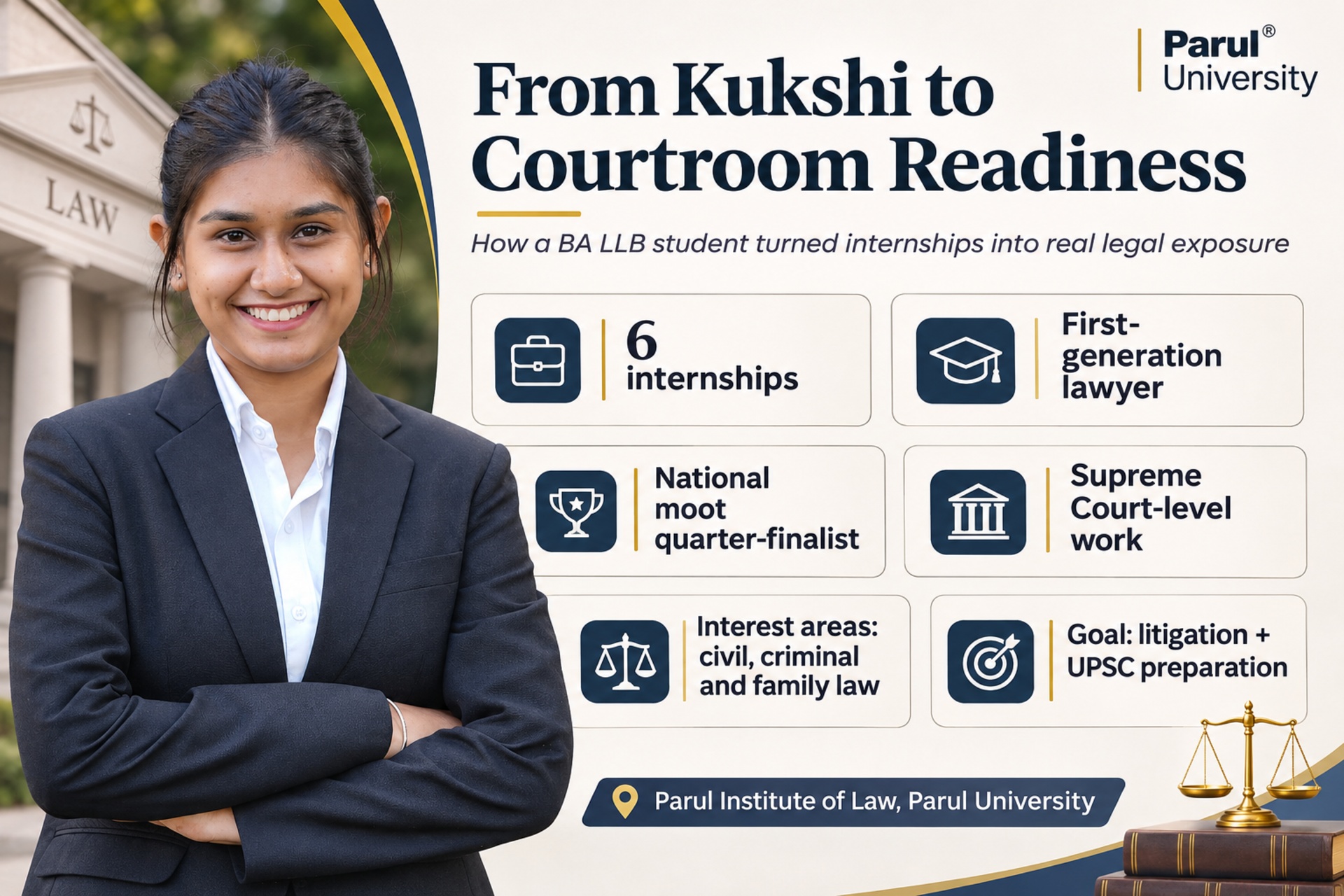
- • First-generation lawyer from Kukshi, Dhar district; took up law for the family business, then chose it for herself.
- • Six internships, rising from legal-rights outreach and Indore High Court chambers to Supreme Court-level work in New Delhi.
- • National moot quarter-finalist at NFSU Gandhinagar and runner-up in Parul Institute of Law's 2025 intra moot.
- • Plans a litigation career across civil, criminal and family law, alongside UPSC Civil Services preparation.
Student:
Vidhi Patidar, BA LLB, final year (batch 2022 to 2027)
University:
Parul Institute of Law, Parul University, Vadodara
Background:
First-generation lawyer from Kukshi, Madhya Pradesh; commerce stream
Internships:
Six, from outreach and High Court chambers to Supreme Court-level work
Moots:
National quarter-finalist (NFSU, 2024); intra moot runner-up (2025)
Career goal:
Litigation, with UPSC Civil Services preparation
Vidhi Patidar: A small-town start, and a practical decision
Vidhi Patidar did not grow up around lawyers. She is from Kukshi, a small block town in the Dhar district of Madhya Pradesh, where her father runs a business in stone crushing and agriculture, and she took up law because the family needed someone to handle its legal side. What began as a practical decision became something she chose for herself once she started visiting courts. In her final year of the BA LLB at Parul Institute of Law, she has six internships behind her, a national moot record, and a clear plan to go into litigation as a first-generation lawyer.
Vidhi did all her schooling at one school in Kukshi, scoring 92 per cent in Class 10 and 84.4 per cent in Class 12 in the commerce stream. Law was not the obvious next step. Her father, looking for someone in the family to manage the legal side of the business, pointed her towards it, and she went in for that reason before the subject took hold of her on its own.
Parul University came by recommendation; her cousins had studied there. It was her first time living away from family, and she is candid that the first year was hard, with subjects like the law of contracts and constitutional law entirely new to a commerce student who had never studied legal principles at school. What carried her through, she says, was the faculty, and the mix of classroom teaching with workshops and visiting lawyers and judges that gave the theory a practical edge early on.
Moot courts, where the confidence came from
Moot court is where Vidhi found her footing. Her first two national moots, both in 2024 at the National Forensic Sciences University in Gandhinagar, took her team to the quarter-finals, and she values them as much for the students she met and how fast she learned from other universities as for the result. Her record since includes runner-up at the 2025 Intra Moot Court Competition at Parul Institute of Law, and participation in the 13th UFYLC Ranka National Moot at the University of Rajasthan, the 6th “You, Amend Your Constitution” competition at UPES, and the Pro Bono Chronicles competition at the University of Lucknow.
She was as active behind the scenes. She helped organise a national training session for the Daksh Loctite initiative in January 2024 and Samvidhan Pe Charcha 2.0 in September 2024, and coordinated with Dr. Sudhir Krishnaswamy, the Vice-Chancellor of NLSIU, during the International Mediation Competition in March 2025. She counts an online constitutional event where she interacted with a Justice and her own Vice-Chancellor among the memorable moments of her student life.
Six internships, six kinds of legal work
The Parul law programme requires a one-month internship every year, and Vidhi did well beyond the minimum, with each placement teaching something different. She started close to the ground and moved, over three years, to the Supreme Court level.
Her first, with Chhatra Sansad in 2023, was about communication: one-to-one conversations, door-to-door campaigns on legal rights and social-welfare work. The next three took her into litigation in Indore. Under Adv. Santosh (S.S.) Pandey at the Madhya Pradesh High Court‘s Indore bench in May 2024 she learned how a case file is built, did legal research, and wrote motions and case briefs while watching matters in both the District Court and the High Court. With Adv. Anurag Parashar, who has been a Pleader for the Supreme Court, she drafted written statements and notices and researched case law, and with Adv. Pranay Joshi in November 2025 she drafted legal notices, bail applications and Memoranda of Parties, sat in on client meetings and prepared case summaries.
| Internship | Place, time and focus |
|---|---|
| Chhatra Sansad | May to Jun 2023: legal-rights outreach and communication |
| Adv. S.S. Pandey | MP High Court, Indore bench, May 2024: case files, motions and briefs |
| Adv. Anurag Parashar | High Court, Indore, Nov to Dec 2024: written statements, notices, case law |
| Adv. Pranay Joshi | High Court, Indore, Nov 2025: notices, bail applications, Memoranda of Parties |
| Singhania and Partners LLP | New Delhi, May 2026: land acquisition, compensation and arbitration research |
| Adv. Aditya Goyal (AoR) | Supreme Court and MP High Court, Aug 2026: filing, e-filing and court procedure |
Source: Student interview, Parul Institute of Law.
Singhania and Partners, and an Advocate-on-Record
The last two internships lifted her to a different level. At Singhania and Partners LLP in New Delhi in May 2026 she moved from the High Court in Indore to Supreme Court work, researching land-acquisition law under the National Highways Act of 1956 and the RFCTLARR Act of 2013, working out how compensation is determined, preparing compensation-revision applications, and drafting Memoranda of Parties for the Supreme Court and the High Courts, alongside research on arbitration jurisdiction.
Then, under Adv. Aditya Goyal, an Advocate-on-Record at the Supreme Court who also practises at the Madhya Pradesh High Court in Indore, she saw procedure from the inside in August 2026: which judge sits in which court, how to appear before them, how the filing section works, and how High Court filing and e-filing are done. For a student headed into litigation, that view of how a court actually runs is the kind of knowledge that is hard to get from the outside.
A day in an advocate's office
Vidhi describes the routine of a litigation intern clearly enough to be useful to anyone wondering what to expect. The day starts with the cause list: she would check the diary to see which cases were listed, pull the files, work out the issue in each and whether a reply or return statement was due. In court, she would wait for the case number to be called and watch the hearing beside the advocate. Afterwards came client meetings, where she would listen to the problem and brief the senior. Some days were mostly office and some mostly court, and either way, she says, the learning did not stop.
Asked whether academics or practical exposure mattered more, she says both, with an example. The first time she drafted a notice, her senior told her there was no fixed format and to write it as she thought best, and that was when she saw what college had given her. She already knew the formats, which body to approach and which section to apply, and that was what let her put the task into practice.
Litigation, the civil services, and advice for juniors
Vidhi wants to be a litigator, and she is clear-eyed that it is hard for someone without family in the profession. She says she is ready for it, because the variety is what draws her: new people and a new case every day, going to court, watching proceedings and framing arguments, rather than the same desk work each day. She is interested in civil, criminal and family law together, and plans to prepare for the UPSC Civil Services Examination alongside it.
Her advice to juniors is specific and, in places, against the grain. Intern where your interest actually lies rather than taking a judicial internship because everyone does, since in her view those mostly teach you how to brief a case rather than how a court works. Explore, but with purpose, because chasing too many things means missing the good ones. Attend every workshop the college offers, even one that does not seem relevant, as she did with a LinkedIn profile workshop at Parul. Build practical exposure alongside academics, since the two work best together. And ask seniors and teachers, who at Parul will point you to the right advocates and chambers. For a first-generation lawyer from a small town, that guidance, she says, is what made the difference.