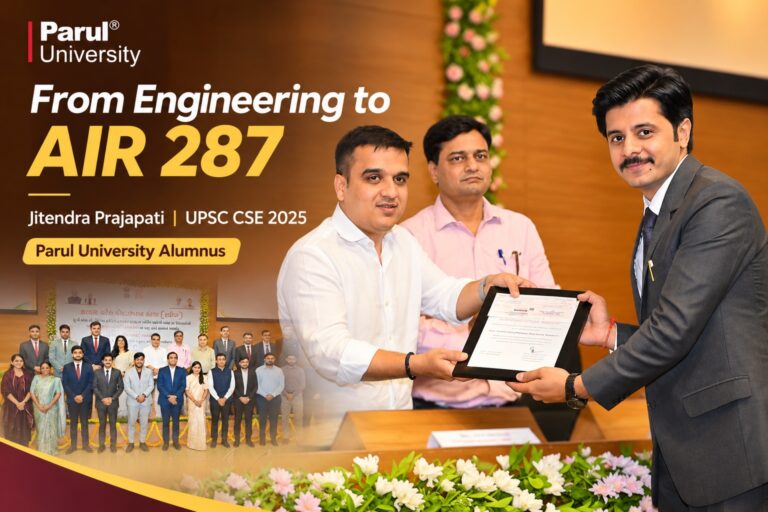
From Parul University to AIR 287: Shri Harsh Sanghavi Ji Felicitates UPSC Achiever Jitendra Prajapati, Inspiring Future Civil Services Aspirants!
- • Choose an optional that suits your background, then decode the syllabus and gather the right books.
- • Analyse previous years' questions before deciding what to read; link current affairs to the syllabus, not random news.
- • Prepare in sequence: Prelims from three months out, Mains answer writing daily for three months, and interview only after Mains results.
- • Write general studies answers in points and optional and essay answers in paragraphs, built on the question's demand and subheadings.
Start with the optional and the syllabus.
Jitendra Prajapati cleared the UPSC Civil Services Examination 2025 with All India Rank 287 on his ninth attempt, after clearing the Preliminary examination three times and writing the Mains three times. A Parul University engineering graduate with political science and international relations as his optional, he was felicitated by the Honourable Deputy Chief Minister of Gujarat, Shri Harsh Sanghavi Ji, for his achievement. He built his strategy stage by stage over those attempts.
For a beginner, the first step is choosing an optional subject that fits your background and graduation, then preparing it thoroughly, because the two optional papers weigh heavily in the final result. He chose Political Science and International Relations because computer science was not available among the engineering options. The second step is to decode the syllabus and collect the books that cover it before anything else.
Plan around the three stages!
His strategy follows the examination’s own sequence. He began with General Studies because the syllabus is wide, competition is tough, and every serious candidate revises it many times; he made the core syllabus his base and revised it properly. Current affairs ran alongside from one newspaper, the Indian Express in his case, and notes were the base he returned to whenever he revised.
Previous year questions changed how he worked. At first he knew nothing about them, but once he analysed them he could see which topics recur in Prelims, which areas Mains favours and which domains are likely to produce questions, and that analysis decided his books and his focus. His rule on current affairs follows from it: link them to the syllabus, not random current affairs.
| Stage | How he prepared |
|---|---|
| Foundation | Optional, chosen to fit his background; syllabus decoded; core General Studies revised repeatedly; one newspaper daily; notes for revision |
| Prelims | Dedicated preparation from three months out; one GS and one CSAT test every Sunday, then revision; no dwelling on scores |
| Mains | Nine papers and heavy writing; daily answer writing for three months through a test series |
| Personality test | Preparation begins only after the Mains result, starting from the Detailed Application Form |
Source: Interview with Jitendra Prajapati, UPSC CSE 2025 AIR 287.
For prelims, he started dedicated preparation three months out. Every Sunday, he wrote two tests, one in general studies and one in CSAT, revised, and moved on without dwelling on the score. After prelims, he switched to mains, which needs a different approach because of its nine papers and its demand for writing, and wrote answers every day for three months through a test series. Only after the Mains result did he begin preparing for the personality test.
His daily routine in Delhi!
His Delhi days followed a fixed pattern, adjusted to whichever stage was next.
| Time of day | What he did |
|---|---|
| Morning | Newspaper (Indian Express), two to three hours |
| Late morning | General Studies, three to four hours |
| Lunch | Answer writing when Mains was close |
| Afternoon | CSAT before Prelims; otherwise, the optional subject |
| Night | General Studies |
How to write a Mains answer?
Answer writing was the hardest skill for him to build. He started out writing long paragraphs without knowing where to begin or end and learned that writing a 150 or 250-word answer is a different skill from knowing the syllabus: it is about choosing which points and which words meet what the question demands.
His method has two steps. First, understand the demand of the question. Second, identify its subheadings, and build the answer around them. The format then depends on the paper. For General Studies he writes in points, which fit more content into the word limit; for the optional and the essay, he writes in paragraphs.
| Paper | Format he uses |
|---|---|
| General Studies | Points, to fit more content into 150 or 250 words |
| Optional (PSIR) | Paragraphs |
| Essay | Paragraphs |
Coaching, test series, and mentors!
He took classroom coaching for General Studies for one year and none after that, relying instead on test series from different institutes, including Forum IAS for both Prelims and Mains, and mock personality tests from several institutes near the final stage. Forum IAS has since published his Mains answer copies for aspirants to study. Mentors filled the gaps self-study could not, in weak subjects and in answer structure. Peer preparation mattered as much: he and his friends wrote and evaluated each other’s answers and ran group discussions and mock interviews together.
Inside the personality test
The detailed application form is the first step to preparing for the interview; the questions the board adopts are derived from it. He had 5 members on his board, who asked in turn, in part as a conversation. They inquired about his optional and international relations, Kutch district, and about administration in Gujarat, about his father’s catering business, and about himself.
He got two questions. One, who was of an engineering background, turned to the concept of data but didn’t see it in the room and only after it had happened discovered that he had prepared material on digitalisation and artificial intelligence that would have answered it well. The other inquired about the history of the conflict between India and Pakistan and how it was linked with the Kutch region, to which he was unable to recall the details. He said that the rest was satisfactory. He was a bit stressed as he walked in, but as soon as he was seated, he had gained in confidence, partly because of the placement interviews he had undergone in college and partly because of seeing in the presence of the Chief Minister how protocol and formality work.
His advice for future aspirants!
Pick one of the optional extras you want to do and learn that one. Understand the syllabus and collect the appropriate books. Follow one newspaper, or read it on a daily basis, and also follow current affairs related to the syllabus of the exam. Before making a decision on what to read, study previous years’ questions for prelims and mains. Develop discipline and find people working their way towards that same objective. Accept every failure as a lesson learned: Try to understand what went wrong, ask questions about why, and adjust for the next time. Convert tech interests into in-demand skills. Choose from B.Tech in Computer Science and Engineering, B.Tech in Information Technology, BCA, and BCA in Full Stack Web Development at Parul University and build the future you’ve always dreamt of!