

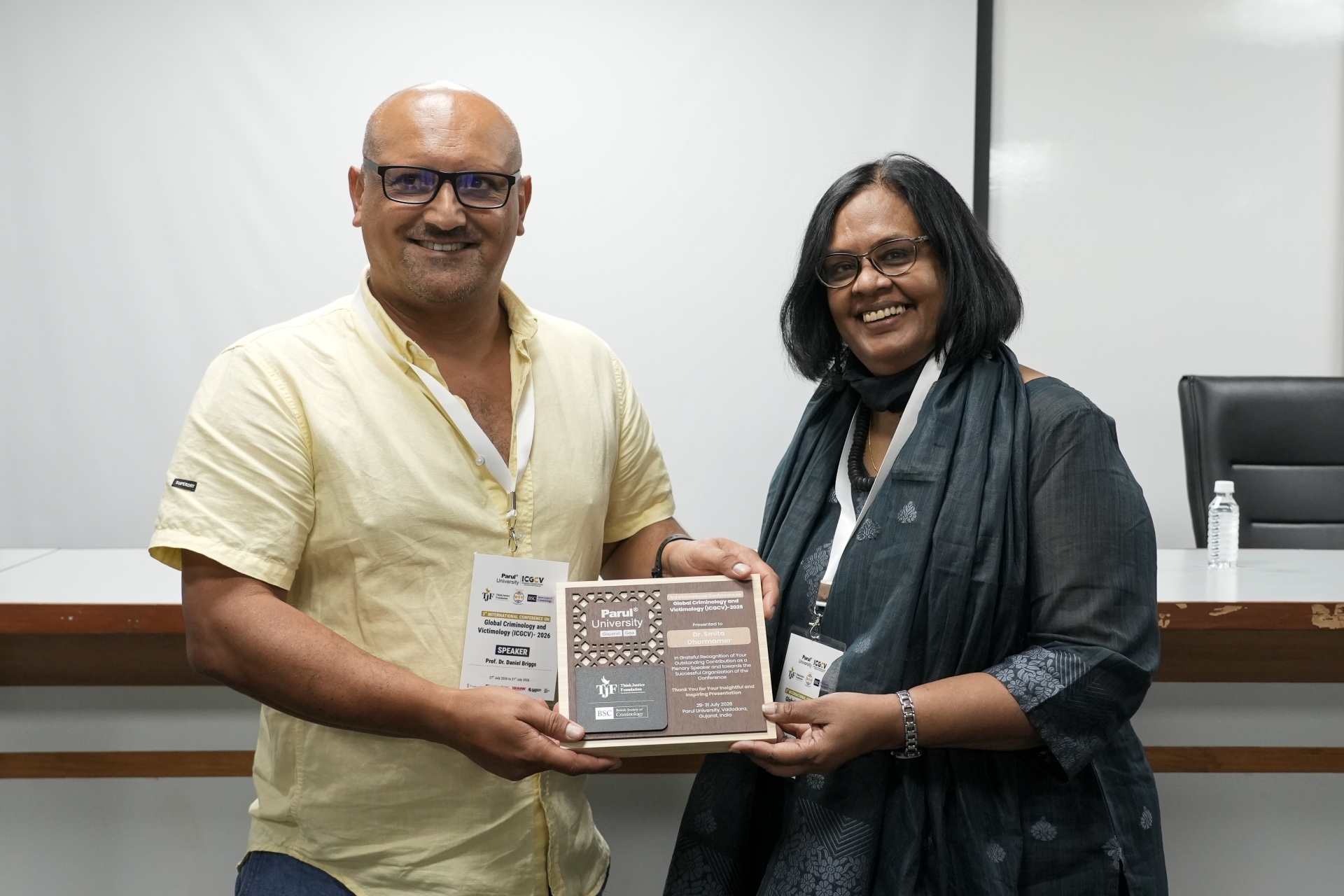
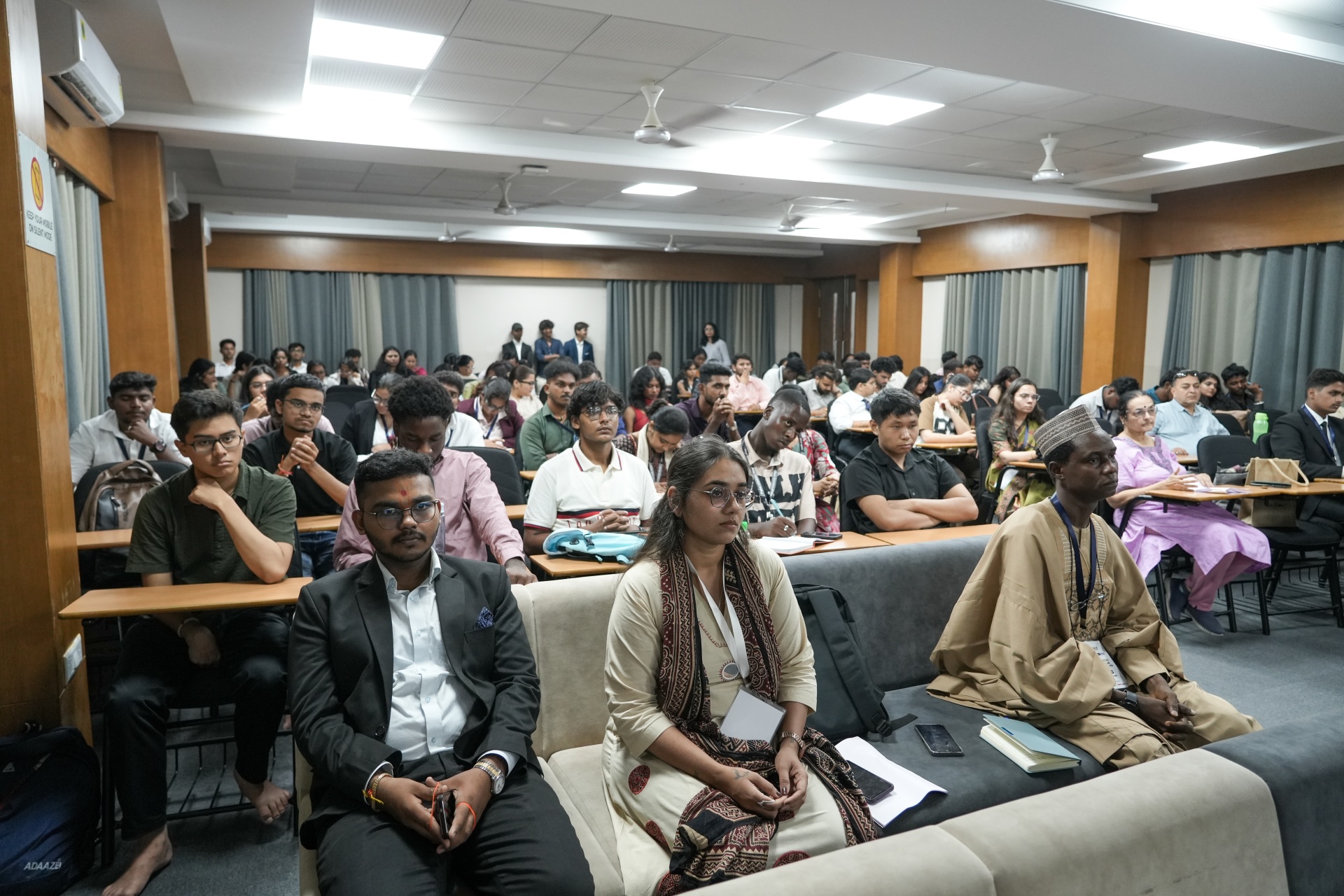
Not all harm is committed by a criminal, and not every victim is created by a crime. That is the premise of zemiology, the study of social harm, which took centre stage in a plenary on structural harm at Parul University’s ICGCV 2026. Here is what it means.
Beyond the Victim-Offender Divide
Dr. Tammy Ayres of the University of Leicester began by questioning one of criminology’s most familiar distinctions: the clean separation of victim from offender. She discussed about how people who have become offenders have faced trauma. They might have faced childhood trauma, poverty, violence, exclusion and structural inequality. Her discussions were mindful. She was vigilant. With atmost care she said that this does not remove individual accountability. In reality it actually paves the attention to structures, systems and institutions.
That repeatedly create conditions of vulnerability. This connects to a wider field, sometimes called zemiology, that looks beyond legally defined crime to examine harms, inadequate healthcare, poor housing, discrimination, educational exclusion, environmental degradation, that may never appear in crime statistics yet cause significant damage.
Structural Harm Hides in Plain Sight
A central idea was that structural harm often remains invisible because it becomes normalised in everyday life. Health inequality, poor housing, racial inequality, intergenerational poverty, and under-resourced institutions may not individually “cause” crime, yet together they create conditions in which harm becomes far more likely. Drawing on green-criminological perspectives and her research in Guyana since 2019, Dr. Ayres showed how a country’s drug economy cannot be understood only through organised crime, but through longer histories of colonial economies, racial division, and uneven development that leave some communities with limited infrastructure and opportunity.
Distributed Victimhood, and Decolonising Criminology
Prisons, Dr. Ayres argued, both concentrate and produce harm. Many people entering prison already carry histories of abuse, trauma, and mental-health difficulty, and some, for example, women imprisoned for drug trafficking, may have been coerced or unaware of what they carried, complicating the victim-offender binary. The harm extends further still, to prison staff exposed to stress and trauma, to families facing hardship and stigma, and to surrounding communities. Victimhood, in this view, becomes distributed across many groups rather than confined to one person. She also called for a decolonising of criminology itself: if research relies only on established Western frameworks, it risks reproducing the very assumptions it questions, and communities should be supported to develop their own, culturally grounded understandings of crime and justice.
Food Inequality as Structural Victimisation
Prof. Dr. Daniel Briggs of Northumbria University brought the idea to an unexpected arena: food. Drawing on research with people experiencing extreme obesity and food insecurity in the United Kingdom, he showed why treating obesity purely as an individual failing misses the point. Many participants had experienced childhood trauma, and compulsive eating was often connected to coping with it, part of a wider pattern in which early trauma underlies later compulsive behaviours. Individual diet-and-exercise interventions, he suggested, rarely address these underlying circumstances, while a wider environment of aggressive advertising, cheap and heavily promoted ultra-processed food, and gaps in healthcare shapes the choices available. In a striking paradox, people facing food insecurity are often surrounded by an environment where ultra-processed food is the most available and affordable option, a structural harm, he argued, not merely a personal one.
Structural Victimisation in India
The conference’s inaugural address had already grounded these ideas in India. Mr. Bezwada Wilson, the Ramon Magsaysay Awardee and Founder of the Safai Karmachari Andolan, reflected on manual scavenging as one of the country’s most enduring forms of structural victimisation, describing, with reference to the influence of Dr. B. R. Ambedkar, how caste-based discrimination denies dignity and justice to entire communities. His call to treat social justice as a research priority, and to develop human-centred solutions to end hazardous labour, embodied the central lesson of these sessions: that victimology must extend beyond narrow legal definitions of crime to include structural violence, social exclusion, and institutional neglect.
Frequently Asked Questions
What is zemiology?
Zemiology is the study of social harm, harm caused to people and communities that may not be defined as a crime in law. It examines injuries produced by structures and conditions such as poverty, inequality, poor housing, inadequate healthcare, and discrimination, arguing that some of society’s deepest harms come not from individual criminals but from the way society is organised.
How can one explain structural harm?
There are certain types of harms to society. They vary by degree and are categorised accordingly. Structural harm is something that damages the systems, structures and institutions of society. This means it seen as inequality, poor housing, exclusion and under-resourced services. Rather than by a single identifiable offender. It might look normal. As it is normalised in routine. We might hear or see it yet it becomes invisible. But still, there are some conditions where vulnerability, addiction, and victimisation become far more likely.
Has someone been victim and an offender both?
Yes, a person can be both. As scholars at ICGCV 2026 session had discussion on this. People who commit a crime or offences, have themselves experienced serious harm. The harm could be childhood trauma, poverty, addiction, inequality and coercion. A person may commit an offence and simultaneously be a victim of wider social harms, which is why criminologists increasingly question the clean separation of “victim” from “offender.”



Addiction as a Social Mirror
Dr. Ayres did not discuss addiction as an isolated “illness” but as a “social mirror” that reflected the broader conditions, deprivation, unemployment, trauma, poor mental health and social exclusion. This poses a difficult question on the social reaction of societies: if addiction is approached mainly as a criminal matter, its health and social aspects are likely to be overlooked, and incarceration itself can worsen the poverty and exclusion that can lead to addiction. When someone is imprisoned for a drug offence should they always be perceived as an offender, or also a victim of structural harm? The issue is not one of excusing the wrong, but comprehending it completely.