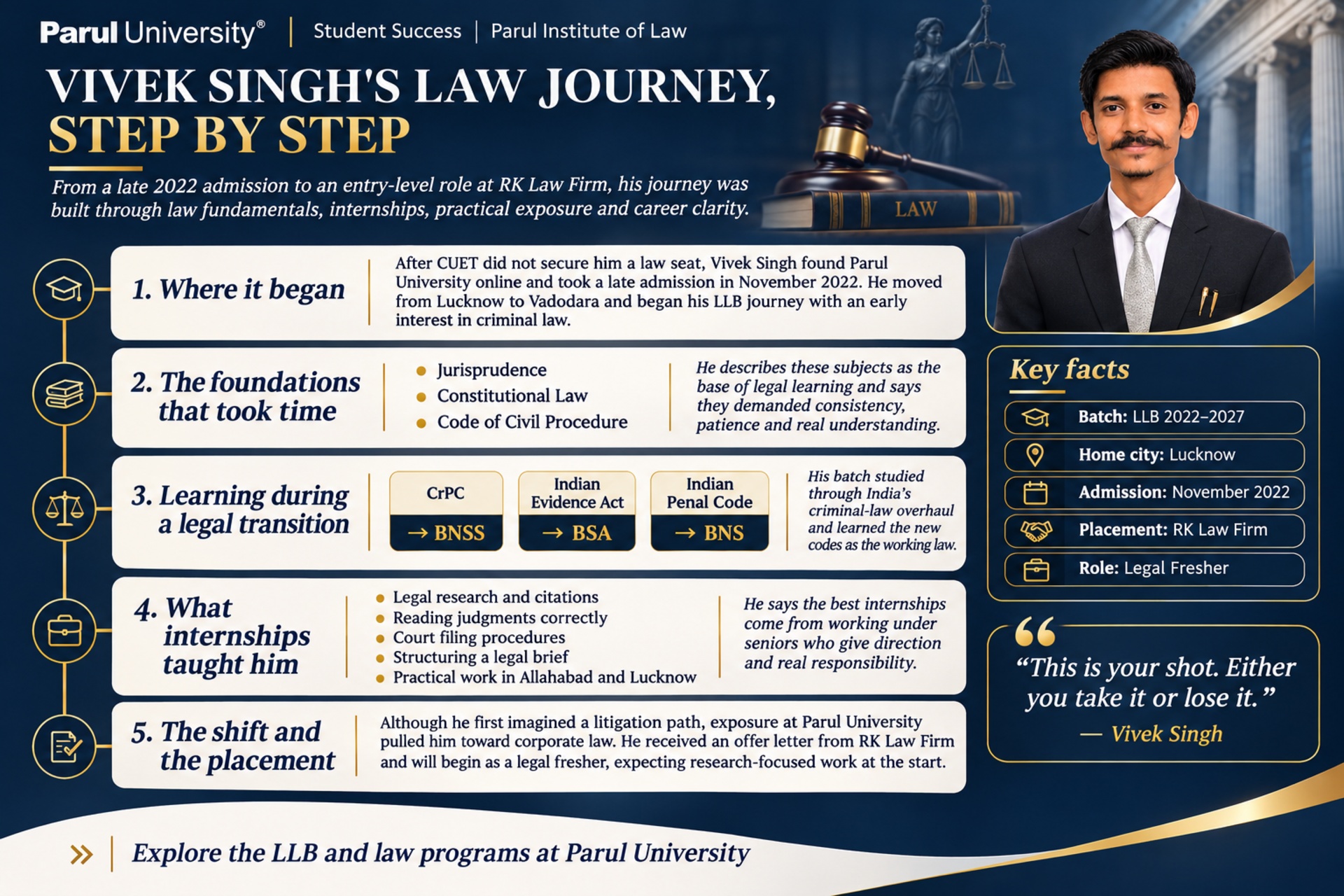
- • Who Vivek Singh is, and the unplanned route that brought him to Parul University.
- • The LLB subjects he found hardest and the criminal-law overhaul he studied through.
- • What his internships taught him, from reading judgments to structuring a legal brief.
- • His shift from litigation to corporate law and his placement as a fresher at RK Law Firm.
Placed at RK Law Firm:
As a legal fresher; offer letter received
Late admission, November 2022:
After CUET did not secure a law seat
Studied through the CrPC to BNSS shift:
India's criminal-law overhaul, mid-degree
Who is Vivek Singh?
Vivek Singh did not plan to be at Parul University. He is from Lucknow; he sat the Common University Entrance Test, and it did not get him a law seat. He found Parul on the internet instead, talked it over with his father, and got an answer that shaped the next five years: the decision was his to make, and if it went wrong, he would carry the consequences himself. He took a late admission in November 2022, came to Vadodara alone, and started an LLB with a pull toward criminal law. Five years later, he is placed as a legal fresher at RK Law Firm in corporate work rather than the litigation he first imagined.
He describes the five years as a rollercoaster, and he does not mean that loosely. There was competition, pressure, and doubt in it, and what he says he learned was less any single subject than how to motivate himself, how to study, and how to keep practical work going alongside the degree. Law, in his telling, is a demanding course that asks for time, patience, and a clear sense of direction, and he is candid that he did not always have all three at once.
The first year and a changing criminal law
The first year was unfamiliar in every direction. The cohort was mixed, with students from across India and from other countries, and that alone made him feel he had chosen well. The subjects were harder to warm to: Constitutional Law, the Code of Civil Procedure, the Code of Criminal Procedure, Criminal Law and the Law of Evidence, all of which took real effort before they made sense.
He also studied through a rare moment in Indian legal history, the overhaul of the country’s criminal laws, and watched the ground shift under two of his own subjects.
| Earlier law | Replaced by |
|---|---|
| Code of Criminal Procedure (CrPC) | Bharatiya Nagarik Suraksha Sanhita (BNSS) |
| Indian Evidence Act | Bharatiya Sakshya Adhiniyam (BSA) |
The same reform also replaced the Indian Penal Code with the Bharatiya Nyaya Sanhita, so Vivek’s batch is among the first to learn the new codes as the working law rather than as an amendment to memorise. He is firm that law rewards consistent attention and punishes the opposite, and he credits the faculty, the dean, and the Training and Placement Cell with giving him the support to keep up, especially in those early years when the subjects were least familiar.
Living away from home!
Vivek came to Vadodara on his own and did not stay in the hostel, though he heard enough hostel stories from friends to feel he missed that side of student life. What he gained instead is, by his own account, the biggest takeaway of the five years: he learned to run his own life. His point is specific and unsentimental. A student who has never been alone does not see what goes into a life that works, the food that arrives, or the bed that is always there, and moving away was how he found out. He believes a law career cannot be built by staying in one place; if you want to learn, you have to be willing to move and to be alone for a while.
The subjects that take the most time
Asked which subjects were hardest, Vivek names jurisprudence, the Code of Civil Procedure, and constitutional law, and then makes a sharper point: these are the base of the whole course. A student who does not understand how courts work, what the different levels are and how drafting is done will struggle later, so these have to be cleared properly rather than scraped through.
Jurisprudence is what he singles out. It is a theory subject thick with authors and schools of thought; it traces how law developed and where it might go, and it is hard to follow at the start. His advice is to give it time, because once it clicks, the rest of the course starts to make sense. It is a measure of how the place worked out for him that he says he would do an LLM at Parul University itself if he gets the chance.
Internships, and learning by doingInternships and!
Vivek completed two to three internships in Allahabad and Lucknow, one of them at a tier-1 litigation firm where he says he learned the most. There he picked up legal research and the tools for it, how citations work, and how to actually read a judgment. The one thing he looks for in an internship is a senior with real knowledge to work under, because law is deep enough that both its theory and its practice need experience, and he thinks a student gains most when practical exposure runs alongside academics.
He is clear-eyed about how internships really work. Seniors do not hold a student’s hand; they give direction and expect the intern to work it out, in a corporate office or a courtroom alike. He went to court for filing procedures, learned to work on files, was briefed on what a judgment said, and was sent to take the order. He also took on real work, bringing two clients to his senior advocate, one with a divorce matter and one with a land matter that is still running, and he earned an incentive for the filing work he did.
The sharpest lesson came from a mistake. Asked to write a brief, he read through the file and made notes, and his senior told him that was not a brief at all. He was shown the actual structure, and he corrected his approach.
| A legal brief, as he was shown to structure it | What it holds |
|---|---|
| List of events | The sequence of what happened in the matter |
| Dates | When each event occurred |
| The prayer | The relief or order being sought from the court |
| The grounds | The legal basis for the claim |
| The judgment | The relevant ruling or decision |
His view on mistakes is plain: they will happen to every intern, and they are only a problem if you stop learning from them. The basics have to be solid, he says, because without them the work becomes slow and hard. Learn from the error, and it is not wasted.
From criminal law to corporate law
Vivek started certain that litigation was the road, with criminal law as his interest and a firm in Delhi among the options he was eyeing. What changed his mind was exposure. At Parul University, he saw how corporate work actually runs, grew curious, and started reading about corporate law in earnest until he understood it was somewhere he could build a career. His reasoning was practical rather than romantic: he has his whole working life ahead of him, the university was putting an opportunity in front of him, and the sensible move was to take it. A point of guidance helped the batch along the way when Ganesh Sir confirmed they were eligible to sit the All India Bar Examination after the ninth semester and walked them through the form
The placement and a fresher's honesty about it
The first interview made him nervous, because he had never sat one. Shambhavi Mishra and Shubhank Khare at the Training and Placement Cell told him not to worry and gave him one piece of advice he kept: be honest, do not lie, and do not mislead, even in a first interview. He answered the panel’s questions, and they told him he had a good personality and that they wanted to hire him. The confirmation came oddly: a message in the group that offer letters were out, a list he checked half-expecting nothing, and his own name on it.
He is unusually straight about what the placement is and is not. He is a fresher. He does not yet hold a licence to appear in court and argue a case, so he expects the firm to use him mainly for research work at first, which suits him, because he knows the research tools and is ready to do it. He admits he may not feel fully satisfied at the start, and his answer to that is patience: to grow strong enough with time that no one can point to a mistake. It is a more honest account of an entry-level legal job than most placement stories offer.
Advice for the future lawyers!
Vivek’s advice to juniors is super clear. Do well across the five years, because they do not come back. Contact the Training and Placement Cell early if a corporate career is the aim, since both litigation chambers and corporate firms come to campus and the cell works to understand what each student actually wants. Do everything on offer, internships above all, but keep the goal in view and line up studies and practical work behind it. He gives internships special weight: there is only practical life ahead, and a student strong in both study and practice is hard to stop.
He is also honest about the fear; the nights before a job came through, when he worried it would not. His point is that the only way past it is through it, and that students who skip placement when it is there are setting up a loss for later. When an opportunity comes; an internship, a moot court, a debate, a sport, just take it up.
This is your shot. Either you take it or lose it.
SOURCE AND CONTEXT. Based on a student interview with Vivek Singh, 2022 to 2027 LLB batch, Parul Institute of Law, Parul University. His placement at RK Law Firm is an entry-level fresher role, confirmed by an offer letter; he states he does not yet hold a licence to appear in court and expects mainly research work at first, and it is described that way here. The criminal-law reforms he studied through are a matter of public record. The closing line in quotation marks is his own; other remarks are reported. His LinkedIn and the Bar Council of India link carry no tracking parameters.
Apply or enquire: admissions.paruluniversity.ac.in
People and organisations
- Vivek Singh Final-year LLB student (2022 to 2027), Parul Institute of Law; placed as a fresher at RK Law Firm
- Parul Institute of Law, Parul University His institute; host
- RK Law Firm His placement; entry-level fresher role
- Shambhavi Mishra Placement Coordinator, Training and Placement Cell, Parul Institute of Law
- Shubhank Khare Training and Placement Cell, Parul Institute of Law
- Ayush Mudgal, Parth Makwana and Mahima Sajani Jacob Faculty he credits at Parul Institute of Law
- Priya Nair Faculty; guided his dissertation research
- Bar Council of India Conducts the All India Bar Examination; statutory body for legal practice