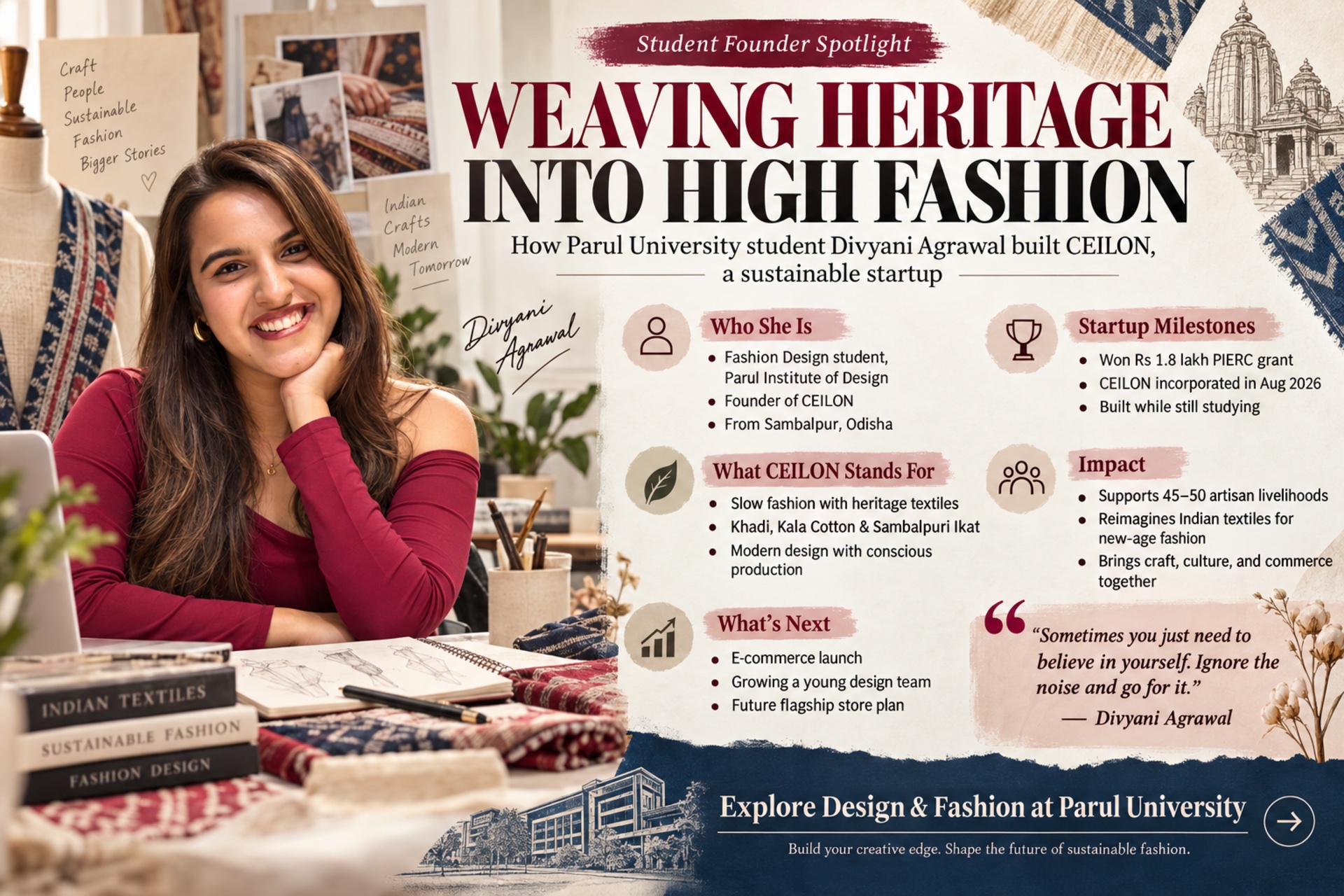
Divyani Agrawal blends creative vision with sharp business sense. A fashion-design student at the Parul Institute of Design, now in her seventh semester, she recently secured an Rs 1.8 lakh startup grant from PIERC, the capital to turn her classroom sketches into a real, working company. From Sambalpur, Odisha, a region famous for its textile heritage, and born into a business family, she brings both an early feel for trade and a designer’s eye to her venture.
Finding the Right Fit
Divyani’s path was not a straight line. She transferred to Parul University in her second year and fell for the exposure it offered, especially its industry contacts. One moment sealed the decision: during a campus fashion event, the actress Sanjana Sanghi (known for “Dil Bechara”) visited, and Divyani was assigned to accompany her through the day. Divyani was then showing a collection built around the theme of warding off the evil eye, and Sanghi admired the intricate garments so much that she took some of the designs with her. Seeing a well-known figure appreciate and wear her work was, Divyani says, an extraordinary validation of what the university’s platform could offer.
An Elite Internship, and a Philosophy
Real-world experience shaped Divyani’s outlook. She earned a highly competitive internship at Pero, the acclaimed craft-led label, in Delhi, a notable achievement given how rarely such brands take students from private universities. Of roughly 60 interns during her stint, she noted, the large majority came from NIFT and NID, with only a handful from private institutions. The brand’s deep roots in artisanal craftsmanship, taking ancient, local Indian techniques and translating them into a global language, resonated with her and became the foundation of her own label. She also attended Lakme Fashion Week in Mumbai, seeing commercial fashion at its largest scale.
The Birth of CEILON
The idea for her brand had been forming for a long time; she spent months untangling funding and logistics before CEILON was formally incorporated in August 2026. Its ideology mirrors what she absorbed in Delhi: take India’s heritage textiles and ancient crafts and elevate them into a modern, international language, making these fabrics far more visible to a global market. What sets it apart is a grassroots, ethical production model. The process starts from the very beginning, spinning the raw yarn, then weaving the fabric from it, a deeply hands-on approach that, she says, provides direct employment to 45 to 50 people. “This proves the brand is not just about selling pretty clothes,” as she frames it; it is about sustaining livelihoods. Her creative inspiration comes straight from home: Sambalpur is globally known for Sambalpuri Ikat, a hand-spun, hand-woven, tie-dye technique she grew up watching slow fashion in practice.
A Slow-Fashion Mission
Divyani holds a strong view on the divide between fast and slow fashion. The mass production of low-quality clothing, she argues, carries a high environmental cost, and she has chosen the harder, opposite path: making fewer, better garments for the conscious consumer. Her primary material is Khadi, which currently makes up about 70 percent of her line, alongside Kala cotton. She is also part of a wider moment: Khadi and India’s heritage textiles have received growing policy and institutional support, and at Parul University, the backing is strong. Design Director Prof. Bhaskar Mitra has a keen personal interest in Khadi and has presented collections built around it. Divyani’s aim is to redefine the fabric for a new generation: to break the “dull and old” stereotype and make Khadi classy, affordable, and genuinely wearable for Gen Z and millennials alike.
The Rigorous Path to PIERC Funding
Securing capital is the hardest part of any launch, and Divyani took a structured route through PIERC. The process was demanding: after probing pitch discussions in Phase One and a further shortlisting in Phase Two, surviving candidates completed “Cohort 10,” a rigorous ten-day PIERC training program, followed by one-on-one interviews and a jury evaluation. The numbers show how selective it was: from an initial pool of 120 to 140, only about 24 remained by the final day, and ultimately just eight or nine received funding, a selection rate of roughly nine percent. Guided by her mentors, Prof. Nakul Patel at PID and Sonal Sudani at PIERC, Divyani said, “I could not have grown this easily or quickly on my own.”
Balancing a Business and a Degree
Running a growing company while attending daily classes is relentless, especially in the seventh semester. Divyani found a smart way through it: her final graduation project, one of the most important parts of a fashion student’s journey, is built directly around her own brand, so her academic and business work advance together. She has begun selling through a physical rack at a nearby multi-designer store and is exploring e-commerce, all while managing the paperwork and logistics largely on her own. It is, she admits candidly, still a tough balance, but a supportive group of peers and mentors keeps it moving.
The Future Story!
Divyani has mapped an ambitious two-year plan. Her immediate goal is to launch CEILON’s e-commerce website and put her full collection online, and she is already building a small team (three to four interns, from NIFT, Parul University, and elsewhere). Further out, she plans a flagship store, likely in Ahmedabad, and intends to grow beyond a Khadi-only identity into diverse collections featuring heritage textiles from across India. To see how she’s growing her career, you can even follow CEILON on Instagram. Inspired already? Delay not and explore Parul University’s B.Des. in Fashion Design & Technology, M.Des. in Fashion Merchandising, and Diploma in Fashion Design & Technology to build your creative edge and shape the future of sustainable fashion.
Sometimes you just need to believe in yourself. People will constantly say you are not ready. Ignore the noise and go for it; time will tell you if you were ready.
– Divyani Agrawal
FAQs
Who is Divyani Agrawal?
Divyani Agrawal is a fashion-design student at the Parul Institute of Design, Parul University, and the founder of CEILON, a sustainable fashion brand built around India’s heritage textiles such as Khadi, Kala cotton, and Sambalpuri Ikat. From Sambalpur, Odisha, she won an Rs 1.8 lakh startup grant from PIERC to build her brand.
What is CEILON?
CEILON is a sustainable, slow-fashion brand founded by Parul University student Divyani Agrawal and incorporated in August 2026. It takes India’s heritage textiles and crafts, spun and woven from raw yarn upward, and reimagines them for a modern, global audience, providing direct employment to 45 to 50 artisans in the process.
How did she fund her fashion startup?
Through an Rs 1.8 lakh grant from PIERC, Parul University’s incubation center, won via a rigorous selection process (a ten-day “Cohort 10” training program, interviews, and a jury) in which only about eight or nine of an initial 120-to-140 applicants received funding. She was guided by dedicated mentors at PID and PIERC.