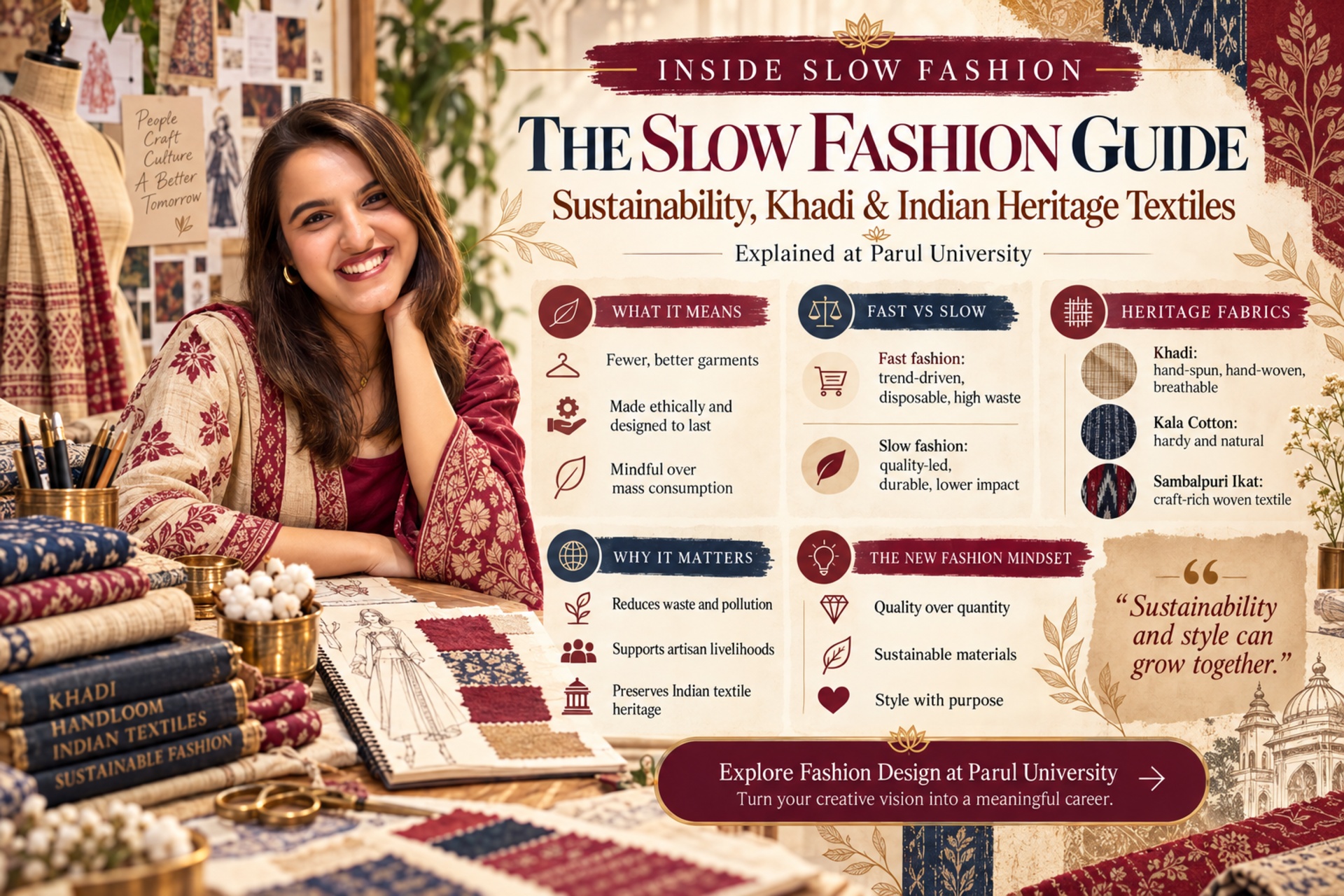
A young designer at Parul University built her entire brand around a single conviction: that the world does not need more disposable clothes; it needs better ones. That conviction has a name: slow fashion, and it is reshaping how thoughtful people think about what they wear.
Fast Fashion vs Slow Fashion
If you’re learning about slow fashion, then begin with its polar opposite. Fast fashion is the term given to the mass production of trendy, low-cost garments in a hurry, intended to be purchased as cost-effective options. The only problem with its convenience is that it’s also one of the biggest contributors to pollution and waste in the world, and a large amount of barely used clothes are ending up in landfills, where synthetic fabrics can take decades to decompose. Slow fashion is the conscious approach, the one that focuses on quality, ethics, and longevity rather than speed and quantity; it’s the conscious approach that aligns with sustainable fashion and is the approach that we seek in the design of our garments.
Slow Fashion = Sustainable Planet!
Slow fashion is defined by a few core principles. Let’s understand each
- Quality over quantity, making fewer, better garments designed to last, not to be thrown away next season.
- Ethical, local production, involving skilled artisans and fair labour rather than anonymous mass factories.
- Sustainable materials, favouring natural, eco-friendly fabrics over low-quality synthetics.
- Mindful consumption, encouraging people to buy consciously and value what they own.
In short, slow fashion asks a simple question of every garment: Was this made well, made fairly, and made to last?
Khadi, the Power of Heritage Textiles
India is blessed with a rich tradition of slow fashion, and few fabrics are as symbolic of this tradition as Khadi fabric. Made by hand, breathable, and comfortable, this natural fabric with its hand-spinning and hand-weaving handicrafts has deep connections with Indian history and has the potential of supporting the livelihoods of the artisans. But it’s not the only such treasure: Kala cotton (a hardy, rain-fed, organic cotton) and Sambalpuri Ikat (a traditional hand-woven tie-dye style from Odisha) are just a few of the heritage textiles that have cultural significance and are true to the word sustainable.
These fabrics are slow fashion fabrics by definition, given that they are created by hand, locally made, and slow to produce.
Redefining Heritage for a New Generation
Perception is one of the issues with heritage fabrics. Talk about Khadi, and most people still think of something that is simple and traditional. A new generation of designers is transforming this, creating an elegant, budget-friendly, and quite frankly, desirable collection of textiles that Gen Z and millennials are looking to incorporate into their wardrobe. The point is that sustainability and style are not mutually exclusive. Heritage fabrics may be modern, comfortable, and desirable, but clothes are what you want to live in, not clothes that you want to look at; it’s a different perspective altogether. The reinvention is what keeps a craft alive and relevant, and it’s a place for young, creative designers to lead.
Slow Fashion Matters!
Slow over fast fashion is a small decision with a big impact. It cuts down on the waste and pollution that contribute to the climate crisis; it helps the artisans and communities who continue to sustain the traditional crafts and techniques, and it maintains cultural heritage that would otherwise disappear.
To the wearer, it represents owning less, better, and longer-lasting items. It’s one of the most enriching ways in which the field of design can serve a purpose that is good and beautiful. Slow fashion is slowly making itself known as the future of fashion, an approach that’s gaining traction as more consumers and creators are turning to it. Got the fashion vision? Build the skills to back it by exploring Parul University’s B.Design in Fashion Design and Technology, M.Design in Fashion Merchandising, and Diploma in Fashion Design & Technology.
FAQs
What is slow fashion?
Slow fashion is a mindset for clothes that focuses on the quality, ethical and sustainable methods of clothing, over the fast pace and quantity of fast fashion. It has a preference for fewer, but better, garments that can last; for relatively more ethical production that is sometimes local; for skilled artisans; for sustainable materials; and for mindful consumption.
What is Khadi, and why is it sustainable?
Khadi is a hand-spun, hand-woven natural fabric that has its roots in the rich Indian history. It is sustainable, as it is a craft requiring very little machinery and is mainly made manually, using natural fibers, and relies on artisans for their livelihood. It is comfortable and breathable and is now being redeveloped as modern and fashionable apparel.
What is the meaning of slow fashion, and how is it different from fast fashion?
Fast fashion is mass production designed for fast, low-quality, trendy garments at the high expense of the environment and social conditions. The opposite of slow fashion is fast fashion: more products of lower quality, produced unethically and unsustainably, often from mass-produced fabrics, and designed to be discarded. One focuses on speed and quantity; the other focuses on quality, ethics, and longevity.