Most startup stories stop at the launch. But for the student founders of Crunchy Wavez at Parul University, the real test began after it. Having built a healthier, sun-dried snack and taken it to market (the full origin story is here), Devanshi Bhatt and Parth Parekh faced the questions every founder eventually must: how do you fund it, sell it, and make people buy it again? This is that part of the story.
Climbing the Funding Ladder
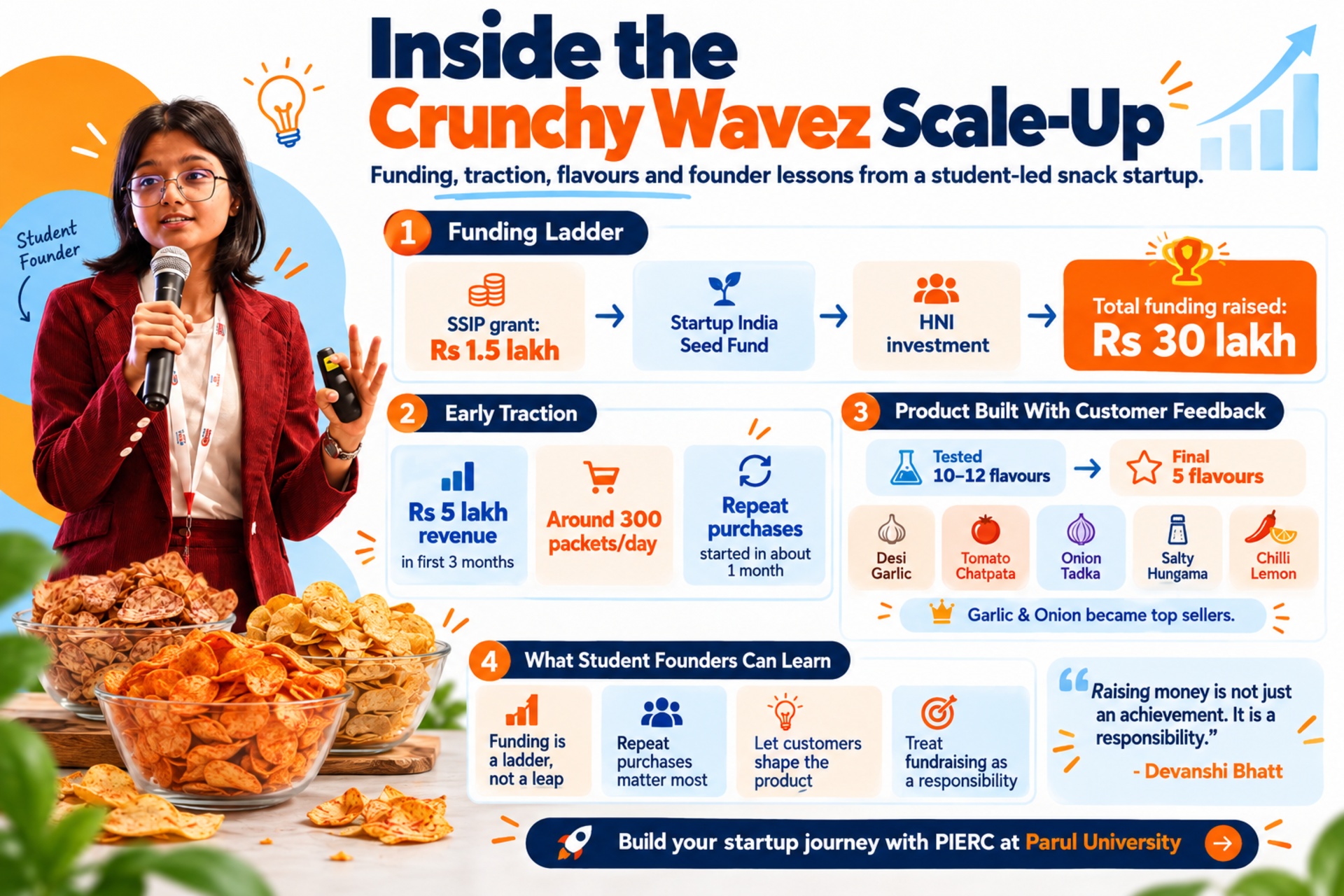
Crunchy Wavez has raised around Rs 30 lakh, and it did so the way most successful student startups do, one rung at a time, up a clear startup-funding ladder. The first external money was a Rs 1.5 lakh grant under the SSIP (Student Startup and Innovation Policy), used for initial product development. Next came support through the Startup India Seed Fund Scheme, which helped with raw-material procurement and supply-chain development. Later still came private capital, in the form of High Net-Worth Individual (HNI) investment. Each stage did a different job, and together they moved the company from an idea with potential to a funded, operating business.
For Devanshi, though, the most important lesson of fundraising was not the amount but the mindset. Raising money, she says, is a responsibility, not a trophy. It meant pitching the business again and again, refining the proposal, presenting real numbers, and explaining the plan clearly, and, she noticed, investors were weighing not just the opportunity but the energy and potential of a student founding team.
Raising money is not just an achievement. It is a responsibility, someone is trusting you with their money, time and effort.
– Devanshi Bhatt, co-founder, Crunchy Wavez
Turning a Launch Into Real Sales
Funding buys you a chance; sales prove you deserve it. After launch, the founders focused on the two questions that decide a snack brand’s fate: will a shop stock it, and will a customer buy it twice? On both counts, the early signs were strong. Crunchy Wavez now averages around 300 packets sold per day, generated roughly Rs 5 lakh in revenue in its first three months of commercial operations, and, crucially for a food product, began seeing repeat purchases after about a month, sold through the university, supermarkets, and nearby stores. Repeat buying matters more than any single sale, because it means customers tried the product and came back, the clearest signal that taste, price, and quality are working together.
A Product Shaped by Its Customers
One reason those repeat purchases came is that the founders let customers design the product. The founders thought of testing the product. The flavours were put out for customers. Some ten to twelve experimental flavours were launched on an experimental basis. The flavours were narrowed to five: Desi Garlic, Tomato Chatpata, Onion Tadka, Salty Hungama, and Chilli Lemon (with garlic and onion emerging as the strongest sellers). Apart from flavour, textures were also tested. First lot of chips were too thick, so the tea, made thinner chips. And a suggestion to mix chilli with lemon became a flavour.
Rather than defend their assumptions, the founders treated every comment as data, a discipline that helped them build a product people actually wanted, and one closely tied to their mission of keeping healthier snacking affordable.
The Founder Behind the Numbers
Behind the milestones is a founder who grew alongside her company. Devanshi’s path began before Parul University, with a diploma in Food Technology and six months working in the snack-manufacturing industry, experience that taught her how food is really made and convinced her to build her own venture. That grounding in food technology is what let her see a solvable problem in an everyday product. She is also honest about the cost: building a company while studying full-time meant real sacrifices, a smaller social circle, and stretches of loneliness, carried through with the guidance of her Head of Department, Dr. Vijay Kale, and the steady encouragement of PIERC. Perhaps her clearest growth is in how she defines success: at first she wanted recognition; now she measures it by impact, and by the original purpose that started it all, making a healthier choice affordable for ordinary households.
What It Teaches Other Student Founders
The Crunchy Wavez growth story carries a few lessons any aspiring founder can use:
- Funding is a ladder, not a leap, start with grants (like SSIP and the Startup India Seed Fund), then build toward private investment as you show traction.
- Repeat purchases beat first purchases, getting a customer to come back is the real proof your product works.
- Let customers shape the product, the best version is rarely your first assumption.
- Treat fundraising as a responsibility, and back it with honesty and real numbers.
- An incubator changes the odds, mentorship, funding support, and a network can turn a student idea into a company.
It is proof that with the right idea, the right support, and the willingness to keep going, a student can build not just a product, but a business.
Frequently Asked Questions
How much funding has Crunchy Wavez raised?
Crunchy Wavez has raised around Rs 30 lakh in total, through an SSIP (Student Startup and Innovation Policy) grant, the Startup India Seed Fund Scheme, and High Net-Worth Individual (HNI) investment. Alongside this, it reported roughly Rs 5 lakh in revenue in its first three months and averages around 300 packets sold per day.
How did a student startup get funded?
By climbing a funding ladder with the support of Parul University’s PIERC incubation centre: starting with a Rs 1.5 lakh SSIP grant for product development, then the Startup India Seed Fund Scheme for raw materials and supply chain, and later private (HNI) investment as the business showed traction. Fundraising involved repeated pitching, clear numbers, and transparency with investors.
What are the flavours of Crunchy Wavez?
As the brand offers snacks, a wide variety of flavours are available. Crunchy Wavez has desi garlic, tomato chatpata, onion tadka, salty hungama and chilli lemon. The range was narrowed from an initial ten to twelve experimental flavours based on customer feedback, with garlic and onion emerging as the strongest sellers.