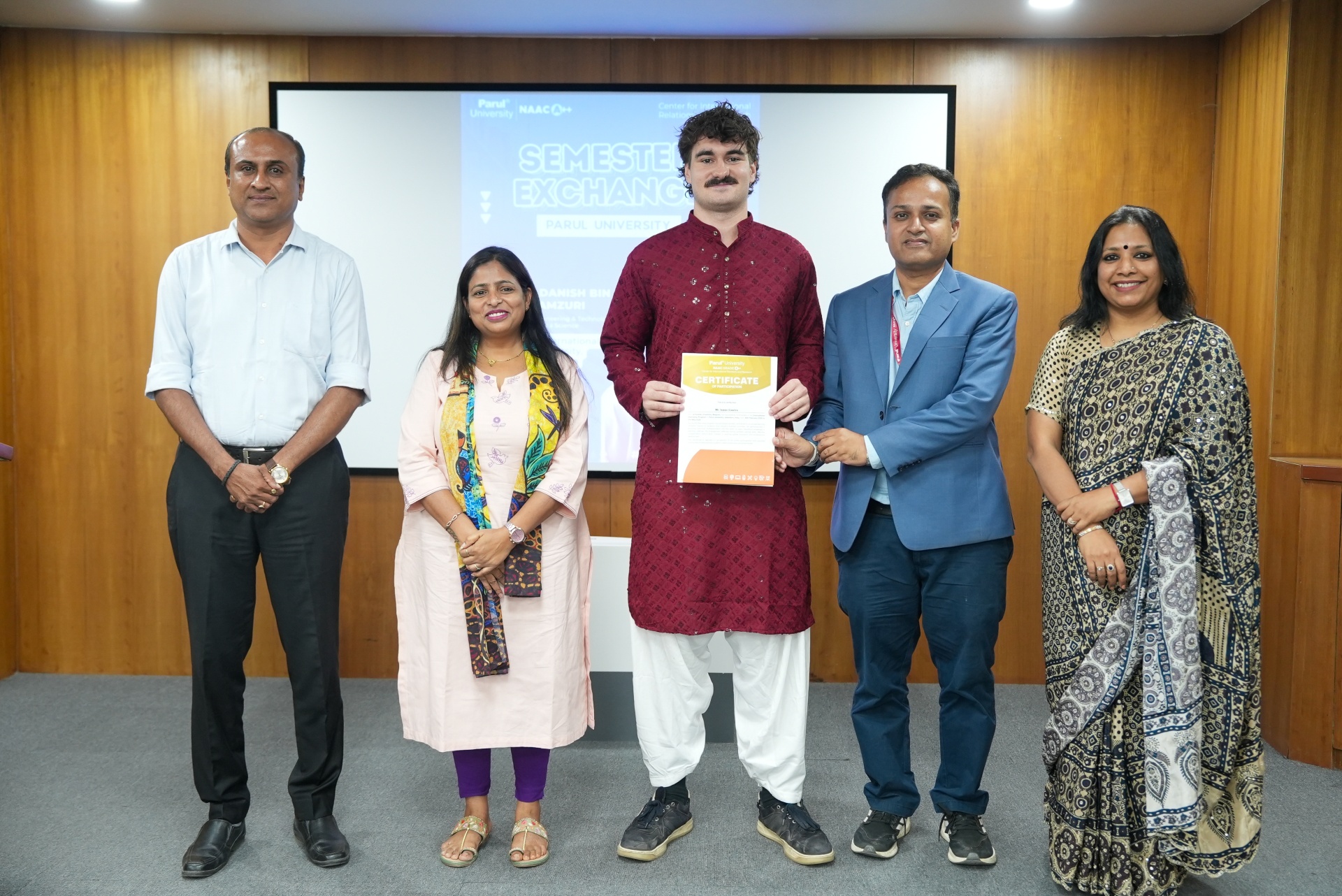
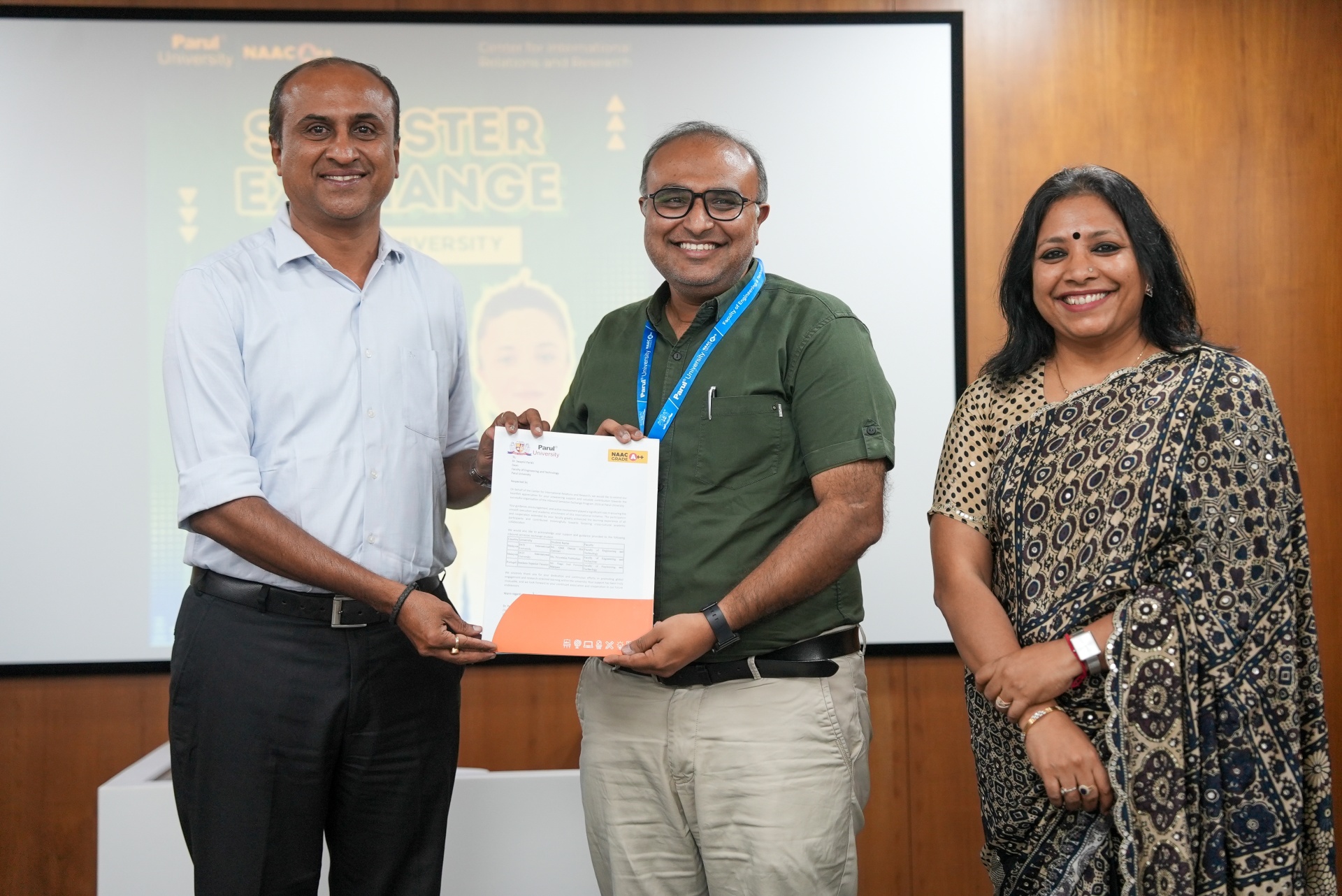
The test of an exchange programme is not what students saw. It is what they made. In 2026, one made a catalyst for cleaning heavy metals out of water. The Chemical Engineering student from Portugal researched environmental catalysis, developing a single-atom catalyst made from cow dung for the adsorption of cadmium, and the Belgian student worked on daily social-impact documentation through a Social Responsive Cell, visiting street schools under the Apni Pathshala initiative with the Saksham Tattvam Foundation. The CIRR has designed the programme in such a way that, apart from understanding the culture, students also grow academically through research and internship projects.
Environmental catalysis research: cadmium adsorption a catalyst derived from cow dung.
A Chemical Engineering student, Tiago Joel Ferreira Marques from Instituto Superior Tecnico in Portugal, came to Parul University under the exchange program and, during the term, conducted research on environmental catalysis to address environmental challenges.
His research project concerned the development of a single-atom catalyst derived from cow dung for the adsorption of cadmium. The project worked at the intersection of two significant areas of environmental chemical engineering. Cadmium adsorption was the main focus of the research. Cadmium is a toxic heavy metal that pollutes water bodies through industrial discharge, and the challenge lies in removing it from contaminated water. Single-atom catalysis has emerged as one of the most effective approaches in modern catalysis research. Deriving the catalyst from cow dung, an abundant and low-cost biomass feedstock in India, positioned the work as both scientifically and economically relevant for pollution treatment in resource-constrained settings. The research was conducted at the Department of Chemical Engineering within the Faculty of Engineering and Technology.
The technical and practical skills Tiago developed across the research term spanned the full methodology of the field:
- Catalyst preparation methods: The synthesis routes for producing the biomass-derived single-atom catalyst.
- Heavy metal adsorption processes: The mechanisms by which the catalyst captures cadmium from contaminated water.
- Laboratory equipment handling: Including, by his own account, novel equipment not available at his home university in Portugal.
- Research documentation: The discipline of recording, analysing, and writing up experimental results to publication standard.
- Environmental sustainability framing: Positioning the technical work within the broader context of cost-effective pollution treatment.
The output was concrete. Faculty coordinator Alok Tiwari confirmed that Tiago presented two research papers in the department during his term, with one research article completed for submission within days of the Farewell Ceremony and a second experimental research project successfully concluded. For a four-month exchange term, producing two research papers and a completed experimental project represents substantive research output, the kind that demonstrates the research depth available to international students at Parul University and that connects to the university’s broader research and innovation infrastructure, including PIERC.
He presented two research papers in our department. One research article is already completed and will be submitted within a few days, while another experimental research project has also been completed successfully.
Alok Tiwari, Assistant Professor and Chemical Engineering Faculty Coordinator, on the Portuguese exchange student’s research output
Also Read: Startups incubated at the PIERC at Parul University.
The host faculty perspective: from hesitation to genuine attachment
The research relationship was not one-directional. The host faculty coordinator’s account traces an honest arc from institutional reluctance to genuine professional respect.
Alok Tiwari, the Chemical Engineering faculty coordinator, was candid that he had initially been hesitant about hosting an international student, anticipating that the process would involve many meetings and additional responsibilities. Initial curriculum-mapping challenges were resolved within three days with support from the CIRR team. Once the student joined the department, frequent interaction built a strong working rapport. By the end of the term, Tiwari described the qualities he most admired: punctuality, discipline, and the listening skills of a student who always arrived with questions and curiosity, which he identified as the best posture for learning.
Department Head Dr. Hariharan T, who hosted the student in the Chemical Engineering Department, described him as gentle, respectful, sincere, and highly active in laboratory research work, completing every assignment with dedication and punctuality. The arc from administrative hesitation to a coordinator stating he would genuinely miss the departing student is among the more honest endorsements of the programme’s value.
Also Read: A Russian Student getting exposure of Modern Public Health and Ayurveda.
Social-impact internship: street schools and the Saksham Tattvam Foundation
Where the Portuguese student’s contribution was scientific, the Belgian student’s was social. Isaac Castro, a Business Development student from Belgium, spent his three-month term working on social-impact projects through the Social Responsive Cell under Director Dr. Vinod Parmar. His work connected to the Saksham Tattvam Foundation and the Apni Pathshala initiative, which operates street schools for underprivileged children.
Dr. Vinod Parmar’s account of the internship was specific and laudatory. Isaac visited several social development projects, including the street schools under Apni Pathshala. His daily discipline was notable: he reached the office at 9:00 AM every day without lateness, prepared daily reports, and submitted them to the supervising faculty. Despite language barriers in interacting with the school children, he communicated through emotion and genuine effort. The detail that stood out in Dr. Parmar’s account was the cross-disciplinary commitment: although Isaac was a Business Development student with no formal social-work background, he showed deep interest in the social development activities, and the hope expressed was that he would continue this work in his own country.
- Daily documentation: Isaac prepared and submitted daily reports on his social-impact work, building report-writing and organisational-communication skills.
- Field engagement: Direct work at street schools under the Apni Pathshala initiative, engaging with underprivileged children despite language barriers.
- Cross-disciplinary application: A Business Development student applying himself to social-work activities outside his core discipline.
- CIRR coordination role: Isaac also worked within the internship department on CIRR semester exchange interviews, scheduling, and documentation processes, gaining intercultural coordination experience.
Despite language barriers while interacting with school children, he communicated beautifully through emotions and genuine effort.
Dr. Vinod Parmar, Director, Social Responsive Cell, on the Belgian intern’s social-impact work
Why these outcomes matter for prospective international students
The two outcomes together establish something a brochure cannot: that an international term at Parul University produces real work across both scientific and social domains.
For a prospective Chemical Engineering student weighing an exchange in India, the evidence is that a peer produced two research papers and a completed experimental project on a genuine environmental problem within four months, with access to laboratory equipment unavailable at their home institution. For a prospective business or social-science student, the evidence is that a peer applied their discipline to social-impact work that extended beyond their core curriculum, gaining field experience and report-writing discipline.
Both outcomes reflect a programme designed around applied learning rather than passive observation, supported by faculty who engaged substantively with their international students. The breadth, from single-atom catalysis to street-school social work, demonstrates that the programme accommodates the full range of academic interests that international students bring.
The research and applied-learning environment in context
The results that the 2026 cohort presented reflected a broader research and applied-learning environment at Parul University. The university has research infrastructure that supports extensive projects. The infrastructure is fully equipped and supports funded research projects. The university also promotes innovation through PIERC, an ecosystem that has incubated more than 240 startups.
International students gain access to laboratory facilities, mentorship, and applied project opportunities. The documented cases from the 2026 cohort produced publication-track research and substantive social-impact work within single exchange terms. The applied-learning orientation connects to the university’s broader engagement with national programmes, including its role as an AICTE Nodal Center for the PM SHRI Regional Mentoring Session, positioning international exchange research within a wider institutional commitment to applied innovation.
FAQs
What research did international students conduct at Parul University in 2026?
The research conducted by the exchange students was on environmental catalysis done by a chemical engineering student from Portugal. Tiago Marques, who developed a single-atom catalyst derived from the adsorption of cadmium. Cadmium is a toxic heavy metal that pollutes the water. During his four-month term he presented two research papers in the Chemical Engineering department, with one research article completed for submission and a second experimental research project successfully concluded, working under faculty coordinator Alok Tiwari and department head Dr. Hariharan T.
What is the cow-dung catalyst for cadmium adsorption research about?
Cow dung catalyst research conducted by a chemical student from Portugal, Tiago Marques. He is an exchange student at Parul University. During his term he conducted the research. It is for cadmium adsorption from water. Cadmium is a toxic heavy metal that pollutes the water. It is a single-atom catalysis is among the most active frontiers in modern catalysis research. The reason of using cow dung is that it is an abundant, low-cost biomass feedstock in India, making the work both scientific and economic. The research developed skills in catalyst preparation, heavy-metal adsorption processes, laboratory equipment handling, and research documentation, and produced two research papers during the four-month term.
What kind of internships do international students do at Parul University?
International students at Parul University undertake internships across diverse domains depending on their discipline. In the 2026 cohort, a Belgian Business Development student worked on social-impact projects through the Social Responsive Cell, visiting street schools under the Apni Pathshala initiative with the Saksham Tattvam Foundation, preparing daily reports and engaging with underprivileged children. He also worked within the internship department on CIRR semester exchange interviews, scheduling, and documentation processes. Other students undertook research internships, including the Portuguese Chemical Engineering student's environmental catalysis research. The internships are structured around applied work with measurable output rather than passive observation, supported by faculty coordinators and department heads across the university's faculties.
What is the Apni Pathshala and Saksham Tattvam Foundation work that international students join?
Apni Pathshala is a street school initiative for underprivileged children that Parul University's Social Responsive Cell supports, working with the Saksham Tattvam Foundation. In the 2026 international cohort, a Belgian Business Development student joined this social-impact work under the Social Responsive Cell's Director Dr. Vinod Parmar. He visited the street schools, engaged with the children despite language barriers through emotion and genuine effort, and prepared daily documentation of the work. The engagement demonstrates how the CIRR programme connects international students to the university's social responsibility initiatives, allowing students from disciplines like business to apply themselves to social-development work outside their core curriculum and gain field experience in community engagement.
How much research output can an international student produce during an exchange at Parul University?
The documented evidence from the 2026 cohort indicates substantial research output is achievable within a single exchange term. A Portuguese Chemical Engineering student presented two research papers during his four-month term at Parul University, with one research article completed for submission and a second experimental research project successfully concluded. The output was enabled by access to laboratory facilities, including equipment not available at his home university, and by dedicated faculty research mentorship. For prospective international students, this demonstrates that the programme supports publication-track research within exchange terms, reflecting the broader research infrastructure and applied-learning environment available at the university across its faculties and innovation ecosystem.
What support do international research students receive from Parul University faculty?
International research students at Parul University receive substantive support from faculty coordinators and department heads. In the 2026 cohort, the Portuguese Chemical Engineering student worked under faculty coordinator Alok Tiwari and Department Head Dr. Hariharan T, who described him as gentle, respectful, sincere, and highly active in laboratory research. The coordinator, who admitted initial hesitation about hosting an international student, resolved curriculum-mapping challenges within three days with CIRR support and built a strong working rapport over the term. The faculty engagement extended to research methodology guidance, laboratory access, and research-paper preparation support, with the coordinator stating by term's end that he would genuinely miss the departing student, citing his punctuality, discipline, and curiosity.


