The word most people associate with a summer school in India is “holiday”. A fortnight abroad, some sightseeing, a certificate at the end. That expectation undersells what a well-run program actually asks of a student, and it is worth correcting, because the academic content is the part prospective participants ask about least and benefit from most.
On Parul University’s Indian Summer School Program, the July 2026 cohort moved through four distinct academic areas in two weeks. Not one subject studied at leisure, but a deliberately broad sweep designed to give students something their home universities usually do not: exposure across faculties, rather than depth in a single one.
This companion piece sets out what that academic program actually covered, drawing on the accounts of students who sat through it. It is the detail the hub page summarises, and this article expands.
Read more about – A Designer’s-Eye View Through Parul University’s Indian Summer School
Why Is This Summer School in India Built Across Multiple Faculties?
The structural choice that defines the academic experience is breadth. In most of the systems these students came from, a degree means studying one subject and largely ignoring the rest. Several of the visiting students remarked on how different Parul University felt, offering multiple courses at once rather than a single track.
For a two-week program, that breadth is the point rather than a compromise. A student is not there to complete a module in their existing subject; they are there to see how several disciplines think, and to sit in rooms they would never enter at home. A computer science student ends up in an architecture session; an education student ends up discussing management. The value is in the range.
The 2026 cohort’s academic program spanned four areas, each contributing something the others could not. A student leaves not with one subject studied in isolation, but with a sense of how four different disciplines frame and solve problems, which is a more portable kind of learning than a single module would have produced.
Read more about – Study in India at Parul University – A Global Learning Experience for International Students
Faculty of Management Studies: Real Business Problems
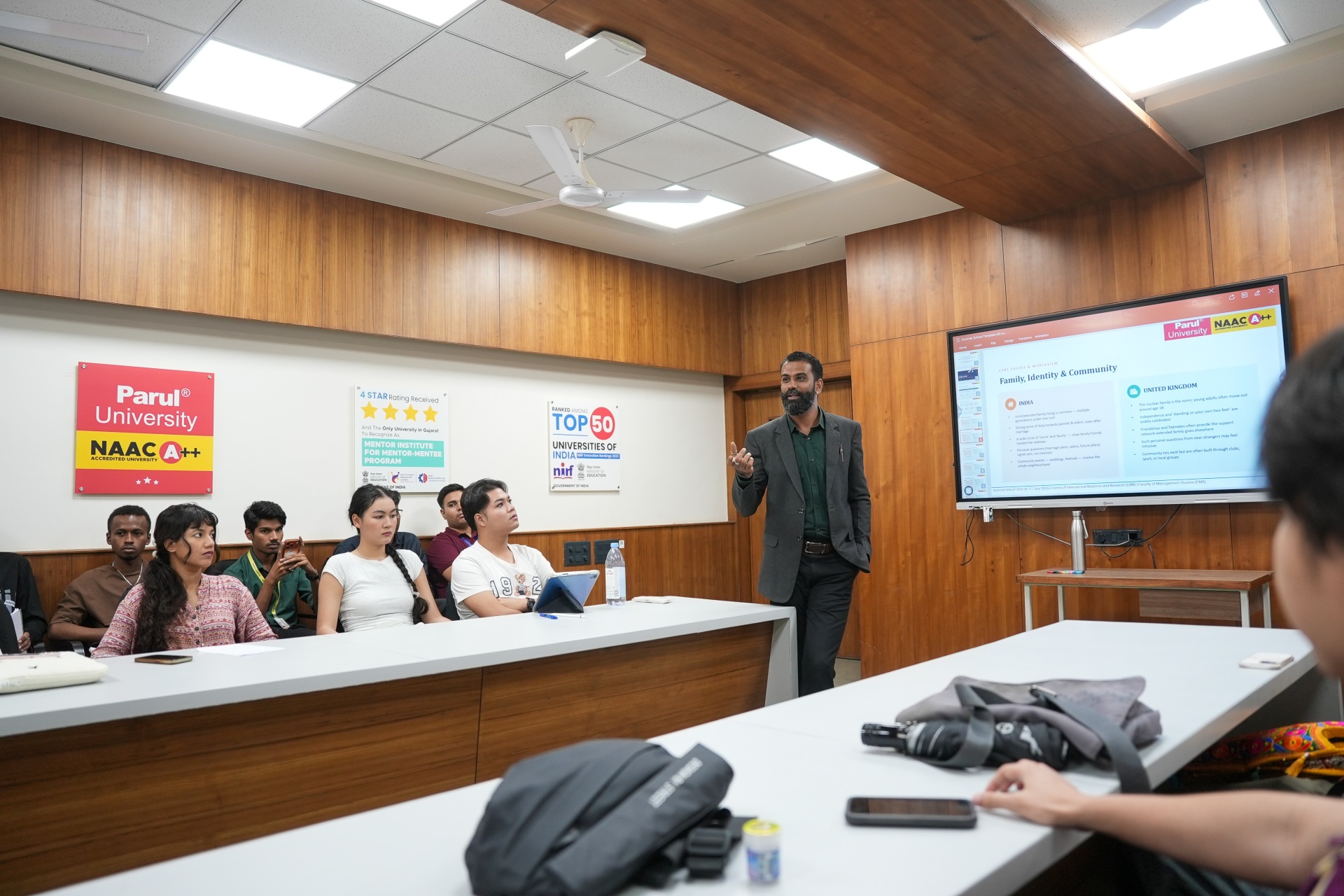
The program was run in collaboration with the Faculty of Management Studies, and the sessions there set the tone. Rather than lectures delivered at the group, participants worked through real business problems, decision-making exercises and current trends in global management practice, in collaborative and interactive formats with faculty experts.
What made these sessions work, by the students’ accounts, was the composition of the room. Discussing a business problem is a different exercise when the people around the table come from different academic and cultural backgrounds and bring genuinely different assumptions to it. The management content became a vehicle for something broader: learning to reason through a problem with people who do not share your starting point.
A business case is a different exercise when nobody at the table shares your assumptions. That is the point of the room.
Faculty of Architecture and Planning: How Designers Think
At the Faculty of Architecture and Planning, participants were introduced to creative design approaches and sustainable practice, and to the fundamentals of architectural thinking, design processes and the faculty’s approach to design education.
For students from unrelated fields, this was an introduction to a way of thinking rather than a technical course. Architectural thinking, how a designer moves from a problem to a considered solution, and how sustainability is built into that process rather than added at the end, is transferable well beyond architecture. For the design-minded members of the cohort, it connected directly to what they were seeing in the city around them, a link the cultural program made vivid.
Faculty of Performing Arts: Learning a Culture Through Its Art
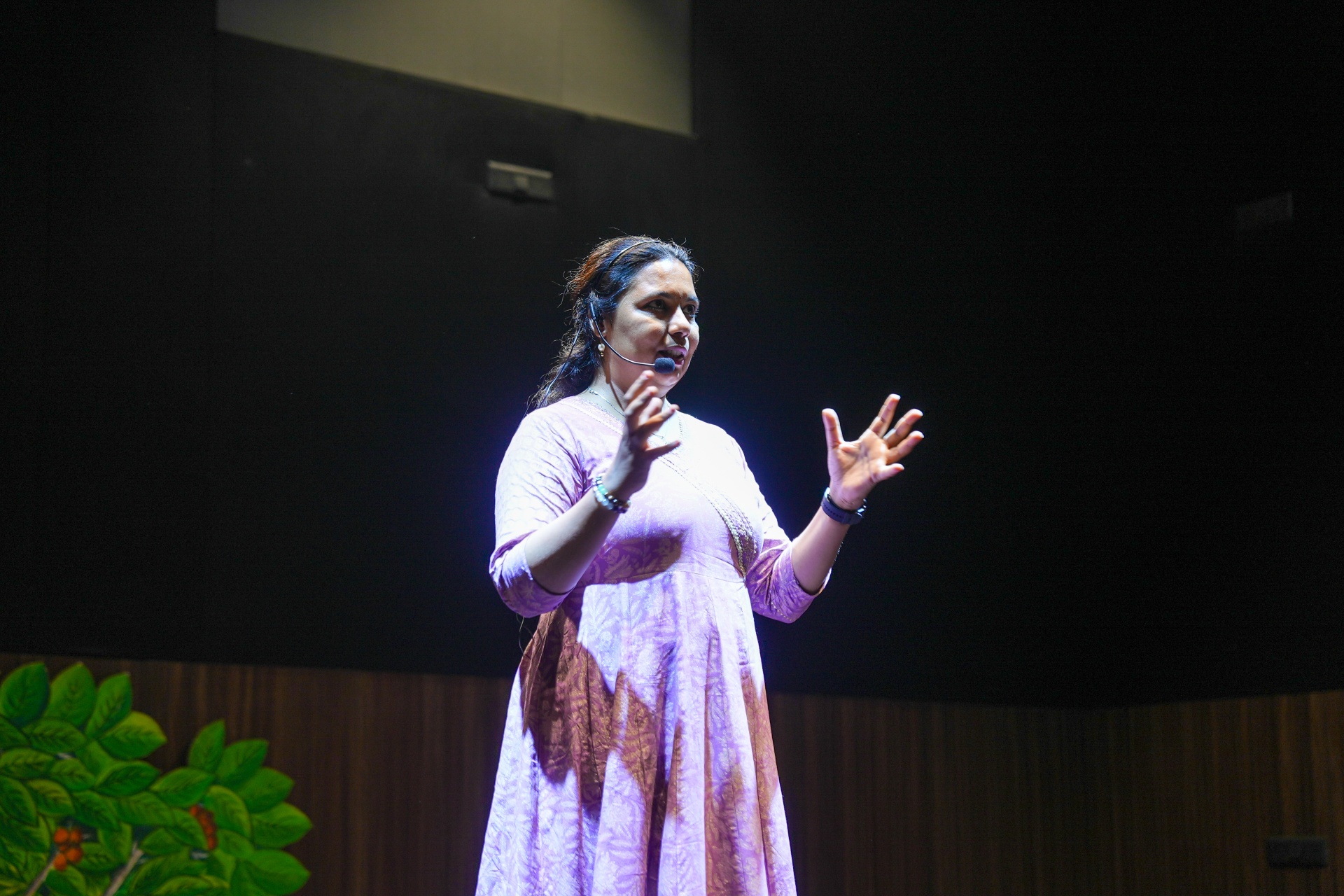
The Faculty of Performing Arts took a different route into India entirely, through its classical dance and music. Sessions included live performances and interactive demonstrations, giving participants a route into the country’s artistic traditions and the stories carried inside its art forms.
This is cultural education delivered as experience rather than explanation. A student learns more about a tradition from watching it performed and trying to understand its structure than from reading a description of it, and for an international cohort with two weeks to absorb an unfamiliar culture, that immediacy matters. It gave them a way to understand India’s heritage that the classroom alone could not.
Read more about – Learning, Culture & Connection – Indian Summer School Journey at Parul University!
The Cross-Cultural Communication Session!
The most quietly practical part of the academic program was a dedicated Cross-Cultural Communication session, built around what it takes to communicate and cooperate across borders.
Through discussion and activity, participants worked on cultural diversity, differing communication styles, and the real skill of adapting how you work when the people around you come from elsewhere. For a cohort of fourteen students from seven countries, this was not a theoretical exercise. They were, at that moment, the case study. The session gave them a framework for something they were already living, and a set of skills, adapting, listening, taking cultural differences as information rather than friction, that carry directly into global academic and professional work.
Harsh, a computer science student from the United Kingdom, singled out this dimension as the outcome he had not expected. He had enrolled for the academic exposure; what he valued most by the end was the international network he built and the way it sharpened his ability to work across cultures. That is the academic program and the international classroom doing the same job from two directions.
“Together, we explored diverse cultures and built lasting global friendships. I wasn’t expecting it before enrolling, but it really helped me enhance my networking skills.” – Harsh, Computer Science, Nottingham Trent University
It is worth being clear about what a two-week academic program can and cannot do. It will not turn a student into an expert in four new fields, and it does not try to. What it does is give a working sense of how different disciplines think, a set of reference points to build on later, and the experience of learning in an unfamiliar system alongside an unfamiliar cohort. If you’re passionate about building a career at the intersection of software, then delay no longer and enrol on Parul University’s B.Tech CSE program and get to work in your dream MNC.