Ayurveda is a wide field. It is a traditional medicine. There are descriptions of it in the scriptures too. Some of the techniques do work for overall body treatment. One of them being Abhyanga. Abhyanga is an Ayurvedic therapy. In which warm, medicated oil is applied and massaged over the body in a systematic way. It is one of the therapies international practitioners study at Parul University’s Ayurveda programs, and, unlike a generic spa massage, it is guided by Ayurvedic principles at every step. Here is a clear, educational guide.
Abhyanga is Different from Ordinary Massage
The key difference, as faculty explained during a recent program, is that in Abhyanga the oil is chosen to suit the individual. Rather than one standard oil for everyone, the medicated oil is selected according to the person’s condition and needs. Abhyanga also has a dual role in Ayurveda: it is recommended as part of the daily routine of a healthy person, and it serves as a Purvakarma, a preparatory procedure, before the deeper Panchakarma purification therapies. Traditionally, it is associated with supporting circulation, easing stiffness, nourishing the tissues, and encouraging relaxation.
The Seven-Position Technique
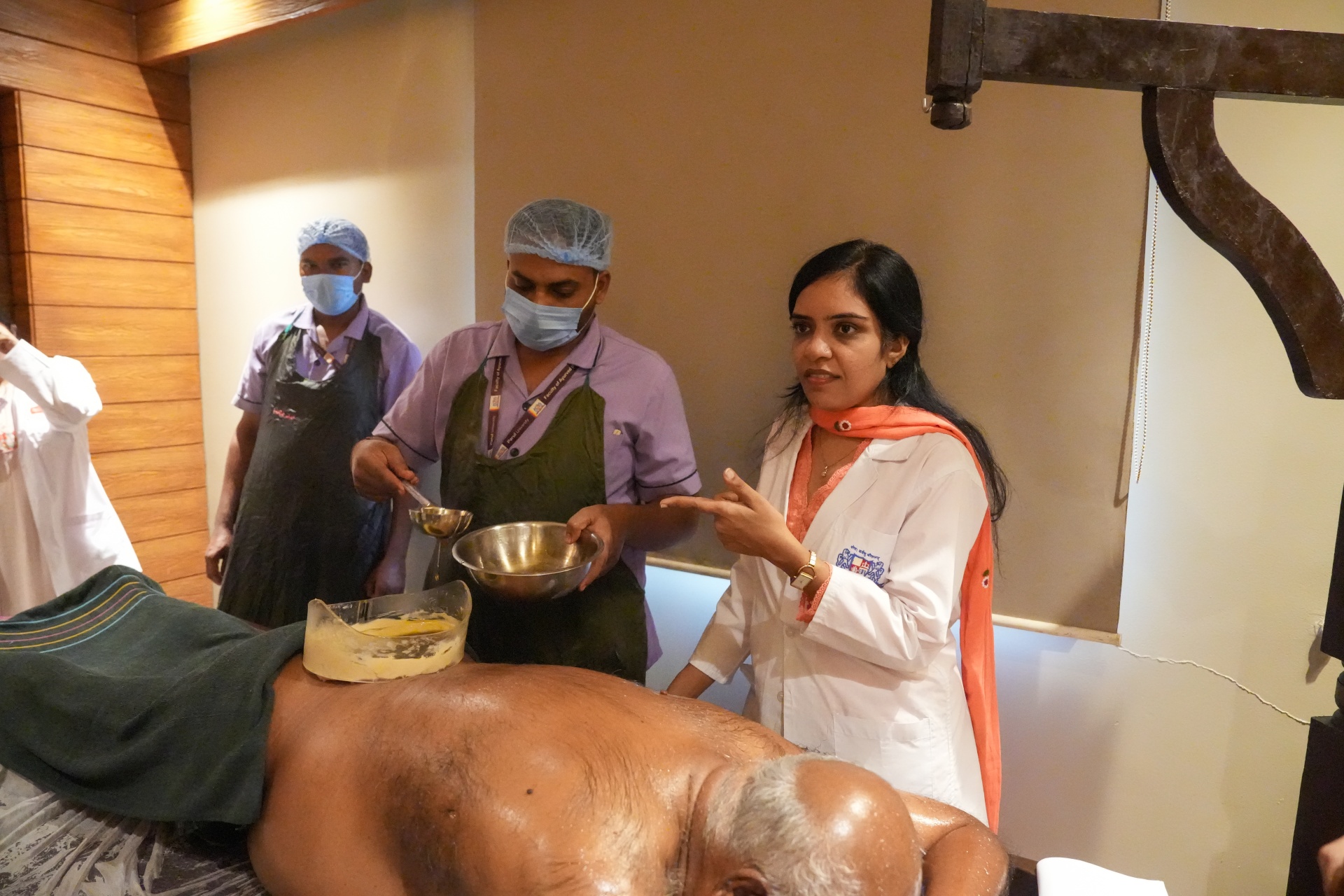
A distinctive feature of classical Abhyanga is that it follows a systematic seven-position sequence rather than a single posture. As demonstrated at Parul University, the procedure typically begins in a sitting position, moves through the appropriate lying and side positions, and concludes seated again, with oil applied across the scalp, face, hands, and feet. Joints are massaged in a circular motion and muscles with longer, linear strokes. Each position is held for roughly five minutes, making the main massage around 35 minutes, and the full procedure, including preparation and rest, about 45 to 50 minutes. The position can be adapted to the individual, and a trained therapist knows which positions to use or avoid depending on a person’s health.
The Oils Used
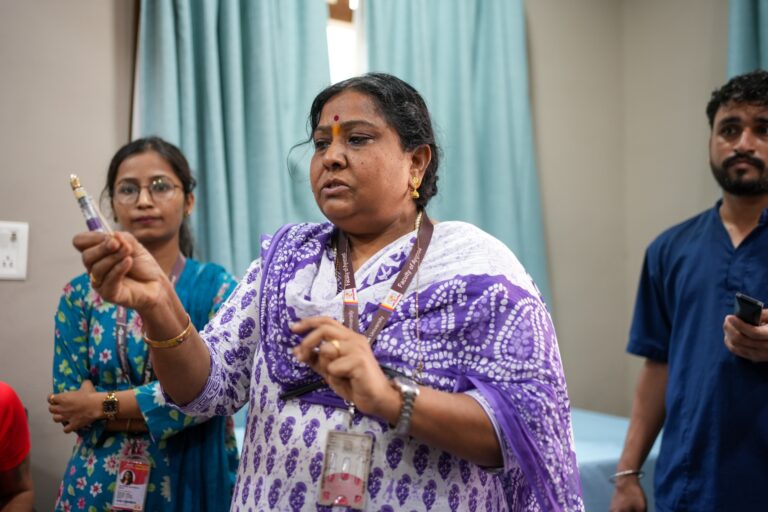
The medicated oil is central. It is traditionally warmed (to a comfortable, skin-safe temperature) before application, and chosen for the individual, one classical oil demonstrated during the program was Dhanvantari oil. Different oils carry different traditional associations, which is precisely why the selection is left to a knowledgeable practitioner rather than made at random. Like all Ayurvedic procedures, Abhyanga follows three stages: Purva Karma (preparation, arranging the oil and materials), Pradhana Karma (the main massage), and Paschat Karma (the concluding stage, rest followed by a lukewarm bath).
Abhyanga and Swedana
Ayurveda doesn’t have only one therapy. There are many. Abhyanga and Swedana are there to name a few. Abhyanga is usually followed by Swedana. It is type where sudation or gentle, controlled sweating, is done. It is done using warm herbal steam or medicated poultices. Ayurveda combines them both for better results. Oleation (Abhyanga) paired with sudation (Swedana). It is used for preparing the body before main purification treatments of Panchkarma. In the traditional texts, it is described as above mentioned. Sudation or Swedana is achieved through steam. The steam is directed at the body (Nadi Sweda). It is directed using warm herbal-bundle poultices (Pinda Sweda). It is made using medicinal powders, leaves, or rice cooked in milk, suited to different purpose.
Can You Do Abhyanga at Home?
A simple, gentle self-massage with warm oil is often described in Ayurveda as part of a healthy daily routine (Dinacharya). However, therapeutic Abhyanga, with medicated oils chosen for a specific condition, and especially as preparation for Panchakarma, is a clinical procedure performed by a trained practitioner. If you have any health condition, or are considering Abhyanga as a therapy rather than simple self-care, consult a qualified Ayurvedic practitioner first.