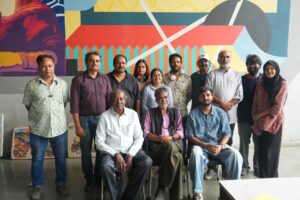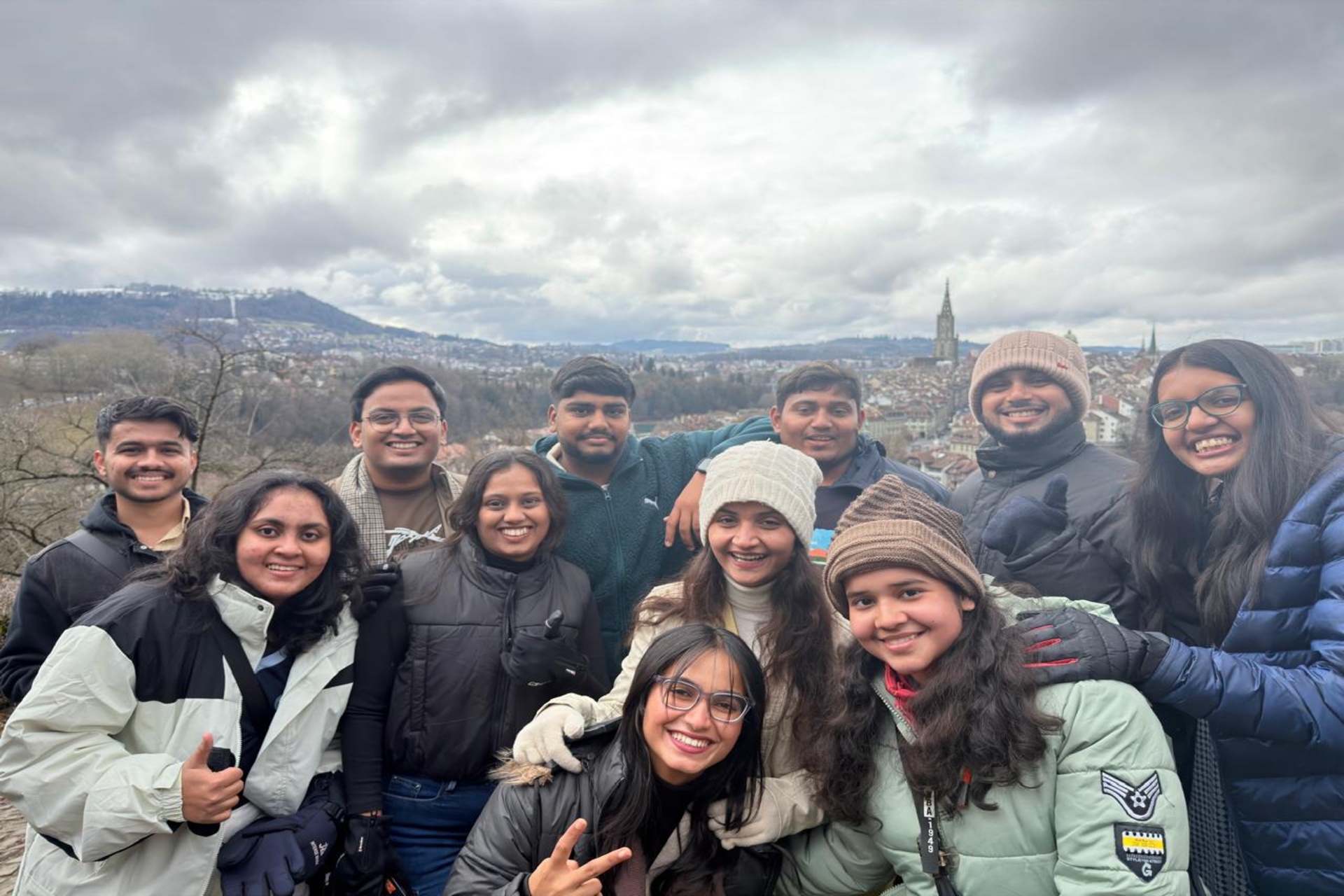
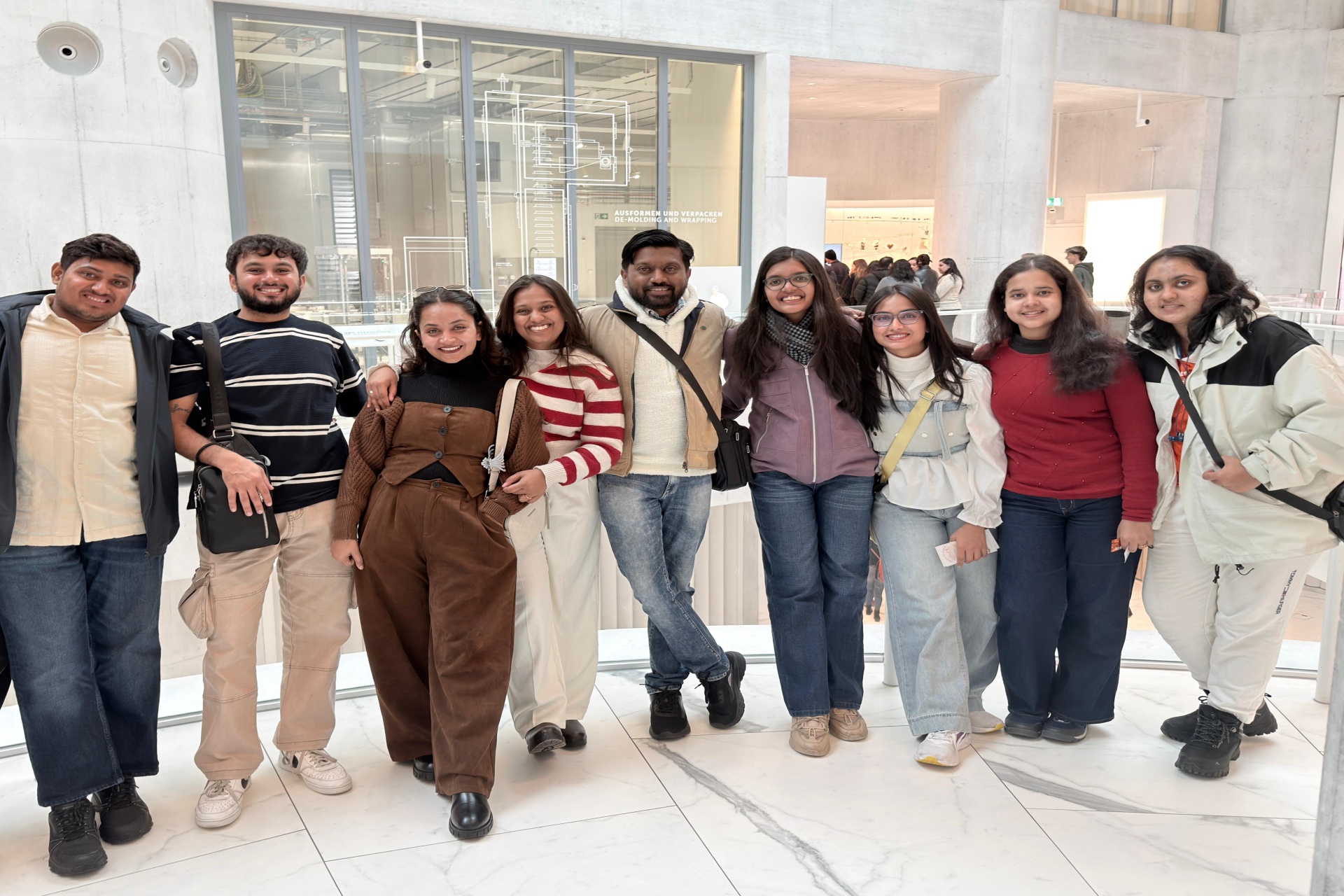
The 2026 cohort of 11 Parul University students travelled to Bern in January-February, arriving in the heart of a Swiss winter. Students got experience of the public transports, food, and culture over there.
They had prepared in advance: researching train schedules, mapping the route, and accounting for potential delays due to snow. The preparation made the difference. They arrived in Bern without incident. According to the students, this navigation phase was unexpectedly fun: experiencing a foreign country with strange routes and unfamiliar systems alongside friends, solving logistical problems in real time, and realising that the independence the program demanded started before the academic component even began.
For students who have never left India, or who have never traveled independently in a country where the signs are not in Hindi or English, this arrival experience is not a footnote. It is the first test. And it builds a confidence that carries into the classroom.
The BFH Classroom: Self-Directed Learning Where Nobody Holds Your Hand
The academic week at BFH was, by any measure, a stretch experience. In the BFH education model, self-directed learning is not a buzzword printed on a brochure. It is the operating system. Students are given assignments and expected to conduct research on their own, develop solutions independently, and present results with limited guidance from trainers. The faculty set the direction. The students do the work.
This is fundamentally different from the Indian academic model most students have experienced, where lectures deliver content and exams test retention. At BFH, the student is expected to generate content, not receive it. The disorientation is real. For Parul University students who had strong technical foundations from GCF certifications and IMPACT training, the technical knowledge was present. What was new was the expectation of complete academic independence.
Each evening, Mr. Hutesh Baviskar held support sessions to help students navigate their assignments, review their LMS (Learning Management System) submissions, and build confidence for the next day’s presentations. His dedication to the students’ success was a defining thread of the program. No student was left to struggle alone overnight with an assignment they could not decode. The support was there. But the responsibility to produce the work remained with the student.
The Competition: Five Teams, Five Pitches, and No Room to Fake It
The innovation management program structured the academic component as a competition. Five interdisciplinary teams, each a blend of Indian and Swiss students, competed through a series of presentations that built on each other. Each round raised the bar. The final pitch required a complete business case: problem statement, proposed solution, market analysis, financial projections, and go-to-market strategy.
The format was rigorous because the problems were real. Swiss industries and organisations had brought forward actual challenges they needed solved. The teams were not practising entrepreneurship. They were doing it, under time pressure, in multicultural teams where half the group came from a different continent with different assumptions about how innovation works.
For Parul University students, many of whom had exposure to PIERC’s startup ecosystem (254 startups, Rs 20 crore+ funding), the entrepreneurial thinking was familiar. What was unfamiliar was applying it within a Swiss academic framework where documentation, structured analysis, and formal presentation standards were significantly higher than what most Indian startup pitches demand.
The Former Student Who Planned the Most Memorable Day
During a free day, something happened that no institutional planning could have produced. A student who had visited Parul University from BFH in a previous year was still in contact with the 2026 cohort. She personally planned a full-day experience for the Indian students: visits to a school and local institute, places that no previous batch had ever seen.
Mr. Hutesh Baviskar describes it as one of the most genuinely warm gestures he has experienced in years of running such programs:
“She planned the whole thing. She came at the hostel we were staying at and said she has planned the whole day for us. She made us visit places which were never visited by any batch which visited before us. Her planning was incredible. We, both the institutes, could not have planned what she ended up planning. She said, I will take care of your children, and their experience.”
This moment captures what a decade-long partnership produces that a one-off exchange cannot: relationships that outlast the program, alumni who feel ownership over the experience, and cross-cultural bonds that generate spontaneous generosity. No MOU can mandate this. It emerges because the partnership has been sustained long enough for its alumni to become its advocates.
Exploring Switzerland: Lucerne, Zurich, Bern, and Interlaken
Beyond academics, the 2026 cohort experienced Switzerland as one of the most visually striking and systematically organised countries in the world. They explored Lucerne (lake views, the partially covered wooden bridge, historical architecture), Zurich (cultural richness, financial centre of Switzerland), Bern (the capital, UNESCO World Heritage Site: Zytglogge clock tower, Bear Park, Rose Garden, Aare River, the Gurten mountain, and Einstein House), and Interlaken (the extreme sports centre of Switzerland, situated between two lakes in the Alps).
For students from Gujarat and other parts of India, the contrast between what they know and what Switzerland presents is not just scenic. It is systemic: the precision of public infrastructure, the integration of heritage with modern urban planning, the cleanliness and efficiency of daily systems. These observations inform how students think about design, planning, and quality standards long after they return to India.
What the Experience Changes in Students Who Go Through It
The programme cost Rs 2.30 lakhs per student. What it produced cannot be purchased separately: the confidence of having navigated a foreign country independently, the academic rigour of having presented to a Swiss jury under competition pressure, the cross-cultural fluency of having worked in a team where half the members think differently about innovation, the BFH certification that signals international academic recognition, and the personal connections that a former BFH student’s spontaneous generosity represents.
Mr. Hutesh Baviskar notes that the 2026 edition benefited from improved advance planning. The academic component was front-loaded, allowing students to immerse themselves in coursework before exploring Switzerland. This approach made the experience richer and more purposeful: the academic pressure came first, and the exploration felt earned.
For students evaluating whether Parul University can provide genuine international exposure, not just a partnership count on a brochure, the BFH program is the most granular answer available. It is not a one-week workshop. It is not a campus visit. It is 15 to 20 days of living, studying, competing, and navigating in a country where everything operates differently, supported by a mentor who held evening sessions every night and sustained by a partnership that is entering its second decade.
Also check the PIERC at Parul University, where startups find their path.
Frequently Asked Questions
What do Parul University students actually experience in Switzerland?
Navigating Swiss public transportation independently in winter. Self-directed learning at BFH where faculty expect independent research and presentations. Multicultural teams (2 PU + 2 BFH students) solving real Swiss industry problems. Competitive pitches with full business cases. Evening support sessions with Mr Hutesh Baviskar. Exploration of Lucerne, Zurich, Bern (UNESCO World Heritage), and Interlaken. BFH certification upon completion.
How is the BFH academic model different from Indian universities?
BFH uses self-directed learning as the core model. Students are given problem statements and expected to research, develop solutions, and present results with limited faculty guidance. This contrasts with the lecture-and-exam model most Indian students experience. Parul University students arrive with strong technical foundations from GCF certifications and IMPACT training, but the expectation of complete academic independence is new and described as a stretch experience.
Is Rs 2.30 lakhs worth it for the Parul University Switzerland programme?
The cost covers travel, accommodation, and all academic expenses for 15 to 20 days at BFH in Bern. The programme provides: BFH certification, multicultural team experience, real industry prototype development, competitive pitch to expert jury, Swiss faculty assessment, independent travel experience, and exposure to Lucerne/Zurich/Bern/Interlaken. BFH faculty described the 2026 cohort as being on a different level compared to previous years. For an international academic programme at a Swiss university, Rs 2.30 lakhs is significantly more affordable than most alternatives.
How does Mr Hutesh Baviskar support students during the programme?
Mr Hutesh Baviskar (PIERC Incubation Manager) accompanies the cohort as the sole faculty member. He holds evening support sessions every night: reviewing assignments, helping students navigate BFH's Learning Management System, building confidence for next-day presentations, and ensuring no student struggles alone with the unfamiliar self-directed learning format. His role bridges the gap between Parul University's support-oriented academic culture and BFH's independence-oriented model.
Can Parul University students bring their own startup ideas to Switzerland?
Discussions are underway for the next MOU (post-2026) to allow Parul University students to carry their own startup ideas to Switzerland and explore European market entry. In the current format, students work on problem statements provided by Swiss industries. Future iterations may combine both: student-originated ideas tested against European market realities with BFH academic support.