Discover how individual needs shape rehabilitation goals and physiotherapy treatment plans.
India recorded 4,71,441 people injured in road accidents in 2024, according to a Ministry of Road Transport and Highways report in June 2026 (The Print). This shows the large number of people affected by road injuries, although not every injured person requires physiotherapy.
Two people may suffer the same type of knee injury but face completely different difficulties during recovery. One may want to return to playing cricket, while another may simply want to walk comfortably.
This is why rehabilitation goals cannot be the same for every patient. For students pursuing a Bachelor of Physiotherapy, understanding these differences is an important part of learning patient care.
Why Do Similar Injuries Require Different Rehabilitation Plans?
An injury diagnosis tells physiotherapists which body part is affected. However, it does not explain everything about the patient’s condition.
Two patients with ankle injuries may have different levels of pain, swelling, muscle strength, and joint movement.
Their medical history and everyday responsibilities may also be different.
For example, a young athlete may need to regain strength for running, while an older person may need support with balance and walking.
Physiotherapists assess these needs before setting rehabilitation goals. The purpose is to help each patient return to activities that matter to them.
Which Factors Affect a Patient's Rehabilitation Goals?
Several factors influence how rehabilitation goals are planned. Physiotherapy students must learn to consider the complete patient rather than focusing only on the injury.
Important factors include:
• Age and Physical Condition:
Muscle strength, balance, and general health may affect recovery.
• Injury Severity:
More serious injuries may require additional treatment and longer rehabilitation.
• Daily Activities:
Patients may need different movements for work, sports, or household tasks.
• Medical History:
Existing health conditions can influence exercise selection and recovery.
• Personal Goals:
Patients may have different expectations about returning to normal activities.
These factors help physiotherapists develop suitable goals based on individual assessments.
How Can Two Patients with Knee Injuries Have Different Goals?
Consider two patients recovering from similar knee ligament injuries.
The first patient is a 22-year-old student who enjoys playing football. Their rehabilitation goals may include improving knee strength, balance, and movement needed for sports.
The second patient is a 55-year-old office worker who wants to walk comfortably and climb stairs without difficulty.
Both patients may require exercises to improve knee movement and muscle strength.
However, their later rehabilitation activities may differ because their daily requirements are not the same.
Their progress also depends on injury severity, treatment, medical advice, and individual recovery.
This example helps students understand why rehabilitation planning must consider more than the injury name.
Get Complete Details From Expert
How Do Physiotherapists Set Suitable Rehabilitation Goals?
Physiotherapists begin by assessing the patient’s movement difficulties, physical condition, and daily needs.
They then set goals that can be reviewed during treatment.
Some important steps include:
• Assessing Movement:
Checking joint movement, muscle strength, balance, and functional difficulties.
• Understanding Patient Needs:
Discussing activities the patient wants to perform again.
• Setting Clear Goals:
Choosing suitable targets, such as improving walking distance or joint movement.
• Monitoring Progress:
Reviewing changes in pain, strength, and movement during rehabilitation.
Goals should be realistic and agreed upon with the patient. Physiotherapists may change them if recovery progresses differently than expected.
How Does Parul University Teach Students About Individual Rehabilitation Needs?
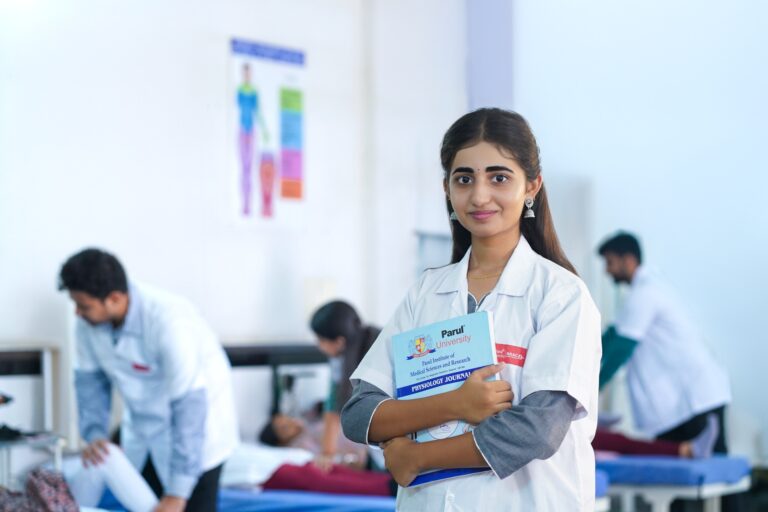
The Bachelor of Physiotherapy programme at Parul University is a five-year course that combines classroom learning with practical clinical training.
Students study anatomy, physiology, biomechanics, and therapeutic procedures to understand body movement and rehabilitation.
The programme offers practical learning through laboratories, clinics, and hospitals, with clinical exposure beginning during the early semesters.
Parul University also provides access to its 750-bed multi-speciality teaching hospital, Parul Sevashram Hospital, and the Pragya Advanced Skills and Simulation Centre.
A compulsory six-month rotating clinical internship further supports supervised patient-care learning.
These experiences can help students understand why different patients require different assessment methods and rehabilitation goals.
Why Should Rehabilitation Goals Change During Recovery?
Recovery does not always follow a fixed path. Some patients improve steadily, while others may experience pain, weakness, or difficulty during certain activities.
For example, a patient who initially needs support while walking may later focus on climbing stairs independently.
Physiotherapists review progress and adjust goals according to the patient’s condition and medical advice.
For students interested in patient care, the Bachelor of Physiotherapy at Parul University offers opportunities to learn how rehabilitation is planned and reviewed.
As students gain clinical experience, they begin to understand that helping someone recover is not only about treating an injury. It is also about understanding what that person hopes to do again.