

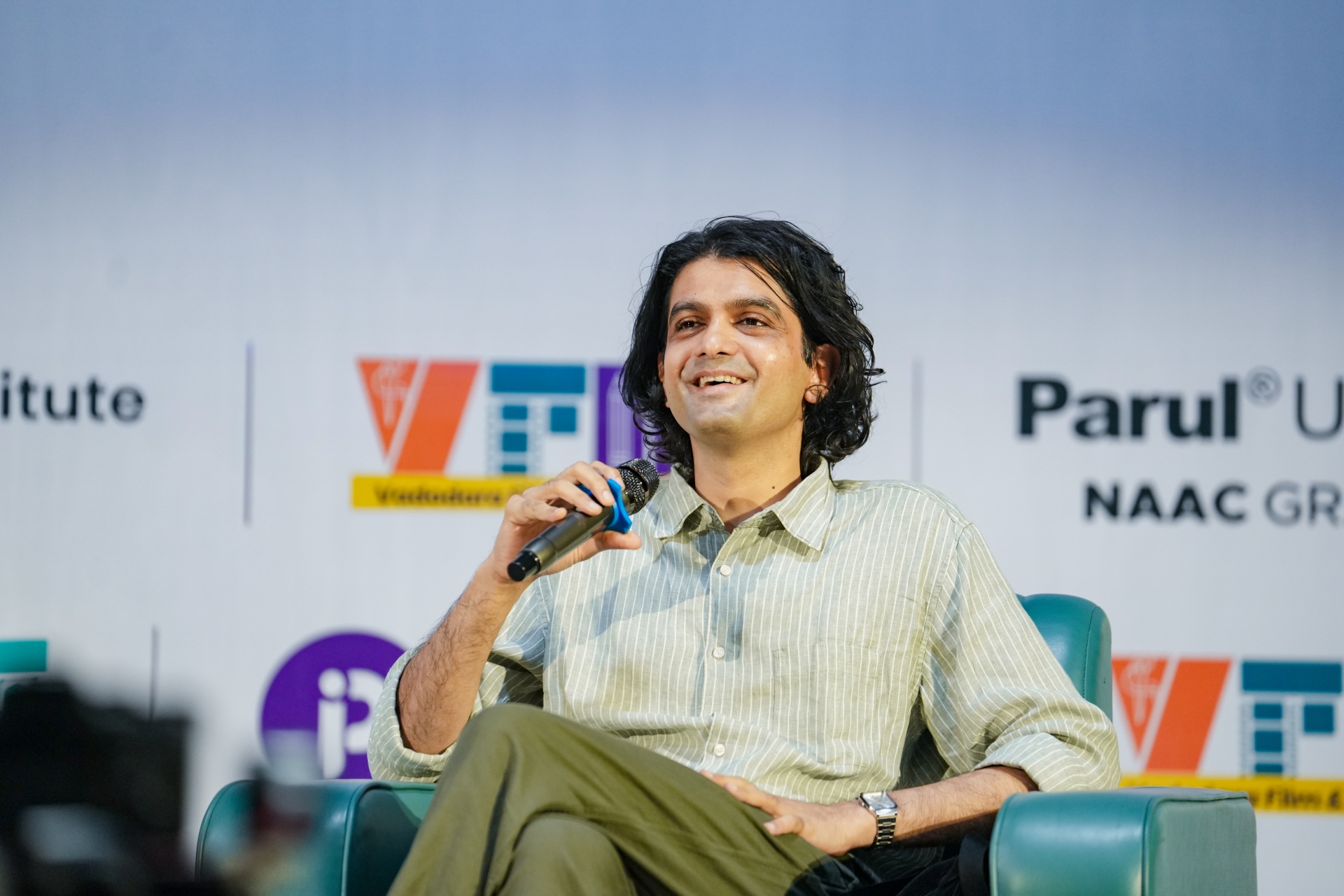
On 3rd Day of VFDF as known as Vadodara Film & Design Festival at Parul Institute of Design, the very known filmmaker behind Newton, Sherni and Sulemani Keeda engaged with PU students and deliberated the honest working situations in early career years.
This session surely says, nothing is gained overnight is for real. Mr. Amit Masurkar sat down with the moderator Aseem Chhabra (director of the New York Indian Film Festival), for a session named – My First Film. His path is very different from most Independent filmmakers and directors of his generation as he did not attend a film school, he holds no reference from the industry, and for most of his twenties his script were unprodued at UTV, Viacom, and every major Bombay based studio.
What changed was not that someone said yes. What changed was that he stopped waiting for someone to say yes.
The Years Before Sulemani Keeda: Signing Amounts and Unproduced Scripts
For years after arriving in Bombay, Masurkar followed the conventional path. Write a script. Get signed by a studio. Receive a signing amount, often around one lakh rupees. Wait for the project to go into production. Watch it not go into production. Write another script.
He described the pattern honestly. A one lakh signing amount sounds significant in the abstract. In practice it must sustain a writer for over a year. If the script does not go into production and no second project is signed, the money runs out before the work resumes. During this period, Masurkar treated every script as his potential debut. None of them became films.
One specific research trip from 2009 would eventually become something. Masurkar travelled through UP that year observing election mechanics and EVM machines, assembling the germ of an idea about a polling officer in a conflict zone. That germ sat dormant for years. It would eventually become Newton, India’s official entry to the 90th Academy Awards for Best Foreign Language Film. If you too have been filming reels and aiming to have a career as a cinematographer, then enrol into Parul University’s B.Sc in Film & TV Production!
The point he made to the room was not that the idea was valuable. The point was that the idea had to wait nearly a decade because he kept trying to get made films he was signed to instead of making films he actually wanted to make.
Sulemani Keeda: A Rs 5 to 6 Lakh Budget, a Roommate in the Lead, and a Script Nobody Would Fund
Sulemani Keeda was not meant to be his first film. It was a side project born out of frustration with the industry’s pace.
The protagonist was based on Naveen Kasturia, Masurkar’s roommate at the time and then an assistant director working under Dibakar Banerjee. Masurkar had spotted Kasturia’s innate acting talent and wrote the character around his personality and language patterns.
The production resembled film school more than professional filmmaking:
- Budget: Rs 5 to 6 lakh rupees, assembled through personal savings and small contributions
- Locations: his parents’ lobby, friends’ offices, and relatives’ car parking lots
- Industry support: despite the micro-budget, figures including Mahesh Bhatt contributed through cameo appearances, moved by the project’s independent spirit
- Follow-up financing: producer Deepa Tracy eventually came on board, investing an additional Rs 20 to 25 lakh to complete the film
The film was released. It was noticed. The cycle that had trapped him for years broke, and it broke because he stopped waiting for permission.
“I thought I’ll follow that path, that I’ll probably have a mentor who will love my work and the mentor will be very gracious and say, bacha, tu picture bana. But that didn’t happen.”
Pan Nalin on selling his Mumbai house to finance Chhello Show
Why Masurkar Did Not Go to Film School
Unlike most of his contemporaries, Masurkar did not attend a formal film school. His route was self-directed:
- He attended various workshops without signing up for a degree programme
- He studied cinematography independently
- He assisted editors to learn the post-production pipeline
- He took acting classes, not to act, but to understand the jargon and craft so he could direct veterans without feeling out of place
The acting-class decision is worth flagging. He told the PID room that he did not specifically because he knew he wanted to work with senior actors like Naseeruddin Shah one day and did not want to be intimated when that moment arrives for real. That mindset and preparation eventually enabled his collaboration with Rajkummar Rao and Pankaj Tripathi on Newton & Sherni, both of them require a director who can speak actor’s simple language. The bigger point for design students was – mastering technical skills is easier, they can be done via workshops, internships or self-study but what cannot be taught is the editorial voice, this needs to be built, everyday.
The Real Struggle Now Is Not Money. It Is Finding the Right Story.
Masurkar was specific about how the career has changed since Newton. Finding financing is no longer the bottleneck. Studios and OTT platforms will commission him. What is hard is finding a story he wants to spend three years obsessed with.
“The real struggle is not getting the money. The real struggle is getting the right story and the right idea. Because if you’re stuck making a bad film, then it’s torture.”
He compared the filmmaker’s persistence to Don Quixote’s. You have to be almost delusional in your love for the project to survive the arduous journey from script to screen. That delusion is not a weakness. It is the fuel. A filmmaker who can let go of an idea easily will not finish it.
Almost 80 percent of his films, he said, are based on real-life observations. Even in fantasy, the basic emotions are real. Newton came from observing a 2009 election campaign. Sherni drew on actual tiger-conservation conflicts in India’s forests. The mechanics of each film trace back to something he watched happen in person.
What PID Students Actually Wanted to Know
Several of the student questions navigated to career logistics –
On directing in regional languages
Masurkar said he is language-agnostic. Cinema has its own language. He speaks fluent Marathi and would direct in Marathi, Kannada, or Gujarati if the script demanded it. The decision is not about mother-tongue loyalty. It is about which language the story needs.
On honesty in an industry that punishes it
Honesty is not a strategy, he told the room. It is a way to keep your own mind at peace. If you cross your own lines to make a project happen, you then have to live with the knowledge of what you did. That is not a career choice. That is a life choice.
On the perceived difficulty of industry people
He said the industry is kinder than its reputation, if you work with full love and respect. He even advised students to surround themselves with inspiring people who motivates you to take charge of their environments. Besides this, he even suggested them to spend time with people who puts you up is the best thing they can do in their career-life journey!
On whether films like Masurkar's can still be made
Yes. You just need the right story and the right community. Vadodara is not a disadvantage. Neither is any other city outside Bombay. If you apply your mind and heart, you can make it wherever you are.
Why This Session Mattered at Parul Institute of Design
Masurkar’s trajectory is the trajectory most design and film students face. Years of waiting. Studios that sign projects and do not produce them. The constant calculation of whether to stay with the dream or pivot.
The PID message that lands next to his session is practical. The Bachelor of Science in Film and TV Production programme covers the complete filmmaking pipeline. The Bachelor of Science in Animation and VFX covers concept through compositing. A diploma in filmmaking runs parallel to both. None of those programmes can guarantee a student’s first film gets financed. What they can do is equip the student to make the film anyway, Sulemani Keeda style, on whatever budget is available, with whatever crew of friends agrees to show up. That is the closest training structure to what Masurkar actually did.
VFDF 4.0 Hosted Bollywood Icons – Sudhir Mishra & Rajat Kapoor!
Frequently Asked Questions
Who is Amit Masurkar?
Amit Masurkar is an Indian filmmaker whose films include Newton (2017), Sherni (2021), and Sulemani Keeda (2014). Newton was India's official entry to the 90th Academy Awards for Best Foreign Language Film. Masurkar did not attend a formal film school and built his craft through workshops, assisting editors, and taking acting classes.
What is Sulemani Keeda about?
Sulemani Keeda (2014) is Amit Masurkar's debut feature film about two struggling screenwriters in Mumbai. It was shot on a Rs 5 to 6 lakh budget in friends' offices, relatives' parking lots, and the director's parents' lobby. The lead role was played by Naveen Kasturia, Masurkar's roommate at the time.
Was Newton India's Oscar entry?
Yes. Newton, directed by Amit Masurkar and starring Rajkummar Rao, was India's official entry to the 90th Academy Awards for Best Foreign Language Film in 2018. The film was based on Masurkar's 2009 research trip to Uttar Pradesh observing election mechanics and EVM machines.
How did Amit Masurkar finance his first film?
Sulemani Keeda was self-financed and friend-supported on an initial budget of Rs 5 to 6 lakh. Producer Deepa Tracy later invested an additional Rs 20 to 25 lakh to help complete the film. Mahesh Bhatt and other industry figures contributed cameo appearances moved by the project's independent spirit.
Can I become a filmmaker without going to a formal film school?
At the VFDF 4.0 session at Parul Institute of Design, Amit Masurkar told students that technical skills can be acquired through workshops, internships, and self-study. He took acting classes specifically to direct senior actors without feeling intimidated. PID itself offers structured training through its B.Sc. Film and TV Production and Diploma in Filmmaking programmes, which combine classroom pedagogy with hands-on production. A PID programme gives students what Masurkar assembled piecemeal: technical skills, peer crew, and production infrastructure on a single campus
What did Amit Masurkar tell students about making films without going to film school?
At the VFDF 4.0 session at Parul Institute of Design, Masurkar said technical skills can be acquired through workshops, internships, and self-study. He specifically took acting classes so he could direct senior actors like Naseeruddin Shah without feeling intimidated. The editorial voice, however, cannot be shortcut. That part has to be built through lived experience and observation.


