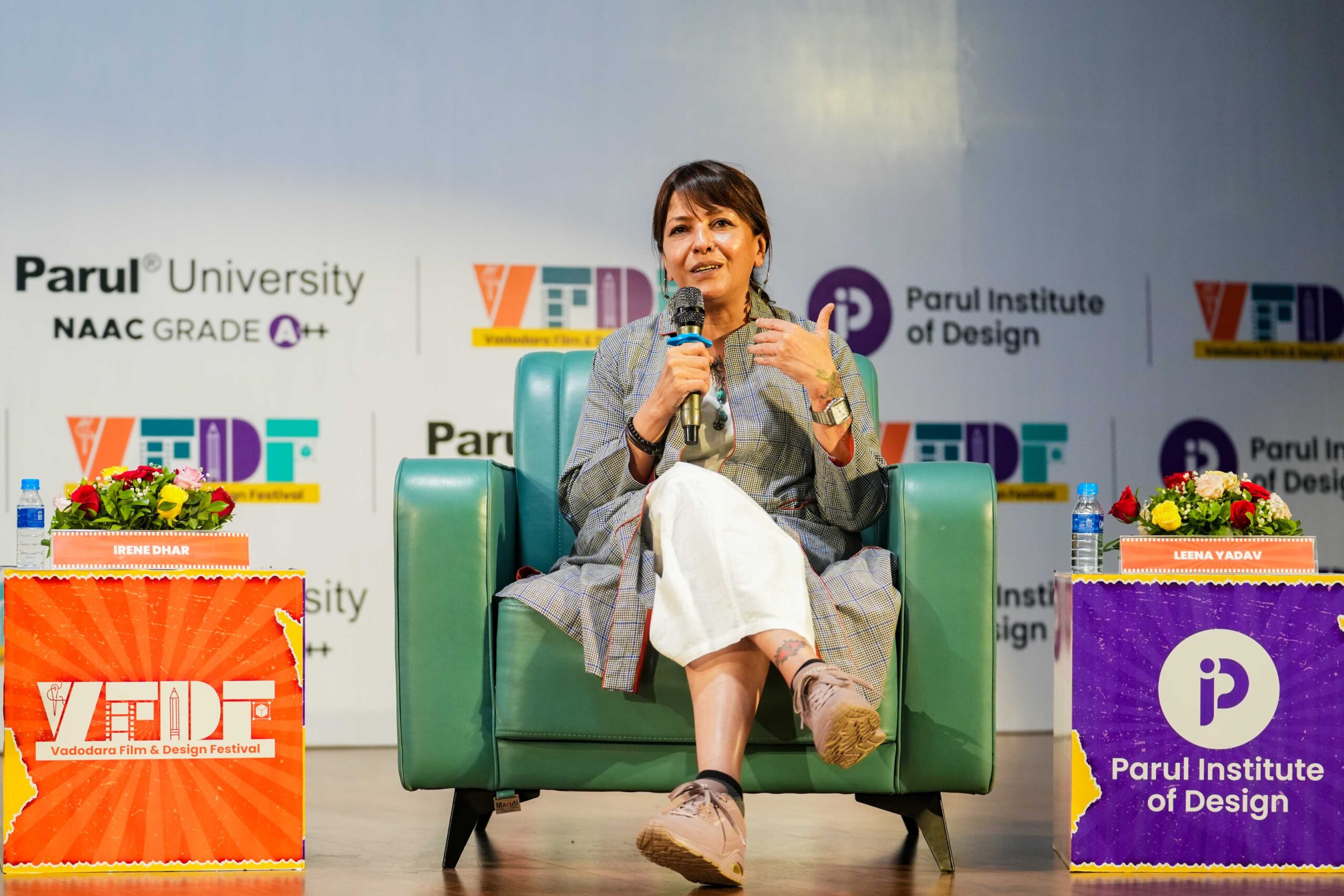
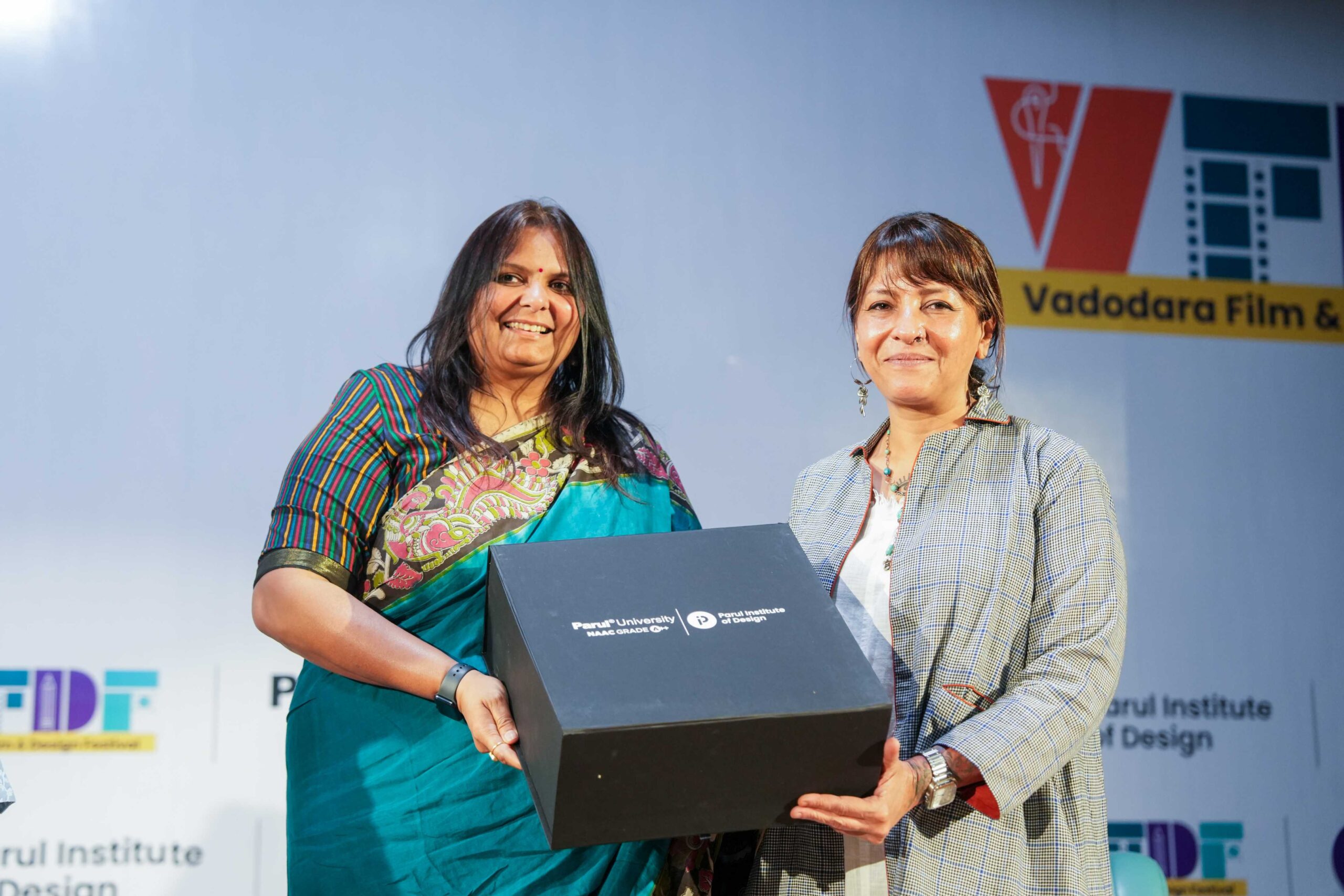
The session was addressed by Leena Yadav, filmmaker behind Parched. She shared a story of her distant cousin sister, who was hospitalised in critical condition. When the sister died, the family expected the male cousin to carry the bier during the funeral. He was seventeen. He had just lost the closest female figure in his life after his mother. He had not slept in three days. He carried the bier.
“There was no space in the ritual for him to grieve. The ritual required him to be strong. His grief was the family’s inconvenience.”
The room fell silent. The story was not a statistic. It was a specific boy, in a specific hospital, on a specific day, carrying a physical weight that symbolised a lifetime of emotional weight he would not be permitted to set down.
This is the kind of narrative that reels cannot carry. A thirty-second Instagram clip cannot capture the pause that followed the story in the actual room. The session moved on only when Harshit Dave gently steered it to the next example.
The Yadav story surfaced three specific patterns the panel later returned to.
- Ritual as constraint: cultural rituals that allocate physical tasks on gendered lines leave no space for male grief at the moments they most need expression.
- Delay as disguise: male grief that is not permitted at the moment of loss surfaces years later in forms the culture does not recognize as grief.
- Presence as performance: the son who carries the bier becomes the strength of his family and is not able to feel it. Differentiating between the two is the first step to healing.
The Boy Who Did Not Cry When His Mother Died
The second story came from a student in the audience.
He described the day his mother died. He was fourteen. His father was abroad for work. His younger sister was twelve. The male relatives who came to the house told him, within an hour of the death, that he was now the man of the house. All of a sudden, he felt the jolt of the responsibilities that he will have to take care of. A sister to take care of, support his dad emotionally, and manage the funeral arrangements. He did all of these things. What he did not do was cry.
He did all of these things. What he did not do was cry.
“For the first year I did not cry. I thought I had processed it. By the second year I had nightmares every week. By the third year I was failing in school.”
The student described eventually finding a therapist in his early twenties and working through the grief that had compounded across those years. The session used his story to name a pattern that Indian men rarely have vocabulary for. The conditioning that treats male stoicism as a sign of strength often produces delayed-action mental health crises that surface years after the original loss.
Read more: Parul Institute of Medical College
The Farmer's Son Who Wanted to Tailor
The third pattern came from Deepti Gupta, founder member of the Indian Women Cinematographers’ Collective.
She described a boy from a farming family in western Uttar Pradesh. Who wanted to become a tailor. The film Sui Dhaga, directed by Sharat Katariya with Varun Dhawan as the main actor, faces the same issue.
The conditioning operates through specific social mechanisms.
- Tailoring is coded as women’s work in many parts of rural North India, despite the global tailoring industry being historically male-dominated.
- A boy who expresses interest in tailoring is told he will be unmarriageable because no family will give their daughter to a man who does women’s work.
- The boy himself absorbs the message that his creative interest is a personal flaw to be hidden.
This conditioning cost Indian society an unknown number of tailors, designers, chefs, nurses, and primary school teachers across generations. The cost is not only to the individual man. It is to the economy.
Read more: B.Design Fashion Design and Technology at Parul Institute of Design
The Haryana Girl and the Punjab Street
Irene Dhar Malik, National Award-winning editor, brought two contrasting geographies into the discussion.
The first was a Haryana girl in her early twenties. Haryana has the worst sex ratio in India. Daughters are routinely pushed into commerce streams in school on the logic that commerce is safer and more marriage-friendly than science or arts. The girl Malik described had wanted to study literature. Her family refused. She completed commerce, became a banker, and years later told Malik that every day at work she felt she was living someone else’s life.
The second was a Punjab street incident. Malik was walking through a market with a female colleague when a man shouted an obscenity at them. Before either could react, a different man, a complete stranger, walked up to the obscenity-shouter and confronted him.
“This is my sister. Apologise to her, and then apologise to her friend, and then leave.”
The obscenity-shouter apologised and left. The confronting man turned to Malik and her colleague, nodded, and continued his own walk. He had never met them. The intervention cost him a few minutes and some physical risk. He did it anyway.
The panel used the two stories to show that patriarchal conditioning is not monolithic. The same culture that produces the Haryana family’s commerce-stream pressure also produces the Punjab stranger’s street-level intervention. Not every story is a story of failure. Some stories are the beginning of what the future could look like.
The Car Follower
Leena Yadav returned to the discussion with a personal experience.
She had been driving alone at night in Mumbai when she realised the car behind her had been following her for nearly twenty minutes. She took three deliberate turns. The car followed each time. She drove to the nearest police station, walked in, and asked them to stop the car and question the driver.
The driver’s explanation was that he had thought Yadav was someone he knew and had been trying to get her attention. The police let him go. Yadav drove home and did not sleep that night.
“What I keep thinking about is not whether he was telling the truth. What I keep thinking about is how many women cannot do what I did. I have the resources to confront. Most women do not.”
The story connected to the broader conditioning pattern. Women are taught to be silent about harassment because confrontation is dangerous. Men are taught that harassment is a trivial matter. Both kinds of conditioning reinforce each other. Breaking either one requires explicit, sustained, uncomfortable conversations. The Closed Door session was one such conversation.
Three structural asymmetries the panel surfaced during this segment.
- Resource asymmetry: Yadav’s ability to drive to a police station assumes a car, safe city geography, and language fluency most Indian women do not have access to.
- Authority asymmetry: the police response to a woman alleging harassment varies drastically by class, caste, region, and language.
- Witness asymmetry: women who cannot resolve harassment through formal channels depend on bystander intervention, which is unreliable and itself gendered.
The Family Man Conversation
The final pattern came from a reference to the 2019 streaming series The Family Man.
The series includes scenes where the protagonist, played by Manoj Bajpayee, uses obscene Hindi language with his family in ways that would not have been acceptable in Indian television five years earlier. Harshit Dave asked the panel about the significance of this shift.
The positive reading is that Indian entertainment is accepting that families actually speak this way, and artificial sanitisation of dialogue makes storytelling dishonest. The negative reading is that normalising obscene language in family contexts, without conversation about why it happens, can reinforce patterns of verbal abuse that Indian households have long tolerated.
The panel landed on a middle position. Honest language in storytelling is valuable. It becomes harmful only when it is not accompanied by honest reflection about the costs.
Read more: B.Sc Film and TV Production at Parul Institute of Design
Why This Session Mattered
Reels-are-not-a-university was Harshit Dave’s framing during the closing remarks of the session.
A two-minute Instagram reel cannot carry the weight of a boy carrying his cousin’s bier. A thirty-second TikTok cannot carry the complexity of a Haryana family’s commerce-stream decision. The social-media economy rewards compression and emotional spikes. Serious conversation requires time, silence, closed doors, and the ability to contradict oneself mid-sentence.
The Closed Door Gender session at VFDF 4.0 created that space. Design and film students at the Parul Institute of Design participated in a conversation that they will not find on any social platform. The experience shapes how they will make work going forward. It shapes what they will choose to show, what they will choose to withhold, and what they will choose to confront.
Read more: VFDF 4.0 at Parul Institute of Design: complete festival guide
Frequently Asked Questions
What is VFDF 4.0's Close Door Gender Session?
It is a closed discussion, that is, a private discussion in the Vadodara Film and Design Festival at the Parul Institute of Design (PID). The festival was anchored by Harshit Dave. Guests like Leena Yadav, Deepti Gupta, and Irene Dhar Malik attended the festival. The session talked about the patriarchy and how it has impacted both men and women.
Who Attended the Festival at Parul University?
A National Award-winning film editor, Irene Dhar Malik, Deepti Gupta, a cinematographer plus director and founding member of the Indian Women Cinematographers' Collective, Leena Yadav, a filmmaker best known for the movie Parched, also attended the festival. All three guests attended the gender discussion panel and a separate close-door session.
How is this session different from the public Gender Jam panel at VFDF?
The public Gender Jam panel focused primarily on the female gaze in cinema and was open to the full festival audience with media coverage. The Closed Door session was restricted to students and invited participants with no video or social media, and went deeper into male conditioning, mental health, and the specific family and social stories that require a private setting to be discussed honestly.
Why do these conversations matter for design and film students?
Design and film students will spend their careers making choices about representation, narrative, and character. Those choices reflect their understanding of the conditioning that shapes how real people behave. Students who have participated in honest closed-door conversations about gender, conditioning, and grief will make different, more nuanced creative choices than students who have only absorbed social-media discourse on the same topics.
Does Parul University Have a Cell to Support Mental Health?
Professional therapists, university counselling services, and mental health helplines. Parul University has on-campus counselling services that are confidential and accessible to all students. Reaching out early for support, before delayed-action grief or long-term conditioning becomes a crisis, is the practical lesson from stories like the one shared during the Closed Door session.


