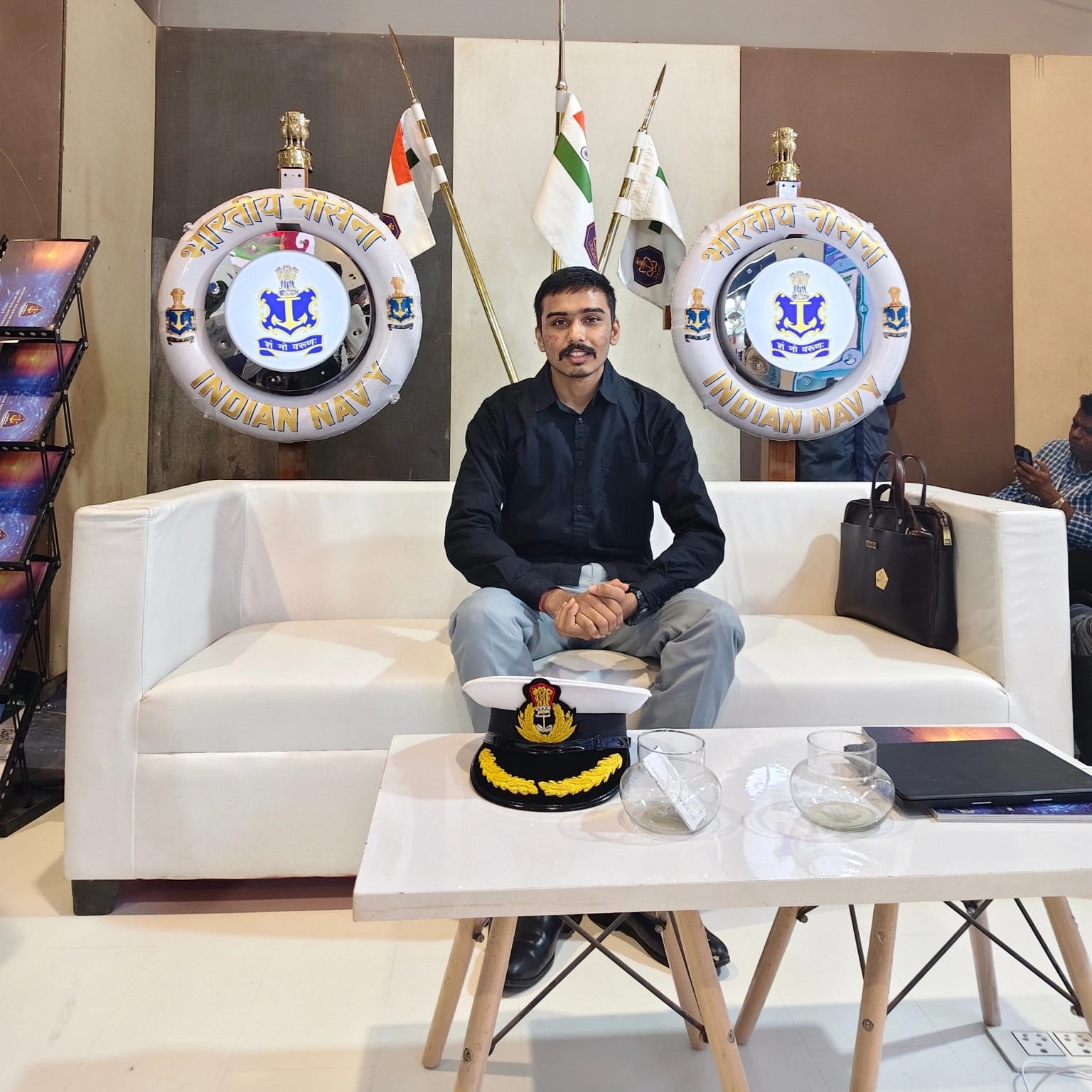
Aryan Madhur Singh is from Rajasthan, from an army-oriented family environment. Growing up in an army family exposed him to military culture and national service. This inspired him to pursue engineering and contribute to India. He went beyond the conventional paths and worked on this innovation of youth-led research and development for the armed forces.
His observation discipline began before he formally entered engineering. During his diploma years following Class 10, he developed the habit of analysing military situations rather than only reading the headlines. Aircraft crashes, naval limitations, security incidents: each one became an analytical exercise. Why had the system failed? What technical or strategic gap had the incident exposed? Was there a technological solution that could prevent recurrence? The discipline produced his earliest defense innovation concepts, including the underwater deception ideas that later matured into LuneX and JalMaya.
Diploma-to-Degree in Aeronautical Engineering at Parul University
Aryan took admission to Diploma to Degree (D2D) in Aeronautical Engineering at Parul University, which started as a diploma and B.Tech degree in aeronautics. The course D2D is designed for lateral entry continuity, allowing diploma passouts to enter the degree course based on the foundation they built during their diploma years. In this D2D course, students can directly enter into the second year of the corresponding B.Tech without restarting.
For students with applied technical interests like Aryan’s, the pathway preserves the hands-on diploma background while adding the deeper engineering and design knowledge that B.Tech provides.
Despite the operational demands of running KarmYodha, securing patents, building a research team, and engaging with defense sector professionals, Aryan has maintained a CGPA of approximately 9.0 across his B.Tech program. The combination of innovation-track work and academic discipline reflects the institutional support framework at Parul University, where faculty have extended structured academic flexibility to enable the kind of research participation Aryan has pursued. The relationship between supportive institutional posture and student innovation output is a documented pattern.
KarmYodha: the youth-led defence R&D initiative
KarmYodha is the youth-led defence research and development initiative Aryan Madhur Singh founded with the explicit mission of developing indigenous solutions for the Indian Armed Forces. Unlike conventional student innovation groups that compete in hackathons and submit capstone projects, KarmYodha operates with a mission-oriented approach: identifying genuine operational gaps within the defence ecosystem, validating those gaps through interaction with senior officers and defence professionals, and transforming them into practical technological solutions backed by intellectual property generation.
The initiative’s distinguishing methodology is the validation step. Before initiating development on any project, the KarmYodha team consults with senior officers, dignitaries, and professionals associated with the defence sector to confirm that the operational gap being addressed is real and consequential. The discipline prevents the common student-innovation failure mode of building technically interesting solutions to problems that the field does not actually have. This innovation aligns with the vision of Aatmanirbhar Bharat. This government initiative focuses on self-reliance, reducing imports, and utilizing the skills, brains, innovations, technologies, research, manufacturing, and IP development of India.
KarmYodha’s team includes Aryan Madhur Singh as founder, along with Jainil Chanpaneria, Tirthraj Vaghela, Mitushi Sharma, Hiya Vyas, Trijay Goswami, and Alpa Patel. Each team member contributes to research, ideation, technical discussion, validation, and mission-oriented concept development across the initiative’s portfolio. The team operates under the broader research environment of the Parul Institute of Engineering and Technology, with mentorship support from Squadron Leader Gaurav Sharma of the NCC Department at Parul University.
Read More: Solnce Energy, India’s first solar bidding platform.
The three innovations: JalMaya, LuneX, and ALCAS
The KarmYodha innovation portfolio currently includes three documented projects: JalMaya, LuneX, and ALCAS. Each addresses a distinct operational gap in Indian defence capability. Two are backed by filed patents.
JalMaya: patent-backed passive sonar deception in AUVs
JalMaya is the patent-backed innovation for which Aryan Madhur Singh is listed as the sole inventor. The patent titled ‘Passive Sonar Deception in AUVs‘ was filed on 31 July 2025 and currently holds published status. The innovation falls within the domain of naval defence and underwater countermeasures. The system is designed to passively bend enemy sonar signals and generate false submarine illusions that confuse hostile anti-submarine warfare tracking systems.
The strategic philosophy underlying JalMaya is intelligent passive defence rather than direct offensive engagement. Modern naval warfare depends heavily on sonar systems for submarine detection and tracking, and enemy anti-submarine warfare units rely on sonar reflections and acoustic signatures to identify underwater threats. By disrupting the enemy’s sonar interpretation rather than emitting active counter-signals that would themselves be detectable, JalMaya enhances submarine survivability while preserving operational concealment. The system demonstrates advanced understanding of underwater acoustic propagation, sonar interaction, and autonomous underwater deployment concepts, with scalable nature and swarm-compatible deployment possibilities.
LuneX: autonomous underwater sonar deception platform
LuneX is the active innovation project that builds on the JalMaya foundation. The system is designed as a compact and autonomous underwater platform capable of mimicking the acoustic signature of submarines through autonomous underwater vehicles. By deploying small underwater vehicles, LuneX generates false-target acoustic cues and sonar scattering patterns that mislead hostile anti-submarine warfare operators and systems.
A defining engineering characteristic of LuneX is passive operation. Unlike active electronic warfare systems that emit detectable signals, LuneX operates without generating active noise emissions. This increases stealth capability while improving survivability for host submarines and naval assets. The innovation also supports swarm-ready deployment concepts through coordinated autonomous underwater vehicles, reflecting forward-looking research aligned with emerging naval warfare strategies that involve unmanned and distributed underwater systems. The combination of underwater acoustics, autonomous systems, naval defence strategy, and sonar manipulation in a single platform demonstrates the kind of integrated systems thinking that defence engineering at scale requires.
Read More: Gaurav Taneja at Aviation Fest 2026.
ALCAS: Auto-Locking Canopy Activation System for aircraft safety
ALCAS, the Auto-Locking Canopy Activation System, is the third major KarmYodha innovation. The patent titled ‘Inertial-Triggered Auto-Locking of Aircraft Canopies’ was filed on 15 October 2025 and currently holds published status. ALCAS was developed collaboratively by Aryan Madhur Singh and Jainil Chanpaneria. The system is focused on pilot safety and cockpit security in fighter and trainer aircraft during emergency situations and high-risk flight conditions.
ALCAS is designed as a mechanical-electronic safety system that automatically locks aircraft canopies during flight, activating upon detection of critical flight conditions such as high G-forces, emergency manoeuvres, crash situations, or ejection scenarios. A major engineering advantage is the fail-safe architecture: the system functions even during electrical or system failures, ensuring that canopy integrity is maintained during emergencies. For combat aircraft where pilot survivability is the highest priority, systems that improve emergency response reliability are strategically valuable. The innovation reflects an engineering philosophy of simplicity, reliability, and operational effectiveness, integrating mechanical fail-safe mechanisms with intelligent activation logic to address critical vulnerabilities in emergency canopy operations.
The networking discipline: how a student reached defence professionals
One of the most operationally instructive parts of Aryan Madhur Singh’s journey is his networking discipline. Most engineering students treat the field of defence as inaccessible: a closed community of officers, scientists, and senior professionals who exist outside the reach of an undergraduate student. Aryan demonstrated the opposite. He used LinkedIn systematically to contact defence and aerospace professionals, sending messages and emails with the confidence and clarity that converted cold outreach into substantive professional relationships.
He regularly followed defence content creators including Squadron Leader Shivam Uppal, whose discussions on aviation systems and Indian defence innovations shaped his analytical orientation. His ongoing mentor at Parul University is Squadron Leader Gaurav Sharma of the NCC Department, who has provided guidance on innovation presentation, intellectual property protection, and the institutional posture required to convert student-level technical ideas into patent-worthy contributions. The combination of public domain content consumption (LinkedIn-based defence discussions) and structured institutional mentorship (NCC Department supervision) produced an unusual depth of contextual understanding for an undergraduate student.
NDTV national recognition and the India Book of Records
Aryan Madhur Singh’s research has been featured on NDTV national television, covering KarmYodha’s ongoing work on indigenous unmanned aerial vehicles, underwater acoustics, and electronic warfare technologies. The national coverage represents a significant validation of youth-led defence innovation in India, demonstrating that student research can produce contributions that warrant mainstream media attention rather than only academic recognition.
Aryan Madhur Singh has also been recognised by the India Book of Records for his work, an achievement that increases the credibility of his innovation portfolio in formal and public-facing contexts. The recognition trajectory itself is instructive: it began with local coverage anchored in regional newspaper visibility, expanded to state-level recognition as the work matured, and reached national television only after the technical depth of the patents and the institutional credibility of the initiative had compounded sufficiently. Aryan has been explicit that the recognition was the consequence of sustained work rather than the goal, and that the work was visible long before the recognition arrived.
Alignment with Atmanirbhar Bharat and the broader vision
KarmYodha’s mission aligns directly with the Atmanirbhar Bharat vision of technological self-sufficiency, indigenous manufacturing, and reduced foreign dependence in strategic sectors, particularly defence. Each of the three documented innovations contributes to this vision: JalMaya and LuneX address underwater warfare technologies where India has historically relied on imported systems, while ALCAS addresses combat aviation safety where indigenous innovation reduces both procurement cost and operational dependency.
The forward roadmap for KarmYodha includes engagement with the Defence Research and Development Organisation (DRDO) and iDEX (Innovations for Defence Excellence), the Government of India’s flagship defence innovation programme that provides funding access for promising indigenous defence technologies.
What this means for Parul University and engineering students
Aryan Madhur Singh’s trajectory at Parul University sits within a broader institutional pattern of research and innovation visibility. The recently held 8th PiCET 2026 International Conference on Engineering and Technology featured 406 research papers across four tracks including networking and cybersecurity, computing and data science, sustainable interdisciplinary applications, and AI/ML, with four international keynote speakers. The Lakshya 2047 Centre for Future Skills, Gujarat’s first NSDC Centre for Future Skills inaugurated on 8 May 2026, provides advanced laboratory infrastructure across VLSI, AR/VR, robotics, and embedded systems that directly supports the kind of defence-oriented research KarmYodha is engaged in.
For B.Tech students at the Faculty of Engineering and Technology, the KarmYodha example demonstrates that student-led innovation at scale is structurally possible at Parul University. The institutional support framework, the available laboratory infrastructure, the faculty mentorship pipeline through bodies like the NCC Department, and the broader research culture across the campus collectively create the conditions under which a D2D student from Rajasthan can become a two-patent defence innovator with NDTV recognition. The pathway is not exceptional. It is reproducible by any student willing to combine technical work with the observation discipline, networking discipline, and validation discipline that KarmYodha’s methodology requires.
FAQs
Who is Aryan Madhur Singh?
Aryan Madhur Singh is a Parul University graduate who started his journey with a diploma in aeronautical engineering and then took a B.Tech. in the same field. He is from Rajasthan and founded KarmYodha, an initiative that is youth-led defense research and development for armed forces. He also worked on other inventions too, like the JalMaya patent, where he was the sole inventor, and co-invented ALCAS patented titled 'Inertial-Triggered Auto-Locking of Aircraft Canopies. These consistent efforts got noticed by NDTV News, which shared his story, and he was recognized by the India Book of Records. He maintains a CGPA of approximately 9.0 across his B.Tech programme.
What is KarmYodha ?
KarmYodha is a youth-led defence research and development initiative founded by Aryan Madhur Singh at Parul University. The initiative's mission is to develop indigenous solutions for the Indian Armed Forces including the Indian Army, Indian Navy, and Indian Air Force. Unlike conventional student innovation groups, KarmYodha operates with a mission-oriented approach: identifying genuine operational gaps within the defence ecosystem through interaction with senior officers and defence professionals, validating problem statements before development, and transforming the validated gaps into practical technological solutions backed by intellectual property generation. The initiative aligns directly with the Government of India's Atmanirbhar Bharat strategic vision of technological self-sufficiency in defence.
What is the JalMaya patent?
JalMaya is a patent-backed defence innovation by Aryan Madhur Singh of Parul University. The patent titled 'Passive Sonar Deception in AUVs' was filed on 31 July 2025 and currently holds published status, with Aryan Madhur Singh listed as the sole inventor. The innovation focuses on naval defence and underwater countermeasures: it passively bends enemy sonar signals and generates false submarine illusions that confuse hostile anti-submarine warfare tracking systems. The strategic philosophy is intelligent passive defence rather than direct offensive engagement, enhancing submarine survivability while preserving operational concealment. The system demonstrates advanced understanding of underwater acoustic propagation, sonar interaction, and autonomous underwater vehicle deployment concepts.
What is the LuneX system?
LuneX is a passive sonar deception system developed under the KarmYodha initiative at Parul University. The system is designed as a compact and autonomous underwater platform capable of mimicking the acoustic signature of submarines through autonomous underwater vehicles. By deploying small underwater vehicles, LuneX generates false-target acoustic cues and sonar scattering patterns that mislead hostile anti-submarine warfare operators. A defining engineering characteristic is passive operation: unlike active electronic warfare systems that emit detectable signals, LuneX operates without generating active noise emissions, increasing stealth capability while improving survivability for host submarines and naval assets. The system also supports swarm-ready deployment concepts through coordinated autonomous underwater vehicles.
What is the ALCAS aircraft canopy patent?
ALCAS, the Auto-Locking Canopy Activation System, is a defence innovation patent developed by Aryan Madhur Singh and Jainil Chanpaneria under the KarmYodha initiative at Parul University. The patent titled 'Inertial-Triggered Auto-Locking of Aircraft Canopies' was filed on 15 October 2025 and currently holds published status. ALCAS is designed as a mechanical-electronic safety system that automatically locks aircraft canopies during flight upon detection of critical flight conditions including high G-forces, emergency manoeuvres, crash situations, or ejection scenarios. A major engineering advantage is the fail-safe architecture: the system functions even during electrical or system failures, ensuring canopy integrity during emergencies. The innovation is strategically valuable for combat aircraft where pilot survivability is the highest priority.
Which Parul University programmes support defence and aerospace innovation?
Parul University supports defence and aerospace innovation primarily through the B.Tech in Aeronautical Engineering, the Diploma in Aeronautical Engineering, and the broader engineering programmes at the Parul Institute of Engineering and Technology including B.Tech in Electronics and Communication Engineering, B.Tech in Computer Science Engineering, and B.Tech in Mechanical Engineering. The NCC Department at Parul University provides structured mentorship for students pursuing defence-oriented research, including the guidance Aryan Madhur Singh received from Squadron Leader Gaurav Sharma. The Lakshya 2047 Centre for Future Skills, inaugurated in May 2026, provides advanced laboratory infrastructure across VLSI, embedded systems, AR/VR, and robotics that directly supports defence engineering research. PIERC, the Parul Innovation and Entrepreneurship Research Centre, extends incubation and funding support to student-led ventures including those operating in defence and aerospace domains.


