

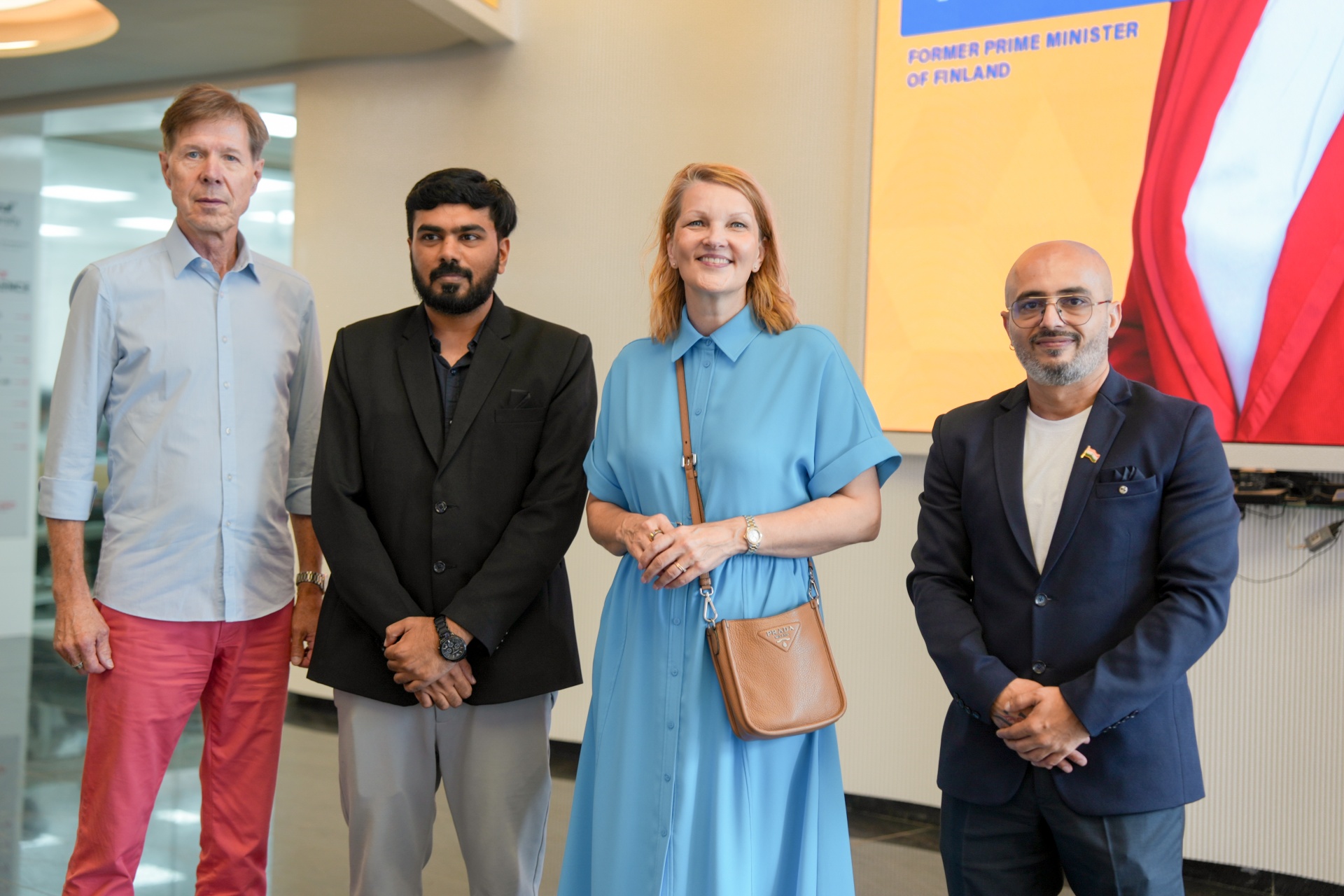
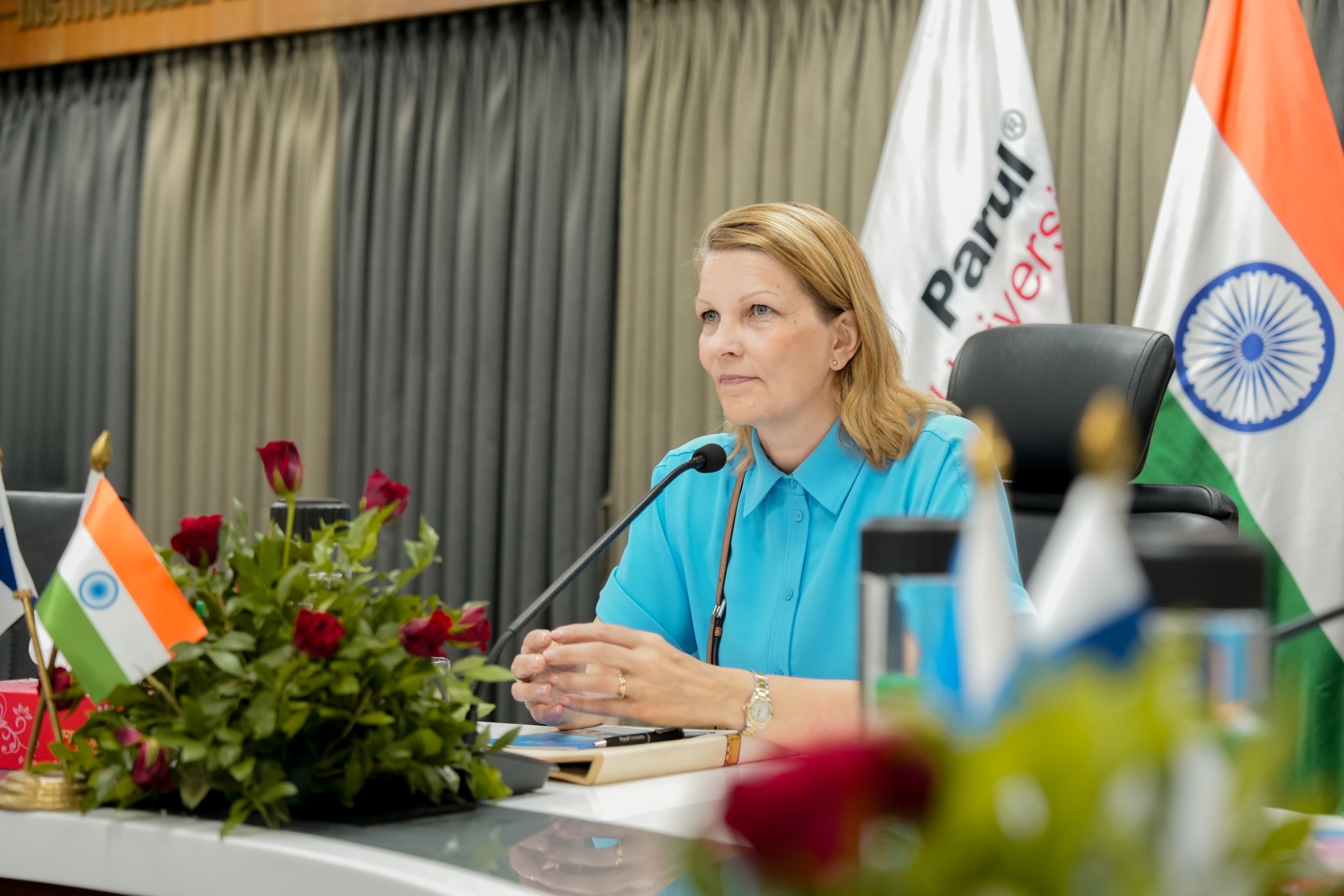
On 16th September 2026, Parul University’s Central Auditorium was buzzing with discussions on how Finland stays on top in the Happiness Index globally. In the 2nd edition of the Global Perspective Series, Parul University was thrilled to welcome H.E. Mari Kiviniemi, Former Prime Minister of Finland, to address students on leadership, cultural diversity, courage, and holistic happiness. It was held in collaboration with IIMUN.
H.E. Mari Kiviniemi
Mari Kiviniemi served as the 41st Prime Minister of Finland, and she was the second woman to hold this position. After serving her contributions as Minister for European Affairs and Minister of Public Administration in the Finnish Parliament for over 2 decades, she later joined as Deputy Secretary-General of the OECD and a member of Club de Madrid. As moderated by RJ Kshitij, with a welcome from anchor Jaimin Thakkar, the session drew warm applause and a standing ovation from students across the university’s many programs.
The Happiest Country on Earth
Asked the question the world keeps asking, how does Finland stay the happiest country? Mari Kiviniemi offered a grounded answer. She said, Finns are not always bursting with joy; they’re simply content with their lives, and thanks to a highly functional society. Safety is central for all, be it a child or anyone; people trust the system and each other. Strong public safety means if someone falls ill, society supports them, followed by removing stress from everyday life.
The Path to Leadership
Mari Kiviniemi traced her own journey with candour. She grew up in a family where politics was dinner-table conversation, and rather than run from it, she was curious. She got involved in her party’s youth organisation as a student, ran (unsuccessfully) in the 1994 presidential electoral college election, and was first elected to Parliament in 1995, entering national politics in her mid-twenties.
She had chosen to study economics, not general business, precisely to understand how a society and its economy function, knowledge that later helped her make realistic promises on the campaign trail. Interestingly, she did not see herself as a typical extroverted politician and once imagined becoming an advisor rather than a leader; she did, in fact, serve as special advisor to Prime Minister Matti Vanhanen before rising further herself.
Women in Leadership Front!
She said that Finland has a long and proud history of women in power. Today, half of its Parliament Members are women, and they have served as Speakers, Presidents & Prime Ministers. Her own journey was not a historical event but a natural progression. About the corporate world, she drew a sharp contrast and said it has fewer women at the top and recalled scepticism from elder male executives, which she eventually chose to ignore and focused on her work.
The Weight of the Office, and Real Courage
What is it like to lead a country? Mari Kiviniemi described the full, constant weight of responsibility.
When you are a regular minister, your power is specific to your department. But as prime minister, all eyes are on you. You are the first person people look at when you enter a room.
– H.E. Mari Kiviniemi, Former Prime Minister of Finland
Yet political power, she stressed, is rarely absolute. She compared the prime minister to the conductor of an orchestra: in Finland’s coalition governments, you cannot simply sign a paper and act; you must listen, negotiate, and work as a team. She illustrated real courage with a decision from her own tenure.
During Europe’s financial crisis, supporting bailout packages for struggling economies was deeply unpopular at home, even within her own party, but she judged it necessary for the long-term health of the European economy and pushed it through, knowing it could cost her the next election. It did. She holds no regrets, framing it as the difference between worrying about the next election and the next generation.
The Room Decides: Reform, AI, and a Cabinet Under Pressure
The session’s liveliest stretch was interactive. One exercise involved the student deciding whether it was the best thing for a prime minister to carry out a reform that the youth are against. Kiviniemi also said the reform was needed but that there was a big lesson: If the young are angry, it must be because the leader has failed to communicate, and in today’s noisy, social media world, a message has to be explained patiently and repeated until people feel heard. In a second exercise on AI in education, students pleaded for the redesign of assessments; instead of preventing the use of AI; banning it is the wrong way to go, said Mari Kiviniemi, and AI should be used wisely, but only after the basics of reading and mathematics are mastered so that students can analyse and use it well.
Wisdom for the Next Generation
In a wide-ranging Q&A, students pressed her on leadership, and her answers were consistent. On international exposure, she called it vital in a world without strict boundaries, noting that universities like Parul provide such networks naturally. On navigating misinformation, she called critical thinking the most important survival skill and a solid education its foundation, paired with a willingness to keep learning as the world changes. On compromise, she said coalition politics runs on it, but one can compromise without losing one’s soul. And on creating change, she urged students to start at the grassroots, join a local youth organisation, get involved in community work, and not underestimate local politics.
India and Finland: Learning From Each Other
Asked to compare the two countries, Mari Kiviniemi said she was struck by India’s startup culture and entrepreneurial energy, something Finland, itself striving to be a startup hub, could learn from. In turn, she felt India could learn from Finland’s welfare model and free education system. Both nations, she concluded, have real strengths and can grow by observing each other. She closed by sharing that she chairs the board of the University of Vaasa in Finland and genuinely loves speaking with young people, whom she called the future. The session ended with a standing ovation and a soft chorus of “Kiitos,” thank you in Finnish.
Why Leaders Like This Come to Parul University
Former heads of government and top-level international personalities are choosy about where they go and what they do; they only accept invitations from institutions they believe to be serious, outward-looking, and worth engaging. Only in the past few months, Parul University has hosted a Former Prime Minister of Finland and a Former Chief Justice of India in open, one-on-one dialogues with its students. That is not a one-off; through platforms like the Global Perspective Series, convening leaders of this caliber has become a standing feature of campus life, and the pattern itself says something real about the university’s standing and ambition. Here, students debated the former prime minister directly, ran a live cabinet simulation, questioned her on leadership, ethics, and compromise, and received honest, unscripted answers; the kind of exchange that lets a young person understand how top leaders actually think and decide. Direct access to that mindset, the reasoning behind hard choices, the discipline of long-term thinking, and the courage to act against short-term popularity is an education no textbook provides. Combined with a campus community drawing students from around 75 countries and the university’s wider international engagement, it gives students a genuinely global outlook and the confidence to carry it into their own careers.
This is, in the end, the clearest answer to anyone weighing what a university is worth: look at who chooses to walk through its doors and what its students are trusted to do once those doors open. When a former national leader spends a morning in open conversation with your students and leaves praising their sharpness, it reflects an institution doing something right. If you wish to study at a university where global personalities come and teach, delay not and save your seat for the upcoming year.
FAQs
Who is Mari Kiviniemi?
H.E. Mari Kiviniemi is the former PM of Finland, and she served as the second female prime minister from 2010 to 2011. She served as Minister for European Affairs and Deputy Secretary-General of the OECD, and then she joined the membership of Club de Madrid. She visited Parul University and addressed students on courage, happiness, and politics.
What did she speak about at Parul University?
In Parul University’s Global Perspective Series, she spoke on political leadership and courage, the responsibilities of the Prime Minister’s office, women in leadership, the responsible use of AI in education, and why Finland is the world’s happiest country, alongside interactive exercises and a student Q&A on leadership and international engagement.
What was her key message to students?
Her central messages were to value education and critical thinking as the foundations of leadership, to think long-term (worrying about the next generation, not just the next election), to communicate patiently, to start creating change at the grassroots, and to keep learning in a fast-changing world. She also emphasised the value of international exposure.


