Gone are the times when you can’t switch careers. This is the time to take advantage of your interests and develop a career in a technical field as well. You don’t need coding either. Wondering how to navigate careers in this direction? Here’s your proven guide to navigating your career from HR to a business analytics role. While studying or after graduation, students often feel, I don’t have a technical background; can I really move into analytics? Check out how one talented MBA student of Parul University navigated a career in business analytics with the sheer support of the Training & Placement Cell of Parul University!
What Business Analytics Actually Is (and Isn’t)
A common myth is that business analytics is really just software and coding.
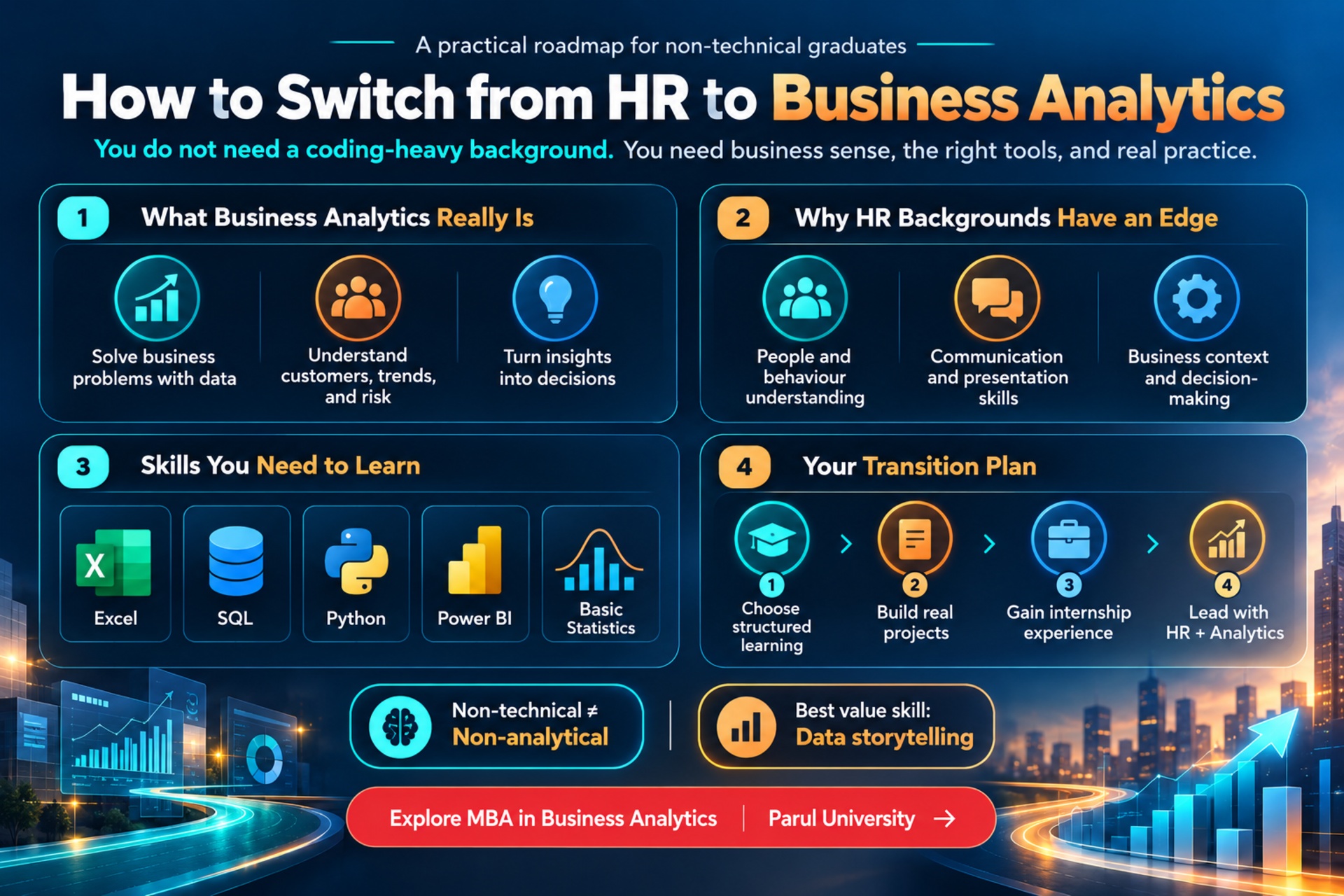
It isn’t. Business analytics is focused on solving business problems, understanding data, customer needs, trends, and how risk management works. Be it tools or any theory, the goal should be to apply real skills, asking the right business-centric questions and working on the data.
Why a Non-Technical Background Can Be an Advantage
Growing fields like HR, commerce, and marketing require skills such as communication, presentation, and understanding people to add analytical value.
- HR and management backgrounds bring an understanding of people, behaviour, and organisations, invaluable for interpreting data about customers and employees.
- Commerce and business backgrounds bring domain knowledge; you already understand the business problems analytics is meant to solve.
- Strong communicators can turn a complex analysis into a clear story a decision-maker will act on, often the rarest and most valued skill of all.
In short, the technical skills can be taught; the business sense and communication you already have are harder to build from scratch.
The Skills You Will Need to Learn
Making the switch does mean learning a practical toolkit. The core skills for business analytics are very learnable, and most structured programs teach exactly these:
- Excel, still the everyday workhorse of business data.
- SQL, for retrieving and working with data from databases.
- Python, for deeper analysis and automation (and far more approachable than beginners fear).
- A visualisation tool like Power BI, for turning data into dashboards decision-makers understand.
- Core concepts, such as hypothesis testing and basic statistics, to reason correctly about data.
How to Actually Make the Switch?
- Choose structured training, rather than piecing it together alone. A program (such as an MBA in Business Analytics) teaches the tools in the right order and connects them to business use.
- Build a project, not just skills. Nothing proves capability like a real analysis. One student built a company’s reporting system from scratch during an internship, then presented it, dashboard and all, to an industry jury.
- Learn on real problems. Internships and live projects teach what courses cannot and let you apply your existing business sense.
- Lead with your combination. “HR plus analytics” or “commerce plus analytics” is a distinctive, valuable profile, not a weakness.
A Word of Honesty
Rely on new tools, master communication and presentation skills, and study how data can be interpreted at all the level and that’s how you can enter into such roles and can lead. One of the students of Parul University even shared: The difference is not talent but the genuine willingness to decide how you want it and actually work after it. “If you’ve the instinct, analytics can be mastered via Parul University’s programs such as the BBA in Data Analytics or the Diploma Program in Business Analytics, and you can get to work for top analytical companies!
FAQs
Can I switch to business analytics without a technical background?
Yes. Business analytics is fundamentally about solving business problems with data, not just coding. People from HR, commerce, marketing, and the humanities regularly move into analytics, and their business understanding and communication skills are genuine advantages. The technical tools (Excel, SQL, Python, and Power BI) are very learnable with structured training.
Is business analytics hard to learn for beginners?
It is challenging but very achievable. The core tools, Excel, SQL, Python, and a visualisation tool like Power BI, are designed to be learned step by step, and a good program teaches them in the right order and ties them to real business use. Most learners find Python and SQL far more approachable than they expected.
Does a non-technical background help in analytics?
It can be a real advantage. Analytics is only useful if the insights can be understood and acted on, so communication, presentation, and an understanding of people and business strengths often built in non-technical fields are highly valued. Combining domain knowledge with data skills makes for a distinctive, in-demand profile.