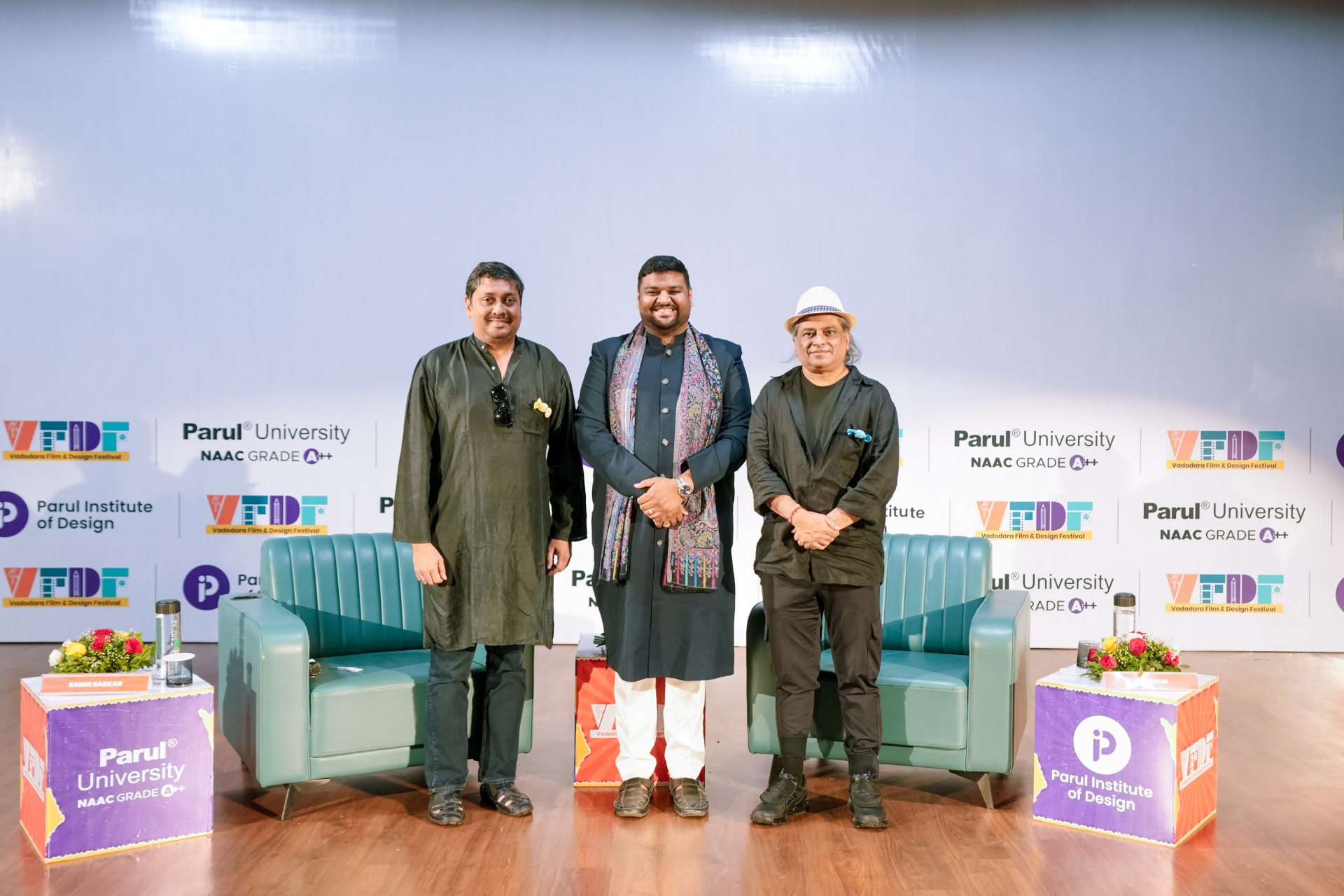
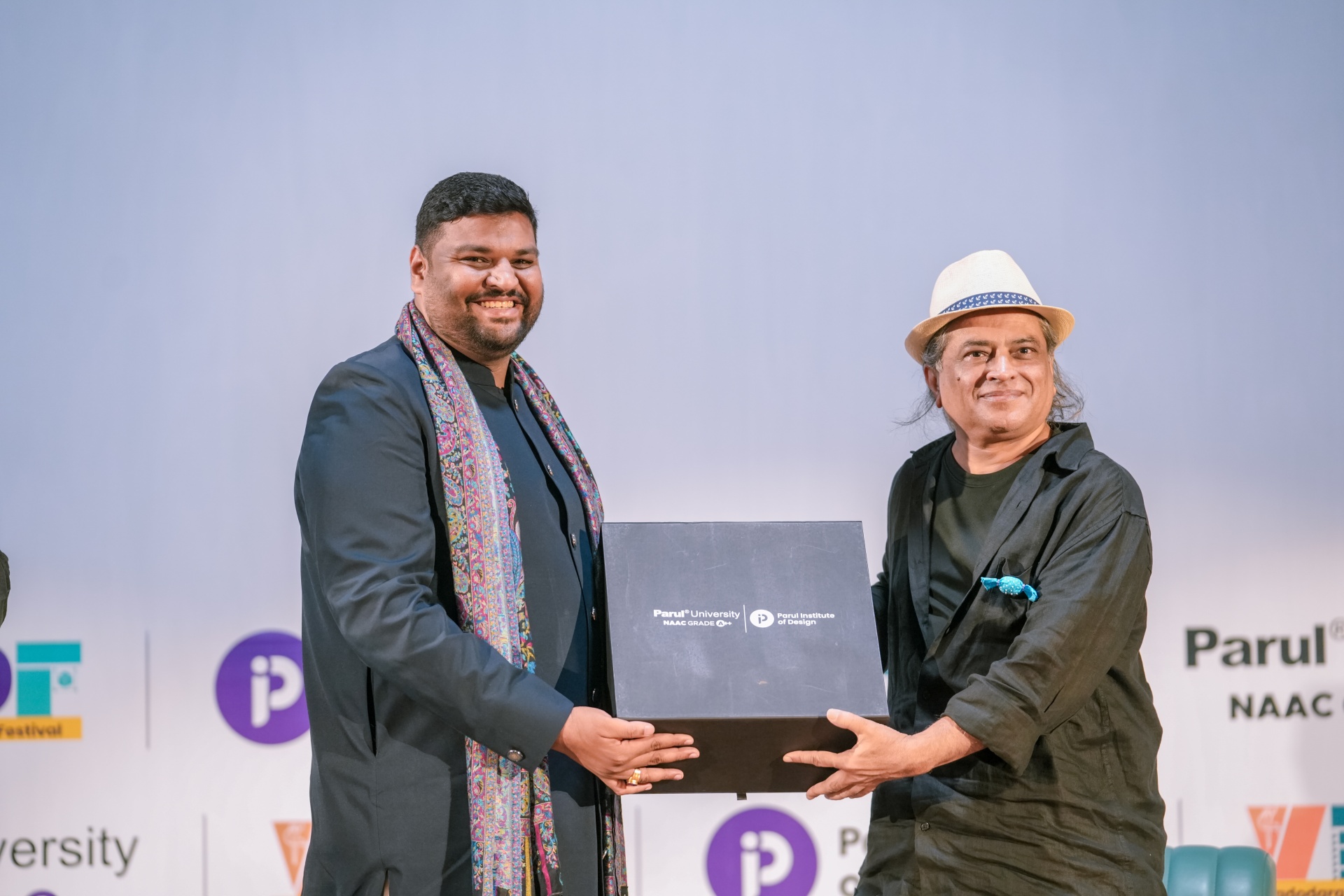
On the very first opening day of the Vadodara Film & Design Festival, held at Parul Institute of Design, a Gujarat-origin filmmaker who grew up in a Saurashtra village with zero access to cinema explained why he sold his Mumbai house to finance his most personal projects. Mr. Pan Nalin, director of Chhello Show (released globally as Last Film Show), made headlines when the film became India’s official entry to the 95th Academy Awards. The same film later went on to find audiences in Japan before returning to wider recognition in India.
In a deep conversation with moderator Sameer Sarkar at PID’s Central Auditorium, Nalin spoke about the path that brought him there. It began in a village with no cinema hall. It ran through one year of Fine Arts at MSU Baroda, graduation from the National Institute of Design, Ahmedabad, fifty wedding videos shot to finance his education, and old film cameras bought at Ahmedabad’s Sunday flea market. It eventually led to selling his Mumbai house because no producer was willing to fund the film he felt compelled to make.
The Filmmaker Behind Samsara, Angry Indian Goddesses, and Chhello Show
Pan Nalin’s filmography runs across three decades of international co-production. His work has been made with partners from France, Germany, Italy, Japan, and the United States. The feature films his PID session drew on include:
- Samsara (2001) – A meditation on desire and renunciation, shot across the Himalayas with an international production team.
- Valley of Flowers (2006) – A period romance filmed in the Himalayan mountains.
- Ayurveda: Art of Being (2001) – A documentary exploring India’s traditional medical systems and healing practices.
- Faith Connections (2013) – A documentary shot during the Kumbh Mela, examining faith, devotion, and spiritual spectacle.
- Angry Indian Goddesses (2015) – Widely described as India’s first female buddy film.
- Beyond the Known World (2017) – An Indo-New Zealand co-production exploring grief and travel.
- Last Film Show / Chhello Show (2021) – The semi-autobiographical coming-of-age film that became India’s official entry to the 95th Academy Awards.
- If you’re passionate about filmmaking, you too can learn to write, shoot, and execute films by enrolling into PID’s B.Sc in Film & TV Production program!
His shorter works and non-fiction films include The Khajuraho (1991), The Doubt (1995), the Eiffel Tower Trilogy of Height, Weight, and Gravity (1997), Echo of Eco (2009), and The Tiniest Invisible Piece of Shit (2020). The through-line across every project, Nalin told the room, is that documentary work was never a step backward from fiction. It was the route that kept him employed while the fiction films waited for funding.
The Chhello Show Story: A House Sold, a Friend Lost, Bangles Made From Film Reels
Chhello Show is a semi-autobiographical film about a village boy discovering cinema for the first time. When Pan Nalin began trying to make it, no producer in India wanted to back the project. He eventually raised just enough money to begin shooting the film independently.
The film released in India with limited attention. Then it opened in Japan and unexpectedly found its first major audience there. Japanese viewers connected immediately with the film’s emotional core and nostalgia for disappearing cinematic traditions. The film became a box-office success in that market and gradually worked its way back into Indian conversation through international recognition.
After the success of the film, Nalin went looking for a man named Muhammad Bhai, who had helped him at the beginning of his career. He eventually found him selling vegetables from a roadside stall. Muhammad Bhai, who had once worked around film distribution and projection culture, told Nalin something he said he has never forgotten. The old film reels, the physical celluloid prints that once carried the performances of Amitabh Bachchan and countless other stars, had eventually been melted down and repurposed into bangles.
“Film reels to bangles. Whenever I see someone adorning bangles, I keep thinking about that transformation. Those bangles surely might carry countless films, memories, and emotions.”
The anecdote became the emotional spine of the session. Chhello Show is a film about a boy learning to love cinema. Muhammad Bhai’s story about the bangles became evidence that the physical form of cinema eventually disappears. What survives is the story itself, not the reel that once carried it.
Vadodara Film & Design Festival 4.0 – Master Designing in the Age of AI!
Pan Nalin briefed students about storytelling, risk & age of content!
The session carried several lines that Nalin returned to repeatedly, each compact enough to stay with the audience long after the discussion ended:
“The peak and foremost way to judge a filmmaker is by his designed films.”
“Beyond money, you just need desire, passion, and kuch kar dikhane ki aag.”
“One village in India has millions of stories to tell.”
“Unless you taste film, you are trapped in content.”
“Think locally to start making the film.”
The last of those ideas resonated strongly with the students in the room. When PID students asked about entering the industry, Nalin advised them not to chase the global market directly. According to him, global audiences arrive naturally when the local specificity is honest and deeply observed. Chhello Show did not connect with audiences in Japan because it tried to imitate Japanese cinema. It travelled because the village, its emotions, and its details felt authentic.
On the larger question of cinema becoming “content,” Nalin was direct. He said he does not want to be positioned as an “alternative filmmaker.” He is not against technology, vertical storytelling, AI, or hybrid forms combining anime and cinema, as long as the emotional connection survives. What he resisted was the reduction of cinema into endlessly scrollable content optimised only for attention spans. Do you binge-watch animated shows? Why just watch when you can learn to create one with a full-fledged production pipeline? Enrol into Parul University’s B.Sc in Animation and VFX program!
Parul Institute of Design Exhibition: 6 Departments, 300+ Student Projects
Why This Session Landed Differently at PID
Three details from Pan Nalin’s biography made this session resonate even more strongly at Parul Institute of Design.
First, Nalin spent a year at the Faculty of Fine Arts at MSU Baroda. He has often spoken about how it was in Vadodara that he first discovered Hollywood and world cinema. The city is not a footnote in his story. It is where the story became visible to him. For PID students, many of whom are also in Vadodara by choice rather than default, that detail subtly reframed the geography around them. The city stops looking like a limitation and starts functioning as a filter for people serious enough to stay and create.
Second, Nalin graduated from NID Ahmedabad. The design-to-film trajectory is not a detour in Indian creative education. It is an established pathway. Design schools in India have consistently produced filmmakers, animators, and visual storytellers working internationally. PID’s own B.Sc Film and TV Production and B.Sc Animation and VFX programmes exist inside a design faculty for precisely that reason.
Third, Nalin financed his early career by shooting nearly fifty wedding videos. He bought his first film cameras from Ahmedabad’s Sunday flea market and used them to make four animation projects and around twenty silent short films. Many of those early works were never completed because he could not afford sound recording or lab processing. The projects were imperfect, under-resourced, and in some cases lost entirely. But they were still made. That detail carried particular weight in a room full of students whose own first projects are also being built under limitations.
Frequently Asked Questions
Who is Pan Nalin?
Pan Nalin (born Nalin Kumar Pandya) is an Indian filmmaker known for Samsara (2001), Angry Indian Goddesses (2015), and Chhello Show (2021). His work is co-produced internationally with partners from France, Germany, Italy, Japan, and the United States. Chhello Show was India's official entry to the 95th Academy Awards.
What is Chhello Show about?
Chhello Show, released internationally as Last Film Show, is a semi-autobiographical film about a young boy in a Saurashtra village discovering cinema. The film draws on Pan Nalin's own childhood. It was India's official entry to the 95th Academy Awards in the Best International Feature Film category.
Did Pan Nalin really sell his house to make Chhello Show?
Yes. Speaking at Parul Institute of Design during VFDF 4.0 on 8 April 2026, Pan Nalin confirmed he sold his Mumbai house to finance Chhello Show because no producer in India was willing to fund the film at the time.
Where did Pan Nalin study ?
Pan Nalin studied Fine Arts at MSU Baroda (Faculty of Fine Arts, Maharaja Sayajirao University of Baroda) for one year before completing his education at the National Institute of Design (NID), Ahmedabad. He has said it was in Vadodara that he first discovered Hollywood and world cinema.
Does Parul Institute of Design offer programmes in film and television?
Yes. Parul Institute of Design offers a Bachelor of Science in Film and TV Production (3-year programme, available in Regular and Honours formats) covering screenwriting, direction, cinematography, sound design, production design, editing, and colour grading. The programme is part of the Faculty of Design at Parul University and admits students through the PU-DAT entrance exam. PID student films have been selected for international festivals including the Festival de Cannes Short Film Corner and CUIFF Film Festival 2025.
What did Pan Nalin say about the future of cinema?
At PID he argued that the future belongs to storytellers, not technology. He is open to new formats including vertical video and cinema-anime hybrids, but drew a line against cinema being reduced to scroll-optimised content. His position: tools will change, but storytelling does not.


