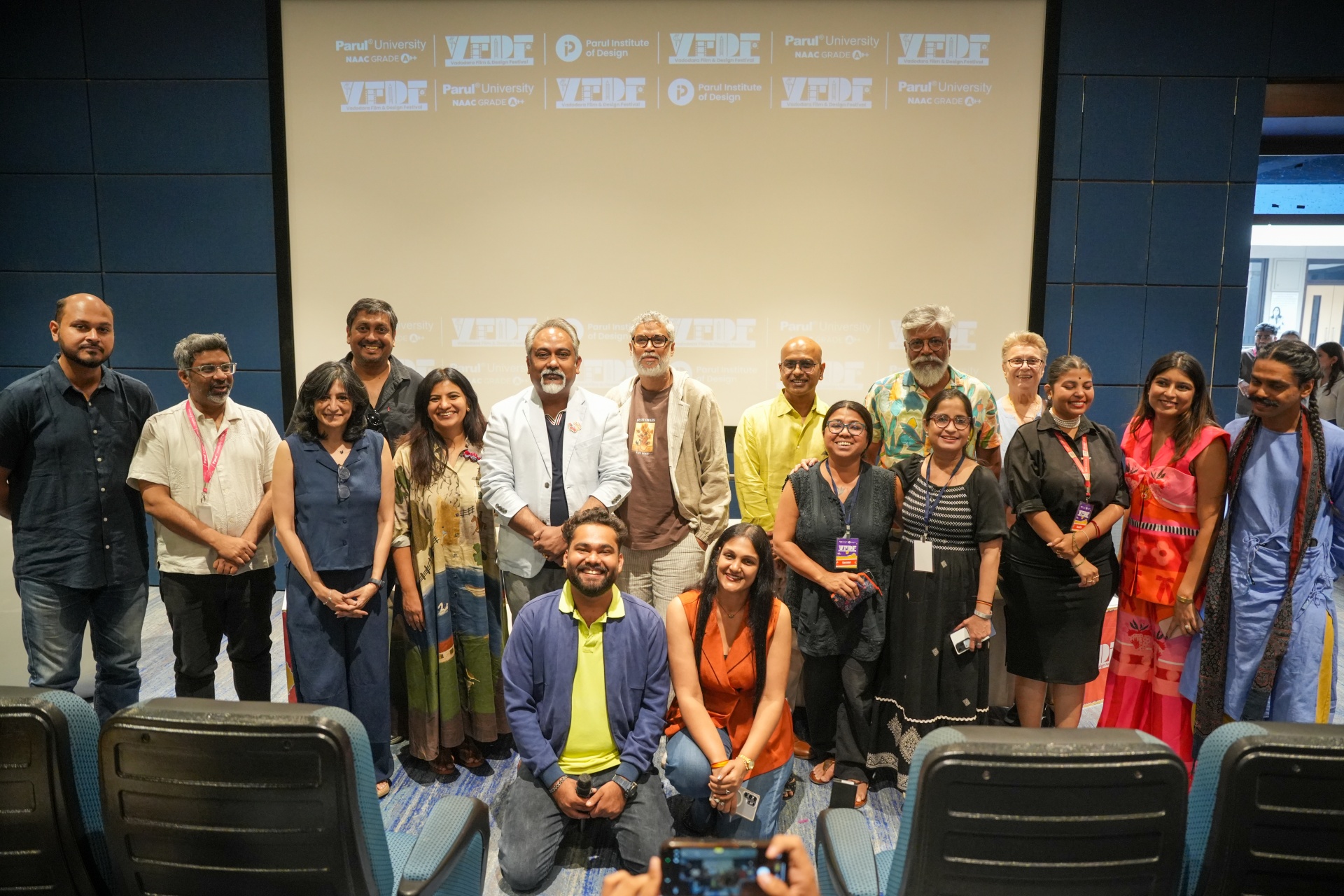
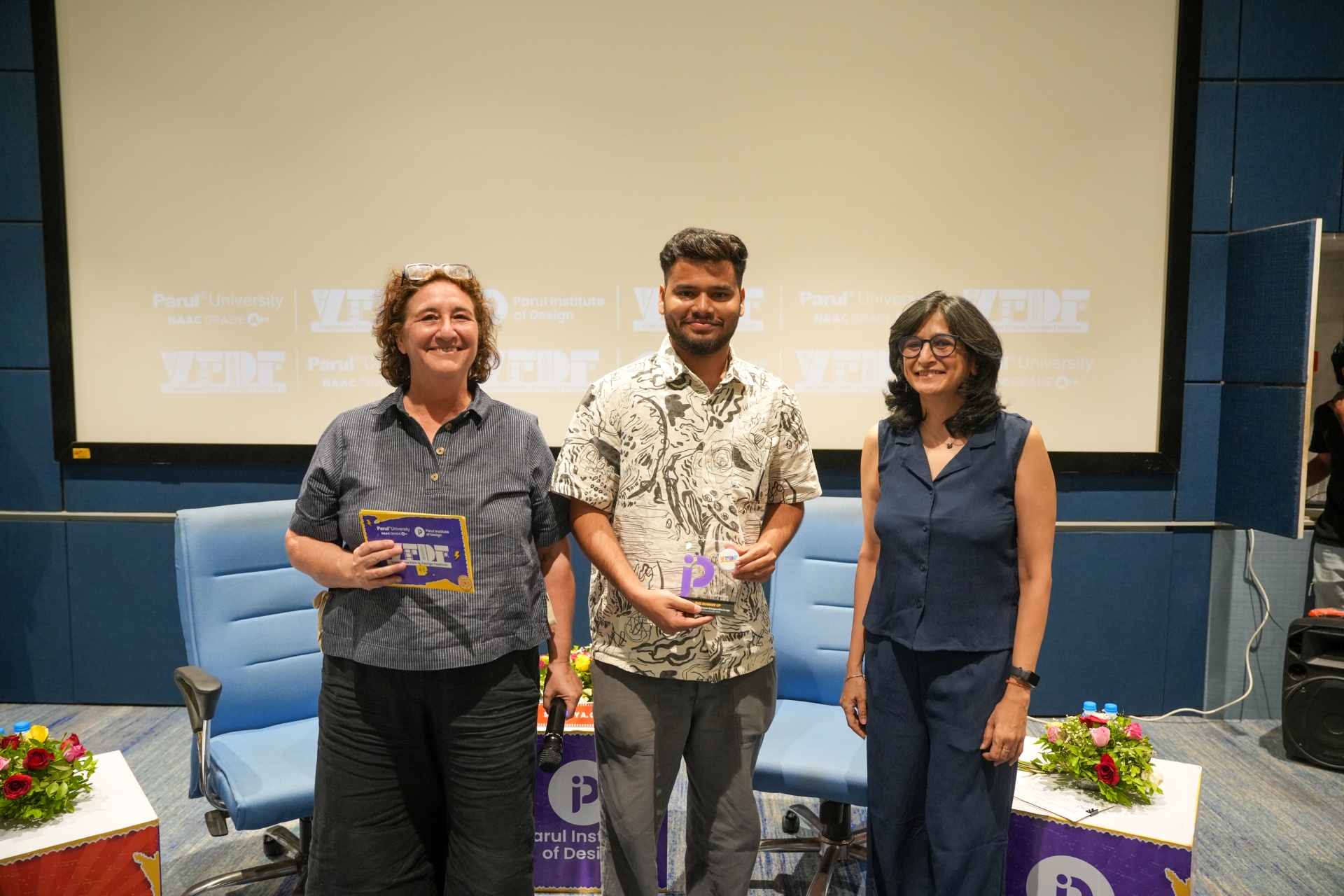
On the opening day of the Vadodara Film and Design Festival at Parul Institute of Design, a French producer began her three-hour workshop not with filmmaking theory but with a game.
Dominique Welinski produced the internationally released film Oblivion Verses and convenes the Cannes Factory programme at Festival de Cannes that pairs young international directors across cultures to co-create short films. Her workshop title was Shaping Narratives in Cinema. She spent the first chunk of it asking every student in the room to spend three minutes describing their relationship to their own name.
The lesson arrived after the exercise. Every student had held the room for three minutes because the story they told was personal. No student had been boring. That was the rule she was about to teach them: a pitch that does not begin with something personal will lose the listener in the first 60 seconds.
Welinski’s path to producing was unusual. She did not train in film. She trained in contemporary dance in the late 1980s in Europe. At that time, she disliked cinema because she found it dictatorial. A filmmaker imposed their version of the world on an audience watching a dead screen.
Then she ended up on a film set by accident. What she saw there was not dictatorship. It was coordination. If the team did not synchronise perfectly in fractions of a second, the shot did not happen. Cinema was not solo authorship. It was collective execution.
The second realisation was scale. In dance, she had struggled to get 50 people into a room for a performance. In cinema, 50 people was one screening in one theatre. The reach was orders of magnitude larger.
She moved into film distribution first, setting up a company with friends to distribute independent American films in Europe. The company ran for nearly two decades. Then the industry shifted from celluloid prints to digital files, and suddenly cinema owners could swap her small films out with a button click whenever a Hollywood title arrived. She exited distribution.
The move to production came when an Iranian director exiled from his country approached her to produce a film titled Oblivion Verses. The film took eight years to make. Because the director could not return to Iran, the Iranian-scripted film was eventually shot in Chile, using Latin American actors, with the Muslim graveyard rewritten as a Christian one and the tea scenes replaced with the national alcohol of Chile. It won awards in Venice.
The Cannes Factory Programme: Why Cross-Cultural Failure Is Instructive
Welinski’s current flagship programme is Factory, which she convenes at Cannes. The model: four young international directors are brought to an unfamiliar country to co-create short films with four local directors. They have a few months. The constraint is deliberate: force two cultures to collaborate under time pressure and see what survives.
The first edition in Taiwan failed in specific ways. Four foreign directors worked with four Taiwanese directors who did not speak English. The translations were literary instead of conversational. Films that were supposed to be 15 minutes became 25 minutes or 10 minutes after the foreign directors left. At the final screening, one Iranian director made racially charged comments about Taiwan’s culture and its mayor. The Taiwanese side nearly sued the programme.
“This was a very fast learning experience.”
Welinski described the failure honestly. She was not defending Factory. She was showing PID students what actually happens in international collaboration. Despite the failure, the organisers invited her back. She has since run the programme in Chile, Denmark, South Africa, Lebanon, and Brazil. She told the PID aka Parul Institute of Design room her dream is to run Factory in India someday. If you’re someone who is super passionate about scripting, filming and editing then delay not and join the creative vibe of Parul University. Bachelor’s Program Bachelor of Science in Film and TV Production is designed for the dreamers and filmers like you!
What a Real Film Pitch Contains: Four Documents
The operational core of Welinski’s workshop was the framework she uses to evaluate pitches for European funding. Students who want to be funded, she told the room, need four distinct documents. Each does different work.
1. The Script
The American approach, where a critical plot point must appear by page ten, does not work for every kind of film. But the script remains the only tool that demonstrates the story actually works on the page. No amount of visual reference can substitute for a script that reads.
2. The Logline
One sentence describing the entire story. This is the hardest document to write. A director who cannot compress their film into one sentence does not yet know what their film is about. Writing plays a major role at all the levels, you too can make an impact by enrolling in BA in English, designed for the writers, grammar nazis, readers and content creators!
Pan Nalin on selling his Mumbai house to finance Chhello Show
3. The Synopsis
The synopsis describes what happens in the film. Welinski was emphatic: do not use phrases like and then something happens or and then the hero makes a tough decision. That is mystery-boxing. A producer is not an audience member. A producer is a business partner who needs to know the ending before committing money. Hiding the ending in a synopsis is amateur writing.
“You don’t have to play mind games with your producers by hiding the plot ending. The producer is your business partner, not your audience.”
4. The Intention Note
The intention note is a document written by the director explaining who they are and why they are making this specific film. It is not psychotherapy. The director does not have to reveal every secret. But the deeper the director goes into why only they can make this film, the better the producer feels about backing it.
The intention note answers three questions:
- Who are you?
- Why do you want to make this film?
- Why is it only you in the whole world who can make this film?
The Danish Short Film That Got Saved in the Edit
To demonstrate how emotion can survive technical failure, Welinski screened a short film produced through the Factory programme.
The film depicted an intense conflict between a man and a woman. He was shouting, claiming ownership because he had paid for her clothes and her food. She was crying, begging him to stop. The scene was emotionally overwhelming.
Then she told students how the film was actually made. It was directed by two directors who could not collaborate: an Iranian man based in Finland and a Zambian woman based in the UK. Their working styles were incompatible. The Iranian director was dominant. The Zambian director refused to take directions from her partner. In the edit room, they discovered the shot coverage was inadequate. There was no time for reshoots. The project had only two days of shooting and nothing left.
The editor’s solution was to cut the film in reverse chronological order. The film that resulted was so strong it was eventually nominated for an Oscar.
The lesson Welinski drew: technique can be rescued in the edit. Emotion cannot be manufactured in the edit. If the underlying emotional content is real, the production crisis becomes a creative puzzle. If the emotional content is fake, no amount of clever editing recovers it.
The Homework Welinski Gave PID Students
The workshop ended with a specific assignment. Every student was asked to take the concept of a film they wanted to make and produce two documents by the next day:
- A one-page synopsis
- A one-page intention note answering the three questions: who are you, why do you want to make this film, and why can only you make it
The next day, students pitched their films to each other as directors pitch in the real world. For a room that included animation students, engineering students, communication design students, and film students, the exercise leveled the field. Technical training did not determine pitch quality. Personal specificity did.
Why This Workshop Mattered at PID
PID’s Bachelor of Science in Film and TV Production programme covers screenwriting and production fundamentals across four years. What Welinski’s workshop added was a specifically international framework for pitching films in European financing environments. A student who understands the logline-synopsis-intention note framework can submit to French, German, Italian, and international co-production funds, not just Indian studios.
The framework Welinski offered is not just European. It is how serious producers anywhere evaluate projects. A student who learns it at 19 has a 20-year advantage over a student who learns it only when submitting to their first international festival.
Frequently Asked Questions
Who is Dominique Welinski?
Dominique Welinski is a French film producer and international film consultant. She produced the award-winning film Oblivion Verses (directed by an Iranian filmmaker, shot in Chile) and runs the Cannes Factory programme that pairs young international directors across cultures to co-create short films. Before producing, she ran a film distribution company in Europe for nearly two decades.
What is the Cannes Factory programme?
Cannes Factory is a programme at the Festival de Cannes that brings young international directors to an unfamiliar country to co-create short films with local directors. Each edition runs in a different country, with recent editions held in Chile, Denmark, South Africa, Lebanon, and Brazil. The programme is designed to force cross-cultural collaboration under time constraints.
What documents does a real film pitch need?
According to Dominique Welinski's workshop at Parul Institute of Design on 8 April 2026, a serious film pitch needs four documents: a script (the actual story on the page), a logline (one sentence describing the film), a synopsis (what happens in the film, without hiding the ending), and an intention note (the director's statement of who they are and why only they can make this film).
What is a director intention note?
A director intention note is a document written by the director explaining who they are and why they are making this specific film. Welinski told PID students it answers three questions: who are you, why do you want to make this film, and why can only you make this film in the whole world. It is not a psychological confession. It is a document that gives a producer confidence in the director's commitment to the project.
Does Parul Institute of Design give students exposure to international filmmaking?
Yes. Parul Institute of Design's B.Sc. Film and TV Production programme brings international practitioners onto campus through PU Talks and workshops as part of the regular academic calendar. At VFDF 4.0, French producer Dominique Welinski (Cannes Factory convener) ran a three-hour workshop teaching international pitch and financing frameworks. A PID student short film, The Fire Kept Its Promise, has been selected for the Short Film Corner at the Festival de Cannes. Admission to PID is through PU-DAT, the Parul University Design Aptitude Test.
What is Oblivion Verses?
Oblivion Verses is a feature film produced by Dominique Welinski. It was directed by an Iranian filmmaker exiled from his country, which meant the Iranian-scripted film had to be shot outside Iran. Welinski arranged for it to be shot in Chile with Latin American actors, with the Muslim graveyard in the script rewritten as Christian and the tea scenes replaced with Chilean national alcohol. The film won awards at the Venice Film Festival.


