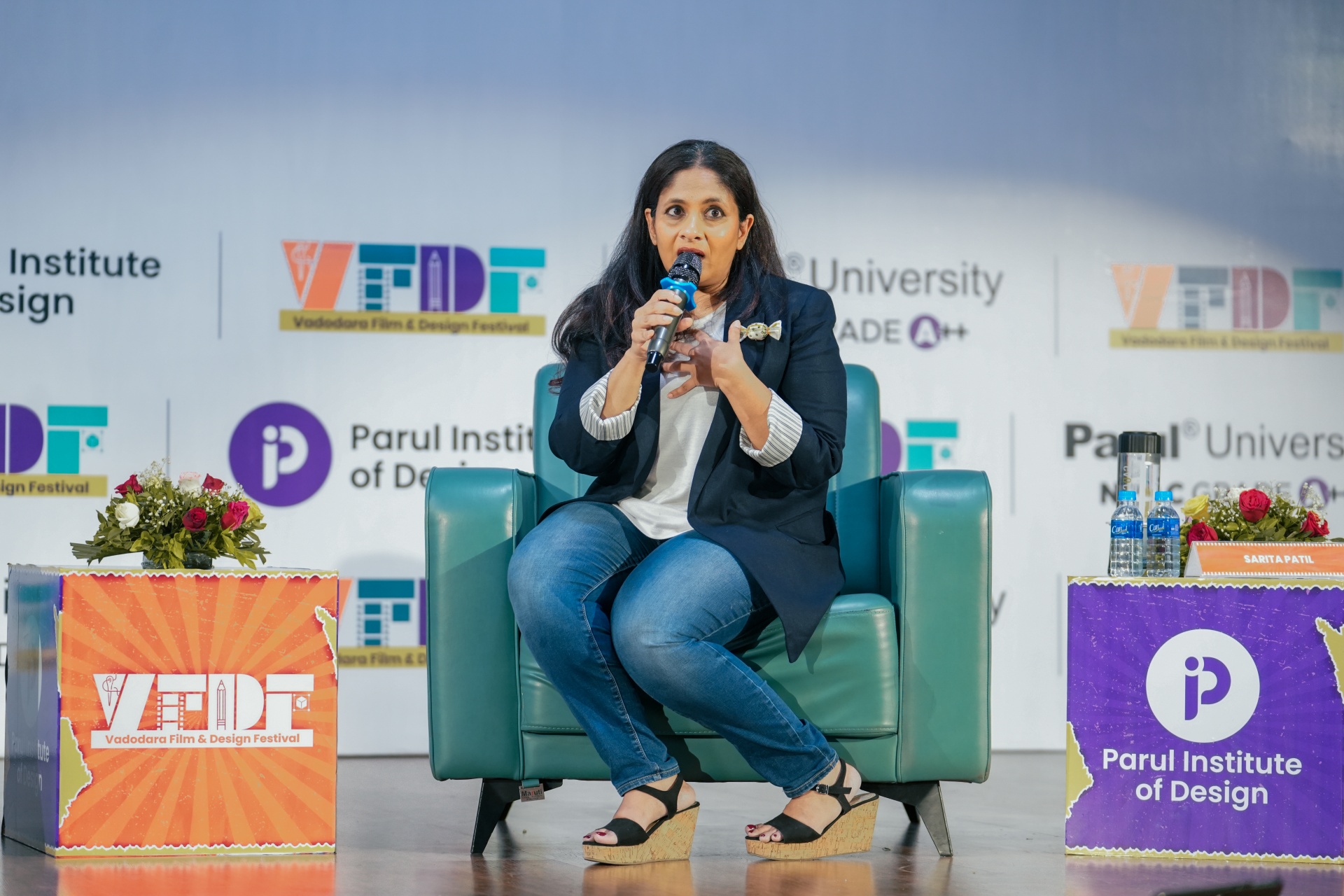
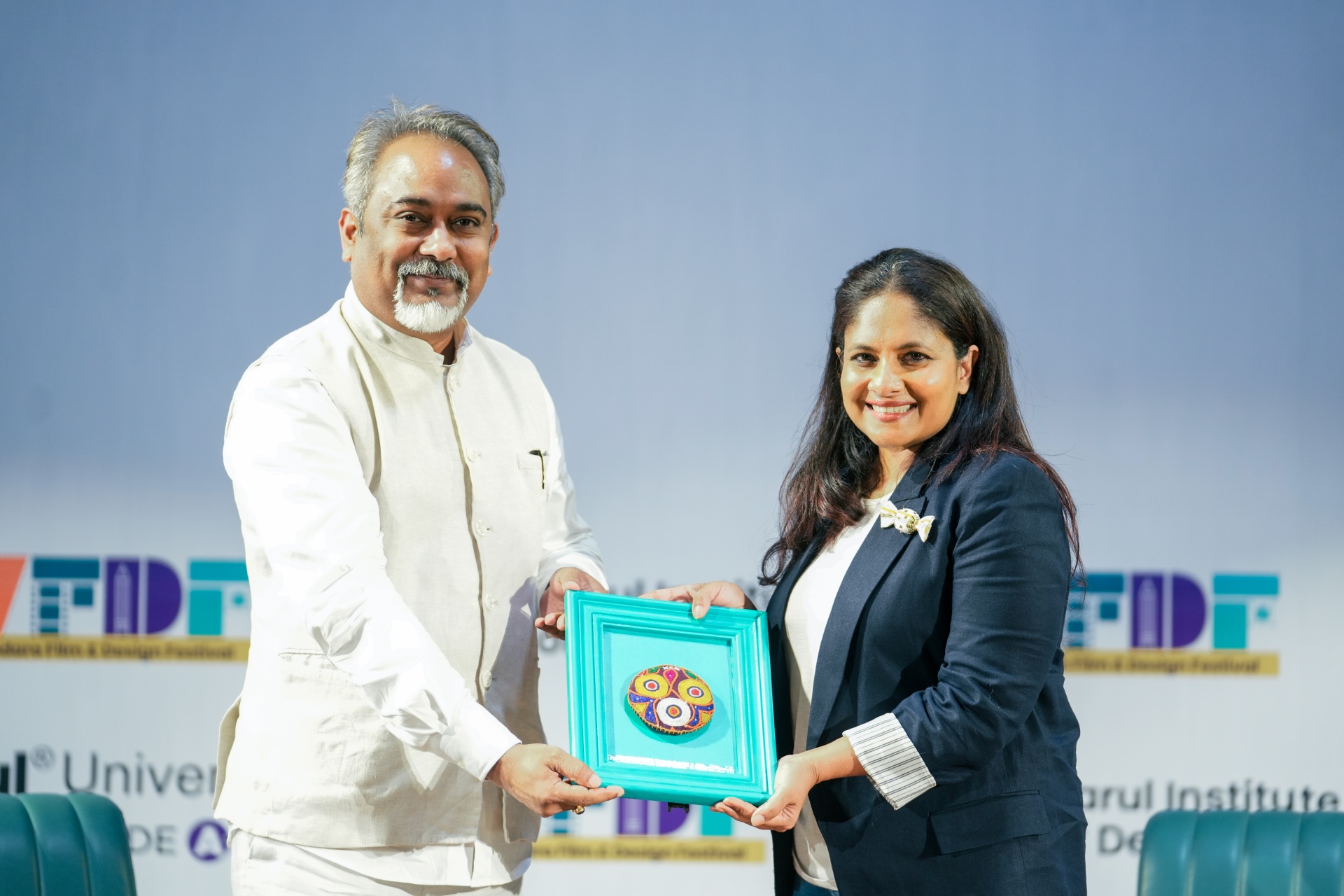
On Day 2 of the Vadodara Film and Design Festival at Parul Institute of Design, the producer of Scoop, IC 814, and Tasveer 8×10 walked PID students through a job most film students fundamentally misunderstand.
Sarita Patil co-founded Matchbox Pictures with Sanjay and Diksha after 26 years in corporate film. Her earlier roles included Vice President at Viacom18 Motion Pictures. At 45, she enrolled in a leadership programme at INSEAD and pivoted from corporate to entrepreneurship. The session, moderated by Sanjay Ram, was titled Producer’s Playbook: Balancing Money and Art.
Her opening point: the producer is not just the money person. The producer is the person deciding what gets made at all. B.Sc in film & TV production readies you at all the levels, from filming to funding, it accentuate your
The Farmer Analogy: Why Production Is Cultivation, Not Banking
Most film students, Sarita Patil said, assume producing is financial. You find the money. You pay the crew. You release the film. That description gets the mechanics correct and the work wrong.
Her analogy was farming. Three phases:
- Acquisition (buying the land): identifying the compelling script, book, play, or news story worth building a film around. This is the editorial decision that precedes all others
- Cultivation (sowing the seed): nurturing the idea. Hiring the writer. Hiring the director. Managing the growth of the project through development, pre-production, production, and post-production
- Harvesting (the market): distributing the finished film, generating revenue, and using that revenue to fund the next acquisition cycle
The phases are not sequential in the way students often imagine. They overlap. A producer in harvest mode on one film is already in acquisition mode for the next. The cash flow across the two cycles is what makes the company financially stable.
New York Indian Film Festival Director – Mr. Aseem Chhabra at VFDF 4.0!
What Scoop and IC 814 Actually Required Before Production Began
Matchbox Pictures focuses on premium content based on real events. Patil used two specific cases to show what that looks like operationally.
Scoop: based on Jigna Vora's memoir
Scoop, the Netflix series based on journalist Jigna Vora‘s account of her arrest in the J. Dey murder case, required the production team to read through thousands of pages of chargesheets, court filings, and original reporting. The editorial decision about what to include and what to leave out could only be made after that immersion. Sarita Patil was clear that authenticity was not optional. The story was on record. A narrative shortcut would have been visible to anyone who had followed the original case. Journalism is for the ones who aren’t afraid to speak or question even the government, that’s why Parul University’s Bachelor of Arts in Journalism and Mass Communication was designed to make your way towards fearless journalism!
IC 814: The Kandahar Hijack
The series on the 1999 hijack of Indian Airlines flight IC 814 required similar depth. The production studied declassified documents, interviewed people adjacent to the event, and cross-referenced multiple accounts before finalising the edit.
“Relationship and building that is very, very critical. Today you should be able to lift the phone on any actor or any director and that director should be willing to work with you. If you’re not accurate, authentic in the industry or in any life phase, your credibility lies there.”
The 3 Types of Film Productions Sarita Patil Actually Finances!
Sarita Patil broke production into three commercial categories, each with a different risk profile:
- Commercial cover shoots: major studio backing, pre-calculated profit and loss statement, contractual control for investors. Casting, budget, and release strategy negotiated in advance
- Passion projects: films backed because the team believes in the story, not because the P&L works on paper. Higher editorial freedom, higher financial risk
- Streaming series: lower financial risk for producers because platforms typically cover production costs once a project is greenlit. The trade-off is less creative autonomy downstream
Matchbox’s portfolio mixes all three. Passion projects subsidise themselves through the revenue from commercial and streaming work. The mix is what keeps the company operational during periods when any single category slows down.
Why Three Co-Founders Work: Compartmentalising by Expertise
Running an independent production company with three co-founders requires clean role separation. Matchbox’s structure:
- Sarita Patil: external relations, studio pitching, sales, and distribution
- Sanjay: ground-level production, crew management, on-set logistics
- Diksha: creative development, special projects, editorial direction
The three founders do not overlap. Each owns their function end-to-end. Decisions within each function do not require consensus across the other two. This is the structural choice that lets the company move faster than larger studios where every decision runs through a committee.
The Canada Shoot That Went Sideways: What Independent Producers Actually Risk
Asked about the most unexpected challenge in her career, Patil cited shooting Tasveer 8×10 in Canada, where the line producer siphoned off all the project’s money. The production team had to use their own personal funds to buy Big Macs for the crew just to keep the set operational before relocating the entire shoot to South Africa.
This is the risk profile of independent production that film schools do not teach. The scripts teach you the craft. What the curriculum cannot simulate is the morning when the bank account is empty and the shoot cannot stop.
What This Session Means for PID Students
Sarita Patil’s advice to PID students was specific. She told them to remain like a sponge, absorbing knowledge, building networks. The relationships students build in film school become the professional network they use for the next 30 years. The directors from the same batch hire each other. Cinematographers from the same batch hire each other. A producer who met a director in year two of a B.Sc programme is the producer who makes that director’s first feature.
PID’s Bachelor of Science in Film and TV Production programme covers the complete filmmaking pipeline including production management. Students graduating as producers, line producers, executive producers, and production managers are on the same trajectory Patil describes, just earlier. The 26-year corporate arc is one route. A direct route into independent production is another.
FAQs
Who is Sarita Patil?
Sarita Patil is a film producer and co-founder of Matchbox Pictures. She spent 26 years in corporate film, including a Vice President role at Viacom18 Motion Pictures, before pivoting to independent production after completing a leadership programme at INSEAD. Her producing credits include Scoop and IC 814.
What does a film producer actually do?
At the VFDF 4.0 session at Parul Institute of Design, Sarita Patil described the producer's role in three phases: acquisition (identifying the story worth making into a film), cultivation (hiring talent and managing the project through production), and harvesting (distributing the finished film and generating revenue to fund the next project). A producer is not primarily a money manager. The producer is the person who decides what gets made at all.
What is Matchbox Pictures?
Matchbox Pictures is an independent production company co-founded by Sarita Patil alongside Sanjay and Diksha. The company focuses on premium content based on real events, including the Netflix series Scoop and the dramatised series IC 814. Each partner owns a specific function: Patil handles external relations and sales, Sanjay handles production, Diksha handles creative development.
Can I train as a film producer at Parul Institute of Design?
Yes. The Bachelor of Science in Film and TV Production programme at Parul Institute of Design covers production management as part of its core curriculum alongside screenwriting, direction, cinematography, editing, and sound design. Students graduate with training as producers, line producers, executive producers, and production managers. PID also runs a Diploma in Filmmaking for students seeking a shorter specialist route. PU Talks sessions with working producers like Sarita Patil (Matchbox Pictures) sit inside the regular academic calendar. Admission is via PU-DAT.
How do film producers balance commercial and passion projects?
Patil described three project categories at Matchbox: commercial films with pre-calculated P&L statements and studio backing, passion projects backed on belief in the story rather than financial return, and streaming series where platforms cover production costs. The mix across all three is what keeps an independent production company financially stable, with commercial and streaming revenue effectively subsidising the passion-project bets.
What was Sarita Patil's advice to film students at PID?
At the Parul Institute of Design session, Patil told students to remain sponges, absorbing knowledge and building networks. The relationships built in film school become the professional network for the next 30 years. She emphasised that authenticity and credibility compound over time. A producer who becomes known for accurate, researched work gets access actors and directors will not give to someone else.


