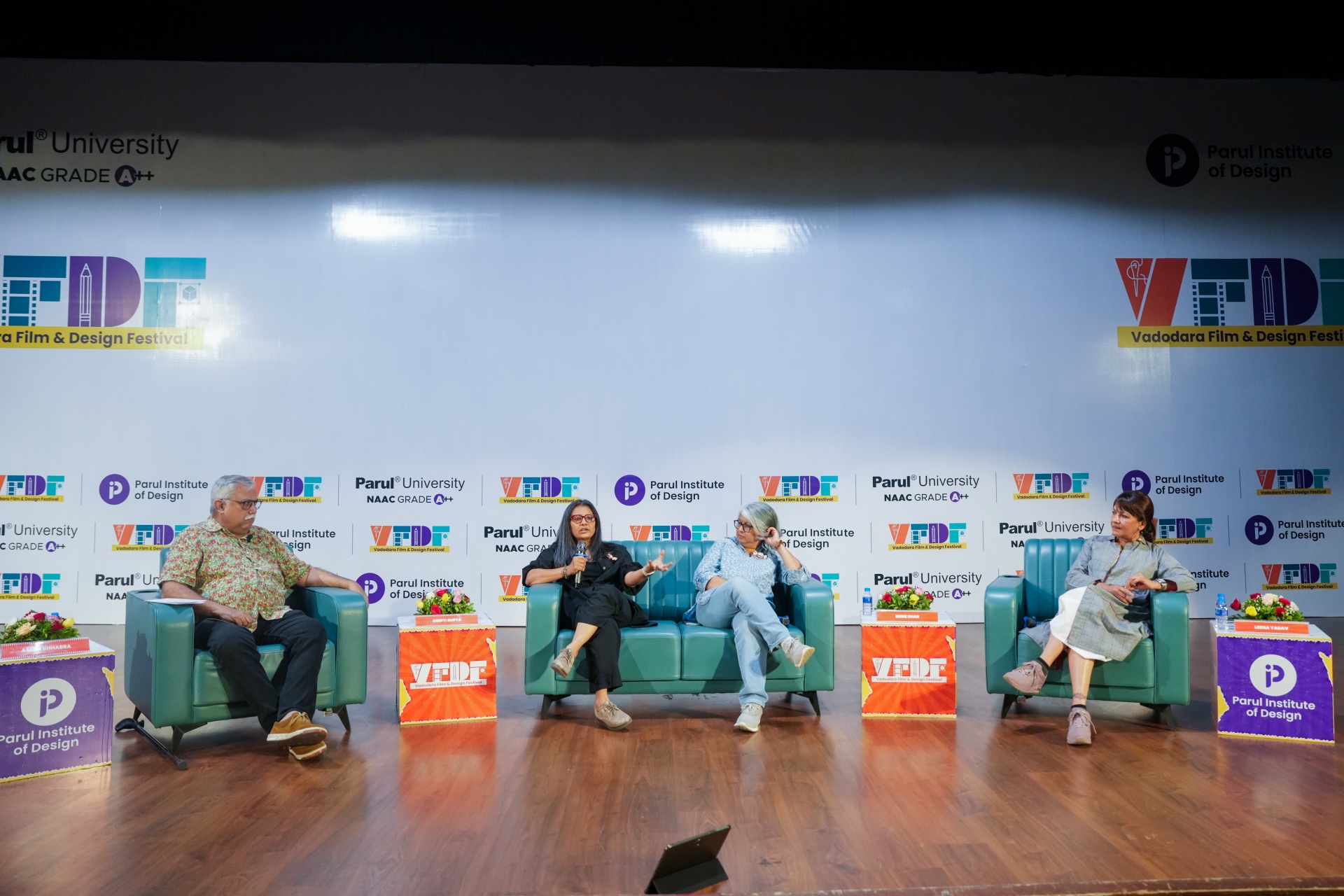
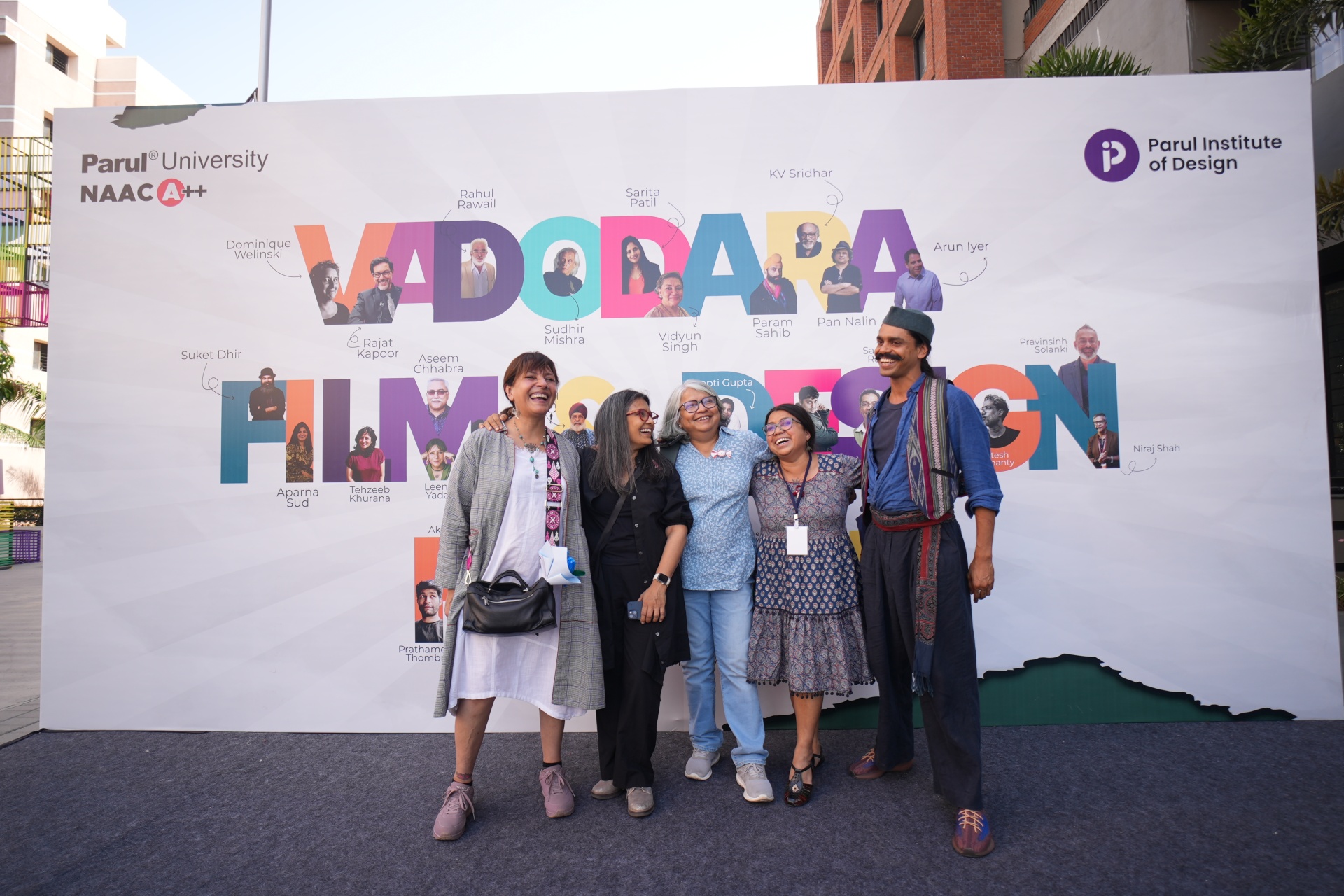
The phrase female gaze is often treated as a synonym for films made by women. The three Indian filmmakers on stage at Parul Institute of Design during the Vadodara Film and Design Festival 4.0 rejected that framing.
The female gaze, they argued across two back-to-back sessions on Day 3, is not about who holds the camera. It is about what the camera chooses to include and exclude. A male filmmaker can operate the female gaze. A female filmmaker can operate the male gaze. The qualifying factor is editorial: does the filmmaker include shots that objectify or diminish a subject when those shots serve no narrative purpose, or does the filmmaker exclude them?
The prime 3 practitioners on stage were Leena Yadav (director of Parched, Teen Patti & Rajma Chawal, Dipti Gupta (founder member of the Indian Women Cinematographers’ Collective), and Irene Dhar Malik (National Award winning film editor). The first session was moderated by Aseem Chhabra, and it was titled as Gender Jam. The second session was moderated by Harshit Dave and it was titled as Gender Vocabulary and Hygiene. Both had same panel but the subject was too big for one session itself.
The Central Argument: Sensitivity Is Not Gendered. It Is an Editorial Choice.
Leena Yadav opened the first session with a specific directorial decision. Amid the production shoot of Parched, she had to film scenes involving young girls in a village setting. A male had suggested including certain shots that as Yadav framed them, would have been standard in mainstream Indian cinema, close ups of the girls’ bodies, lingering camera positions, framing that might emphasised vulnerability in a way that served no other purpose. He made the decision to exclude those shot as the scene was shot without them.
“The question is not who is behind the camera. The question is what you choose to film and what you choose to not film.”
Dipti Gupta extended the argument from cinematography. As a working cinematographer on Indian productions, she has repeatedly faced pressure from directors to frame women in specific ways: lower angles that emphasise cleavage, reverse shots that linger, close-ups that objectify. Her position: a cinematographer can decline those framings. The decline is the craft decision. The gaze follows from it.
Malik closed the opening argument from the editing side. A film editor receives the footage shot. Her editorial choice is what to include in the final cut and what to leave on the cutting-room floor. If a director has shot an objectifying sequence, the editor can edit around it. That editorial decision, made at post-production, is the third layer of the gaze. It is not retroactive. It is additive.
The three layers work together. Director decides what to shoot. Cinematographer decides how to shoot it. Editor decides what survives into the final film. Each layer can independently choose to operate the female gaze or the male gaze, and the resulting film reflects the cumulative choices. If you’re passionate about TV & Film production, then enrol into PU’s Bachelor of Science in Film and TV Production program and say yes to your dream package + production studio!
Leena Yadav on Parched and Why It Took Five Years to Finance
Parched is Yadav’s 2015 film about four women in a Rajasthan village navigating marriage, sexuality, patriarchy, and agency. It was produced by Ajay Devgn and distributed internationally. It is widely taught in Indian cinema courses as a case study in contemporary feminist Indian filmmaking.
She told PID students the film took five years to finance. Studios would meet her, agree the script was strong, and then decline to produce it. The reasons varied. The film was too niche. The film would not travel. The characters were too critical of Indian village structures. The sexuality was too explicit for Indian markets and not explicit enough for international markets.
The film was eventually made because Ajay Devgn personally backed it. His production company absorbed the risk. The film’s commercial performance in India was modest. Its international festival performance was strong. Its cultural impact (the conversations it started in Indian film studies about rural women’s representation) continues to grow.
Her practical advice to PID students: if you are making a film about Indian women that refuses to soften the politics, plan for five years of financing conversations. Do not assume the script’s quality will shortcut the process. The process is the process.
Dipti Gupta on the Indian Women Cinematographers' Collective
Dipti Gupta is a founder member of the Indian Women Cinematographers’ Collective (IWCC), an organisation that exists because Indian cinematography as a profession has been historically dominated by men. The IWCC was founded to provide mentorship, career support, and community for women working as cinematographers in Indian film and television.
Her argument at PID was specific. Cinematography is not technically different for women than for men. The camera is the same. The light metering is the same. The composition principles are the same. What is different is the ecosystem. Indian film sets have historically not included women camera operators in large numbers. The absence was not a matter of technical capability. It was a matter of access and expectation.
The IWCC’s work is to shift that ecosystem. Mentorship programmes connect established women cinematographers with emerging ones. Advocacy work ensures women cinematographers are considered for assignments that historically went by default to men. Documentation work captures the history of women in Indian cinematography, much of which has been written out of industry narratives.
Her advice to PID students considering cinematography: apprentice with someone early. The technical training at a film school is necessary but not sufficient. What makes a cinematographer employable is time on set assisting, watching, and learning under a working DOP. The IWCC helps facilitate those apprenticeships for women entering the field.
Irene Dhar Malik on the National Award and What an Editor Actually Does
Ira Dhar Malik is a National Film Award winning editor. Her work spans fiction features, documentaries, and experimental work. Her argument to PID students was about the editor’s role in shaping film meaning, not just film length.
An editor, she argued, is not a technician who assembles the director’s vision. An editor is a second author of the film. The script is the first author’s document. The shoot produces raw material. The edit is where the film is actually made. The sequence of shots, the rhythm of cuts, the decision of which take to use, the choice of what to exclude from the final cut: these are editorial decisions that determine whether the film becomes the film it could be or stays the film the director imagined.
Her specific case: a scene shot as a conflict can be edited as a conflict, as a reconciliation, as an ambiguity, or as a false reconciliation. The same footage, the same performances, the same dialogue. Four different edits produce four different films.
Her practical advice to PID students: learn to edit even if you do not plan to become an editor. A director who cannot edit is at the mercy of their editor. A cinematographer who cannot edit shoots too much. A screenwriter who cannot edit writes too much. The editorial mind is the organising mind of filmmaking. Developing it is a general-purpose skill, not a specialist one.
The Second Session: Gender Vocabulary and What Students Actually Asked
The second session with the same panel, moderated by Harshit Dave, was structured as an open conversation with students. The questions from the PID audience were specific and practical.
On how male filmmakers can support female filmmakers
Yadav’s answer: by not speaking over them. In every production meeting with mixed-gender teams, women’s suggestions get absorbed into the team’s output while men’s suggestions get credited to the men who made them. The fix is not complicated. Attribute correctly. If a woman on the team suggested an idea, say so when the idea is later adopted.
On whether women-only projects perpetuate separation
Gupta’s answer: the IWCC is a women’s organisation because women have been historically excluded. It will dissolve itself when cinematography as a profession is no longer gender-skewed. The organisation’s existence is a symptom of the inequality, not a cause of separation.
On whether the current generation of Indian men is any different
Malik’s answer: the film industry is changing slowly. The next generation of male filmmakers at PID and similar institutions is more aware of gender dynamics than the previous one. But awareness does not automatically produce behaviour change. The test is not what students believe. The test is what they do on their first sets.
On whether the female gaze sells commercially
Yadav’s answer: Parched made money internationally. Dil Dhadakne Do made money. Queen made money. 12th Fail made money. The market for films that do not follow the standard male-gaze commercial formula exists and is growing. The problem is that studio decision-making is slow to adapt. Students making films now should plan for the market that exists, not the market that existed ten years ago.
What This Means for Women Students Considering Film Programmes
The Gender Jam panel at PID produced one specific, repeatable framework for women considering a film education in India.
- Technical capability is non-negotiable. The female gaze is not an excuse for technical weakness. Women cinematographers, editors, and directors are expected to meet the same craft standards as their male counterparts. The route to operating the female gaze is through technical excellence, not around it
- Find community early. The IWCC, similar professional collectives, and peer networks of women working in film are practical resources, not just moral support. Students should connect with these networks during their undergraduate years, not after graduation
- Expect the ecosystem to lag. Individual male collaborators may be aware and supportive. The industry structure (casting, financing, distribution) is slower to change. Plan careers that assume the lag
- Develop cross-functional skills. The directors, cinematographers, and editors who succeed are those who understand each other’s work. Women entering any film role should learn the adjacent roles, not just the specialist one they are training for
PID’s Bachelor of Science in Film and TV Production and Bachelor of Science in Animation and VFX programmes are designed around this cross-functional structure. Students rotate through screenwriting, direction, cinematography, production design, editing, and sound design across the four-year curriculum. The PU Talks line-up across 2025-26 included women practitioners across all three panels discussed in this article, integrated into the regular academic calendar.
Frequently Asked Questions
What is the female gaze in cinema?
The female gaze is a term for an editorial approach to filmmaking that rejects objectifying or diminishing representations of subjects (typically women) when those representations serve no narrative purpose. At Parul Institute of Design's Gender Jam panel, Leena Yadav, Dipti Gupta, and Irene Dhar Malik argued that the female gaze is not about who is behind the camera. It is about what the camera chooses to include and exclude. A male filmmaker can operate the female gaze if they make those editorial choices. A female filmmaker can default to the male gaze if they do not.
Who is Leena Yadav?
Leena Yadav is an Indian filmmaker whose films include Parched (2015), Rajma Chawal (2018), and Teen Patti (2010). Parched is widely taught in Indian cinema courses as a case study in contemporary feminist Indian filmmaking. It was produced by Ajay Devgn's production company after five years of financing rejections from other studios.
What is the Indian Women Cinematographers' Collective (IWCC)?
The Indian Women Cinematographers' Collective is a professional organisation that provides mentorship, career support, and community for women working as cinematographers in Indian film and television. Dipti Gupta is a founder member. The collective exists because Indian cinematography has historically been male-dominated, not for technical reasons but for ecosystem and access reasons.
Who is Irene Dhar Malik?
Irene Dhar Malik is a National Film Award winning film editor who has worked in fiction features, documentaries and experimental film. At the Gender Jam panel of Parul Institute of Design she argued that the editor is not a technician who assembles the director’s vision but a second author of the film, whose decisions about sequence, rhythm and exclusion shape meaning at a fundamental level.
Does Parul Institute of Design offer a course in film for women?
Courses offered by Parul Institute of Design are Bachelor of Science in Film and TV Production, Bachelor of Science in Animation and VFX. The courses are available for all genders. Students are given cross-disciplinary training through a rotating curriculum in screenwriting, direction, cinematography, production design, editing and sound design. Women practitioners such as Leena Yadav, Dipti Gupta, Irene Dhar Malik, Aparna Sud, Shital Verma, Sarita Patil among others were integrated into the regular academic calendar during 2025-26 in PU Talks sessions. The admission process is PU-DAT i.e. Parul University Design Aptitude Test.
Can a man make a film with the female gaze?
According to the Gender Jam panel at VFDF 4.0, yes. The female gaze is an editorial choice about what to include and exclude, not a biographical fact about the director. A male director who makes the choice to exclude objectifying framings when those framings serve no narrative purpose is operating the female gaze. A female director who defaults to conventional objectifying framings is not.
What does a film editor actually do?
A film editor receives all the raw footage shot during production and assembles the final film. Their decisions include which takes to use, what sequence to place shots in, what rhythm to set for cuts, and what to exclude entirely. Irene Dhar Malik argued at PID that an editor is a second author of the film. The same footage edited four different ways produces four different films. Learning to edit is valuable even for students who plan to direct or shoot, because it develops the organising mind of filmmaking.


