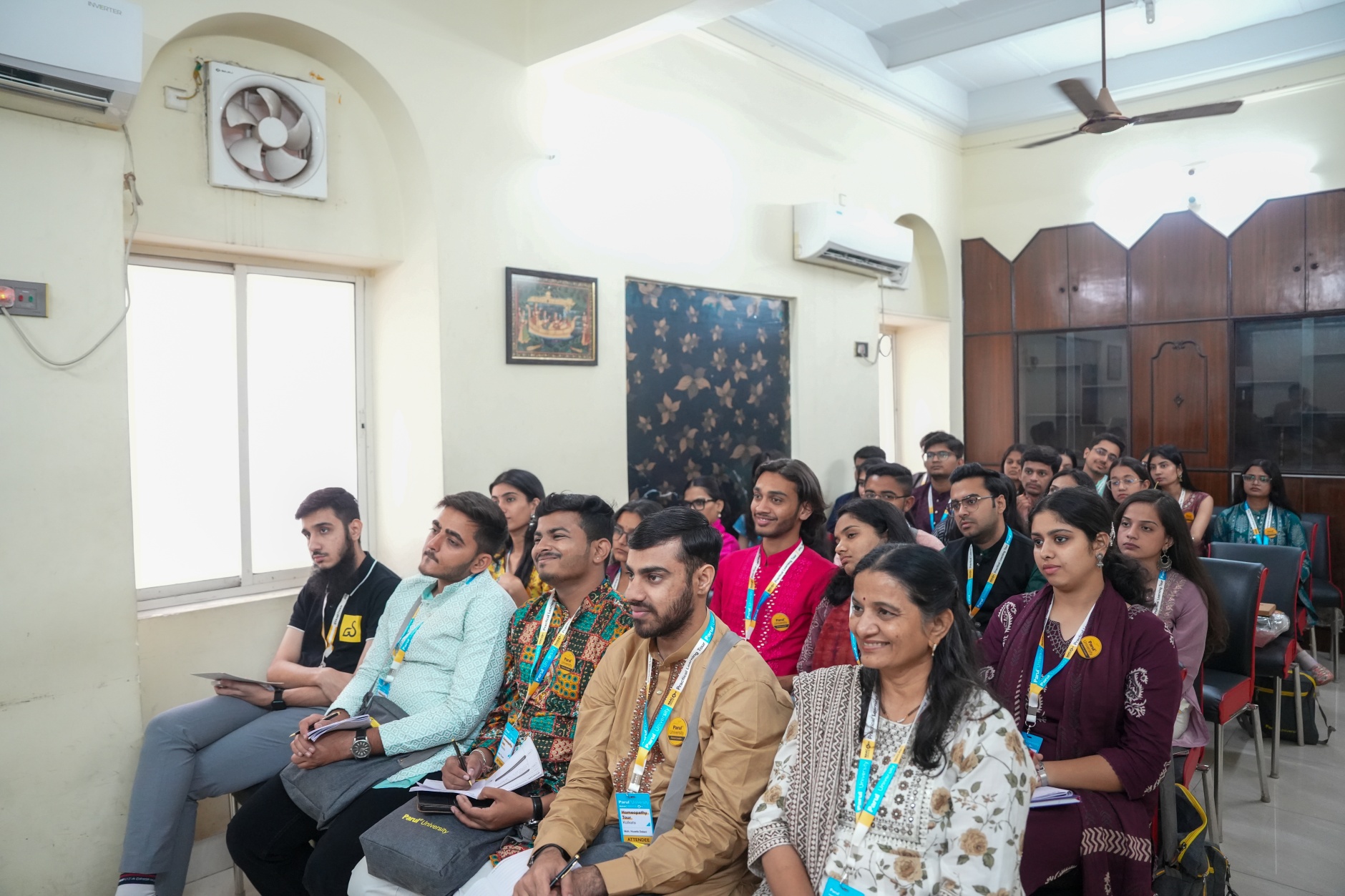
There is a certain weight to some places. You feel it before anyone says anything. Calcutta Homoeopathic Medical College and Hospital stands as one of India’s earliest homoeopathic institutions. Decades of work have shaped how it operates, from the rows of classical texts on its shelves to the seriousness with which its faculty approach both teaching and patient care.
Prof. Dr. Rajat Chattopadhyay, the Principal, did something during the OPD observation that no textbook can replicate. He narrated his clinical reasoning as he worked through a case in front of the students. Not after the fact. In real time.
He started with pathognomonic symptoms: the ones that define the disease picture and establish what the pathology is doing. These are not prescribing symptoms, but they are foundational. Without correctly mapping them, everything built on top is unstable. Only after that framing is solid do the characteristic symptoms, the ones that differentiate one patient from another and point toward the correct remedy, become readable.
Students who try to skip straight to the characteristic symptoms end up confused. The sequence matters. That was probably the single most practically applicable thing anyone learned on the entire tour.
“Never get deviated from the principles of Homoeopathy.”
The library stopped people mid-step. CHMCH houses a heritage collection of rare homoeopathic texts, original editions and early compilations that would be nearly impossible to find elsewhere. Some predate modern medicine. The institution’s philosophy: you cannot properly practice what you do not fully understand, and you cannot fully understand without knowing where it came from.
And then there was the WWII detail that caught everyone off guard. During World War II, CHMCH was selected to treat air-raid victims, and so dedicated beds were set aside. The medical establishment of that era placed enough confidence in homoeopathy to include it in crisis response. For students who sometimes encounter scepticism about their chosen field, that piece of history carries weight. The discipline has been tested before. It showed up.
Bengal Academy: Treat Your Questions as Idols
Dr. Biswajeet Das opened with an analogy that stayed with the room. Treat your questions as idols. Approach knowledge the way a devotee approaches aarti: with sincerity, consistency, and expectation of illumination.
The session was structured around dialogue, not presentation. His emphasis on Hahnemann‘s original writings was emphatic: they are not supplementary material. They are the foundation. Students who approach classical texts through summaries operate at a remove from the philosophy, and that remove shows up in the consulting room.
The section on chronic disease was the session’s most clinically dense content. Chronic disease cannot be managed if you treat it as an isolated set of symptoms. The maintaining cause must be addressed. The totality of symptoms, not just the presenting complaint, determines the remedy. He worked through cases of chronic diarrhoea, endocrine conditions, and ADHD.
The ADHD discussion illustrated how a neurodevelopmental condition looks entirely different when framed miasmatically versus symptomatically. The symptom list is one thing. Understanding the soil in which those symptoms grew, including family history, gestational factors, vaccination history, is something else. The second understanding leads to genuinely curative treatment. If you’re passionate about extending quality health-care with healing science and holistic medicine, explore homeopathy courses after 12th from Parul University and bring on the change you wish to see!
BHMS Kolkata Tour – POV on Research, Manufacturing & Protocols
Hahnemann Academy: Faith First, Then Science
Prof. Dr. Asok Kumar Das from Hehnemann Academy drew a distinction between fundamental research and clinical research that most students had not considered carefully. For practising physicians, the question is not just whether something has been studied but whether the study tells you what to do when a patient is sitting in front of you. Clinical research takes priority.
Medicine is learned at the bedside. Not in the lecture hall, not through textbooks alone, but through actual patient interaction. Students who spend more time with patients develop a feel for disease, for remedy selection, for what individualisation actually looks like in motion. That feel does not come from any other source.
On practice itself: simple, strictly scientific, Hahnemann’s Way. For chronic diseases, one well-chosen individualised remedy aimed at removing the maintaining cause. No shortcuts, no combinations for their own sake.
He then grounded philosophical conviction in scientific inquiry. The Bernstein experiment and Rustum Roy‘s work on molecular rearrangement: serious attempts to understand what homoeopathic preparations actually do at a physical level. These are not fringe references. They represent legitimate scientific investigation into the mechanism of action.
“When treating the patient be Homoeopath, when researching, be Scientist.”
Mahesh Bhattacharya: The Emergency Department and the Organon as Living Document
The academic atmosphere at Mahesh Bhattacharya is disciplined in a way that students noticed immediately. Dr. Alok Misra and Dr. Rudranil Chatterjee (HOD, Department of Organon of Medicine) jointly guided the visit.
The lecture on backache therapeutics demonstrated individualisation in action. Two patients presenting with lower back pain may require entirely different remedies depending on onset, modalities, emotional context, and constitutional type. Treating the diagnosis rather than the patient is one of the most common clinical errors. The departmental museums, with specimen-based learning, bridged theoretical knowledge and observable reality in ways diagrams cannot.
The Emergency Department answered a question students had perhaps carried without voicing: what does homoeopathic practice look like in acute situations? The department demonstrated preparedness for acute conditions, the role of first-aid and acute prescribing, and referral protocols for cases requiring conventional intervention. Not every case is a chronic constitutional case awaiting a deep-acting remedy. Practitioners need to be prepared for urgency and you can master all these phases by enrolling in Doctor of Medicine Homoeopathy (MD) from Parul University!
“Aphorisms should be the guiding principles of every homoeopathic practitioner.”
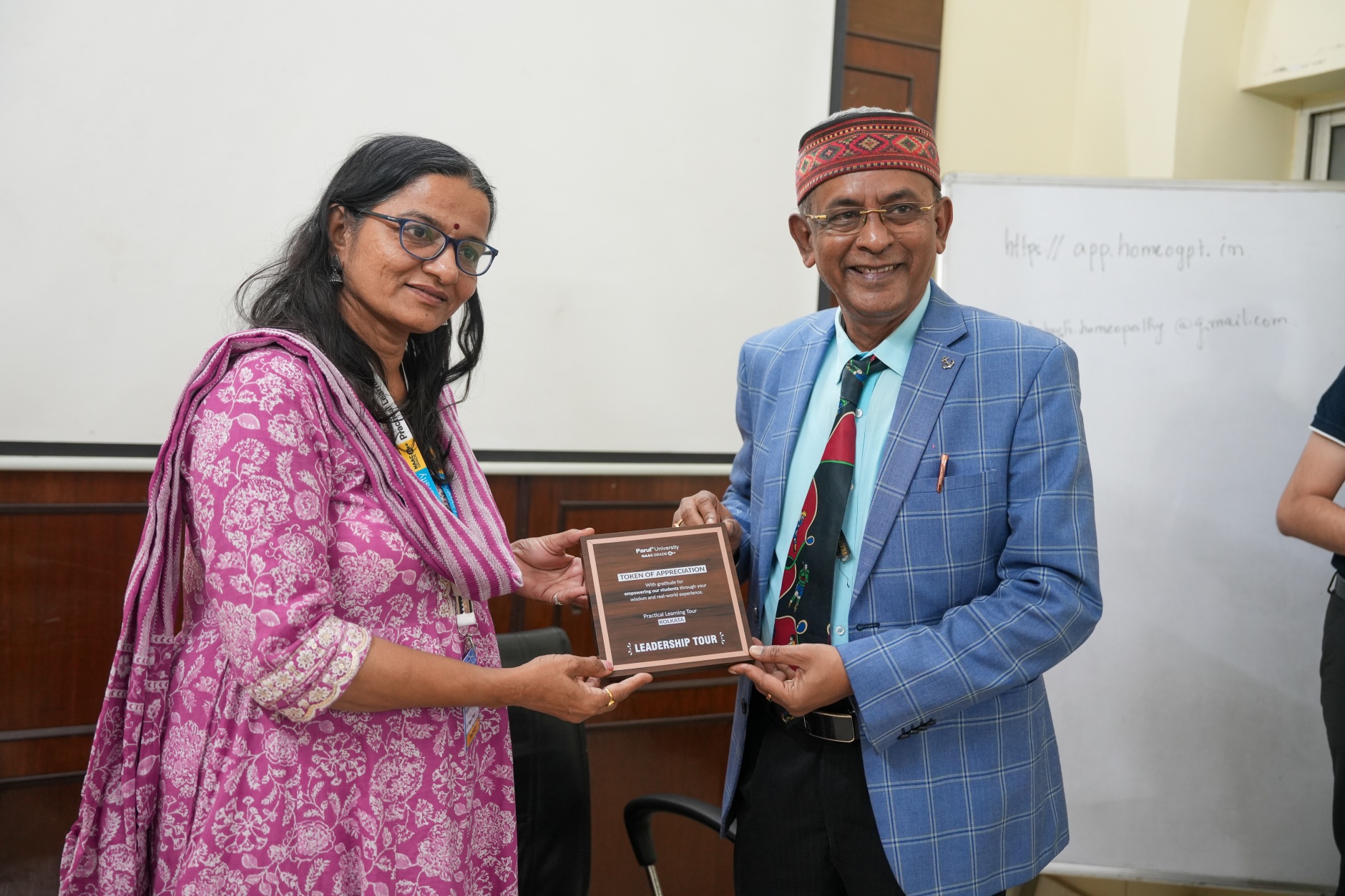
Dr Samit Ghosh: Classical Thinking Meets AI
Not every session on classical homoeopathy ends with a demonstration of artificial intelligence. Dr. Samit Ghosh‘s session at Progressive Hall managed to be deeply grounded in philosophical fundamentals while also being thoroughly contemporary, and crucially, it made both feel natural.
Disease, in the homoeopathic understanding, primarily affects the vital force. The physical symptoms are outward manifestations. You are not treating the symptoms. You are treating the disturbance underneath them. That distinction changes how you take a case: the questions you ask, the weight you give different symptoms, the remedies you consider.
HomeoGPT is an AI-assisted repertory tool that Dr Samit Ghosh uses in his own practice. The key question: does it help or does it replace? His position: it helps. The practitioner still frames the case, decides which symptoms to repertorise, evaluates the output against clinical understanding, and makes the final prescription. The tool accelerates part of the process without taking the process away from the physician. BHMS at Parul University is designed for the students who are passionate about blending classical homeopathy with industry insights!
“Your knowledge and understanding with experience will boost your confidence, which every aspiring homoeopath should have.”
Student feedback: Dr Ghosh’s practical approach and clear communication resonated. Students described leaving with a more future-ready mindset. In a field that can sometimes feel in tension with the times, a session that made classical homoeopathy feel both rigorous and current was genuinely valuable.
BHMS Kolkata Tour – 10 Institutions, NIH Kolkata, CCRH Labs & Banerji Protocols
Frequently Asked Questions
What is individualisation in homoeopathy?
The patient is not a disease category. They are a person with a specific, layered, particular story: physical, emotional, constitutional. The remedy is chosen for the individual, not the diagnosis. At CHMCH, Dr Rajat Chattopadhyay demonstrated the sequence: pathognomonic symptoms first (mapping the disease picture), then characteristic symptoms (differentiating the individual). Students who skip to characteristic symptoms without mapping pathology first get confused. The sequence matters.
What is HomeoGPT?
An AI-assisted repertory tool used by Dr Samit Ghosh in his practice. It handles the computational complexity of repertory analysis when managing high patient loads. The practitioner frames the case, decides which symptoms to repertorise, evaluates the output, and makes the final prescription. The tool accelerates analysis without replacing clinical judgement. Technology that supports classical practice rather than bypassing it.
Is homoeopathy effective for chronic diseases?
At Bengal Academy, Dr Biswajeet Das worked through cases of chronic diarrhoea, endocrine conditions, and ADHD using miasmatic theory. The approach: identify the maintaining cause, assess totality of symptoms (including family history, gestational factors, vaccination history), and prescribe one well-chosen individualised remedy. The ADHD discussion showed how a neurodevelopmental condition looks entirely different when framed miasmatically versus symptomatically. The symptom list is one thing. Understanding the soil in which symptoms grew leads to genuinely curative treatment.