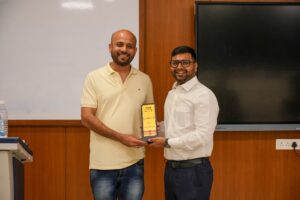
The colleges teach drawing and dreaming. They do not teach the service-business reality of architecture. The session was the missing module. The exclusive session of Kiran Kapadia was held at his own studio in Mumbai. Kiran Kapadia, the founder of Kapadia Associates, spoke to Parul University’s students on design practice, product design, animation & interior design. He even showcased his portfolio presentation and explained his working manual – how a design business runs, what aspects colleges are missing, how AI can be utilised in a studio and what’s wrong with the planning of Indian cities. Kiran Kapadia, who has been a visiting teacher and is intimately familiar with how design colleges operate, was explicit that students leaving college often have no idea how to charge fees, cost projects, or manage a studio.
From Vogue to Top Design Dignitaries- PID’s Industry Tour To Mumbai!
Global experience and why you should work before doing your master's
Kiran Kapadia began with his own trajectory. He completed his first degree in India in the 1980s when domestic options for advanced study in design were limited, which pushed him to study abroad. The exposure mattered. He returned with a working appreciation for what exposure to different professional contexts actually does for a young designer. His specific recommendation to students considering a master’s degree was direct: work first. He worked for two years before his master’s, and even that, he said, was insufficient. The reason is that students with real industry experience learn twice during graduate study: from the faculty and from their more experienced classmates. Students with no industry experience can only learn from the faculty.
One must go with an open mind to absorb and learn. There is a lot to learn from various contexts.
Kiran Kapadia, Founder, Kapadia Associates, on global exposure
Studio culture and how leadership actually works
Asked about leadership, Kiran Kapadia rejected the idea that a healthy studio runs on a single dominant figure who issues instructions. The functioning model is collaboration. He laid out a golden rule: when something goes wrong, the manager takes responsibility, and when something goes right, the manager shares the credit. The rule creates psychological safety, and psychological safety is what allows team members to put forward ideas they would otherwise self-censor.
Salary is not what keeps a team together. Money, he was clear, is not what holds employees in place. A team member who feels they do not belong in the studio environment will leave even when the pay is high. For a company to grow into a large business, the employees themselves have to grow inside it. The framing puts career development on the studio leader’s desk, not on the employees.
Three concrete uses of AI at Kapadia Associates
Kiran Kapadia’s account of AI was practical. He was specific about where the studio actually uses it. Asked how Kapadia Associates uses AI, Kiran Kapadia offered three concrete examples rather than an abstract endorsement.
- Parking optimisation: AI is used to design and plan parking flow patterns that minimise driving conflicts within a building, calculating the smoothest in-and-out routes to prevent accidents and congestion.
- Contextual image placement: AI is used to place rendered images of a proposed building into actual photographs of the Mumbai surroundings the structure will sit within, so that the client can see exactly how the new structure will look in its real urban context rather than in an isolated render.
- Climate and sustainability modelling: This is the heaviest AI use at the studio. AI is used to calculate precisely how sunlight will strike windows in May, how wind will move through skyscraper clusters during the monsoon, and other climate-driven variables that determine how comfortable a building will actually be to live in. The aim is structures that perform better for human habitation, not just better-looking renders.
His broader advice on technology was unambiguous: do not become the slave of the tool. Determine the design aim first, then use whatever tools serve that aim. The position aligned with what students heard from Gayatri Khanna at Milaaya, who drew the same line between AI-assisted concept work and human-executed craft.
The biggest gap in design education today
This was the most candid section of the session, and the one students remembered most.
Kiran Kapadia, who has been a visiting teacher, was explicit that colleges excel at training students to draw and dream but rarely prepare them for the business of being a designer. Students leaving college often have no idea how to charge fees, cost projects, or run the affairs of a studio. The only place these skills are learned is through real practice. He was sharper still about what architecture actually is. Architecture is a service industry, exactly like law or accounting. Lawyers solve legal problems for clients. Accountants save clients’ tax. Architects solve spatial problems for clients. A designer who treats their work as a solitary artistic expression has misunderstood the profession. Design has to be treated as a service to the person paying for it. If you wish to master urban design and urban planning at all levels, enrol on Parul University’s Master of Planning program!
Design is a service industry, exactly like lawyers or accountants. Lawyers solve problems, accountants save taxes, and architects solve spatial problems for the clients. You have to treat it as such. You cannot just go inside your room and behave as a lonely artist.
Kiran Kapadia, Founder, Kapadia Associates, on what colleges fail to teach
The three things every project must establish before it starts
Kiran Kapadia offered a project checklist that students wrote down.
Asked what a designer should establish first on any new project, he was crisp: understand the client’s brief, understand the client’s budget, and understand the site. If those three things are clear at the start, the project tends to succeed. If any one of them is unclear, the project tends to drift. The checklist sounds basic. It is also the most frequently violated rule in design practice.
- The client’s brief: What does the client actually want this project to do?
- The client’s budget: What is realistically available to deliver it?
- The site: What does the physical location require, allow, and refuse?
He paired the checklist with a second principle: a strong, clear core concept at the start protects the design from disintegration through hundreds of mid-project changes. If the designer is clear, the design stays clear. But a strong concept is not enough on its own. The client must trust the concept fully. If the client is unsure, the design will be edited to death. Kiran Kapadia described introducing clients to several strong concepts early, specifically to build confidence; once trust is established, the design proceeds without constant interference. If you’re passionate about design and architecture, enrol on PU’s B.Arch programme as it’s designed to give you hands-on experience and exposure from day 1!
Materials and climate: India is not the West
On materials, Kiran Kapadia argued that simplicity is the discipline. The studio uses a narrow range of materials and avoids mixing too many colours or textures, too much glossiness, or too much roughness. The simplicity is decided early and held throughout the project. The harder principle was the one about climate. Materials behave differently in different climates, and Indian conventions cannot be borrowed from Western design without consequence. India has a strong, bright sun. Overly glossy materials are visually harmful in this light. Indian interiors should lean toward shaded surfaces and natural materials. The West, with overcast skies and weaker light, can use glossy and vivid materials because there is less sunlight to reflect off them. Designers must design for their own sky.
Remember, you are to design for your skies.
Kiran Kapadia, Founder, Kapadia Associates, on materials and climate
Urban design: making cities for people, not cars
The session’s biggest argument was about how Indian cities have been built around vehicles rather than human beings.
Asked about the redevelopment of slums such as Dharavi, Kiran Kapadia warned against romanticising poverty: space is precious in every major city, and it has to be used wisely. The deeper issue, he argued, is that Indian cities care too much about cars and not enough about people walking. He compared Indian cities to London and Singapore. Indian regulations demand parking provision in new buildings. London’s regulations do the opposite: in central London, new construction is deliberately prohibited from including parking, so that fewer cars enter the city. The result is that even wealthy Londoners take the public train. Singapore taxes vehicle purchases heavily and invests in strong public transport. Mumbai, despite having a Metro, leaves pedestrians with almost no safe walking infrastructure outside the stations. An older person cannot safely walk most of Mumbai.
His urban-design prescription was about land-use diversity, not just transit. Indian office districts are dead at night. People drive long distances between their residences, work, and leisure because the city is segregated by use. The fix is mixed-use neighbourhoods: student accommodation, offices, commercial space, and luxury apartments in the same area, so that most journeys do not require driving across the city. The argument has direct implications for how design students think about the urban environment they will design within.
The future of presentations and visual tools
Asked about virtual reality and game-engine presentation tools, Kiran Kapadia was open about where the studio is and where it is going. Kapadia Associates uses VR currently, but only internally for the design team to walk through rooms. Client presentations continue to rely on conventional video and images. He was, however, convinced that game-engine technology is the future of presentation. Major firms globally already use it to produce walk-through cities. He told the Animation students directly that their training will be central to the design of the future, because the design world will increasingly rely on game-engine and animation skills to communicate built environments to clients before they exist.
What each design discipline took from the session
- Interior Design students: Spatial planning, material selection by climate, and the balance between aesthetics and usability.
- Product Design students: User-centric design, ergonomics, and the discipline of treating design as service rather than self-expression.
- Architecture and Animation students: The future role of game-engine technology in design communication and how the studio uses AI in real projects.
- All disciplines: The framework of design as service, the three-point project checklist, and the materials-for-your-sky principle.
Always be humble and hold patience.
Kiran Kapadia, Founder, Kapadia Associates, in the closing of the session
FAQs
Who is Kiran Kapadia and what is Kapadia Associates?
Kiran Kapadia is a renowned Mumbai-based architect, and he is the founder of Kapadia Associates. He completed his degree in the 1980s in India and has been a visiting faculty member for design colleges. He spoke on these topics: studio culture, AI in architecture, design education, urban planning in Indian cities, and shared strong views on design as a service industry!
How does Kapadia Associates use AI in architecture practice?
According to Kiran Kapadia, Kapadia Associates uses AI for three specific purposes. First, AI is used in parking design to plan flow patterns that minimise driving conflicts within a building. Then, AI is used for rendering images from real photographs, so clients can visualise the new structures in sync with the urban context. AI is heavily used in climate and sustainability modelling, wherein his broader advice on AI is to determine the aim first and then the usage of tools. One shouldn’t become the slave of technology; use your intuition and master your craft!
What does Kiran Kapadia say about Indian urban planning?
Kiran Kapadia argues that Indian cities have prioritised cars over pedestrians and that this is a fundamental design error. Indian regulations require parking provision in new buildings; London does the opposite, prohibiting parking in new central London construction so that fewer cars enter the city. Singapore taxes vehicle purchases heavily and invests in strong public transport, with the result that even wealthy residents use public transit. Mumbai, despite having a Metro, leaves pedestrians without safe walking infrastructure outside stations, making it dangerous for older people to walk. His prescription includes both transit policy and mixed-use neighbourhood design that places student accommodation, offices, commercial space, and apartments in the same area, so that most daily journeys do not require driving across the city.
What are the three things every architecture project must establish at the start?
Kiran Kapadia, founder of Kapadia Associates, told Parul Institute of Design students that any new design project must establish three things clearly before work begins. First, understand the client's brief: what the client actually wants the project to do. Second, understand the client's budget: what is realistically available to deliver it. Third, understand the site: what the physical location requires, allows, and refuses. If those three things are clear at the start, the project tends to succeed. If any one of them is unclear, the project drifts. He paired this with a second principle: a strong, clear core concept at the start protects the design from disintegration through mid-project changes, provided the client trusts the concept fully.
Why does Kiran Kapadia say design is a service industry?
Kiran Kapadia argues that architecture and design are service industries in the same sense as law or accounting. Lawyers solve legal problems for clients. Accountants save clients' tax. Architects solve spatial problems for clients. A designer who treats their work as a solitary artistic expression has misunderstood the profession. His critique of design colleges follows from this: colleges excel at teaching students to draw and dream but rarely prepare them for the business of being a designer, including how to charge fees, cost projects, and run a studio. The service-business reality of design has to be learned through real practice, which is part of why the Parul Institute of Design Mumbai Industry Tour exists.
What materials should be used in Indian architecture according to Kapadia Associates?
Kiran Kapadia argues that material choice in Indian architecture must respond to India's specific climate, not borrow from Western conventions. India has strong, bright sunlight, which means overly glossy materials reflect harmful light and should generally be avoided in favour of shaded surfaces and natural materials. The West, with overcast skies and weaker light, can use glossy and vivid materials because there is less sunlight to reflect off them. The studio's own discipline is simplicity: a narrow range of materials, restraint in mixing colours and textures, and consistency held through the project. The underlying principle is that designers must design for their own sky.