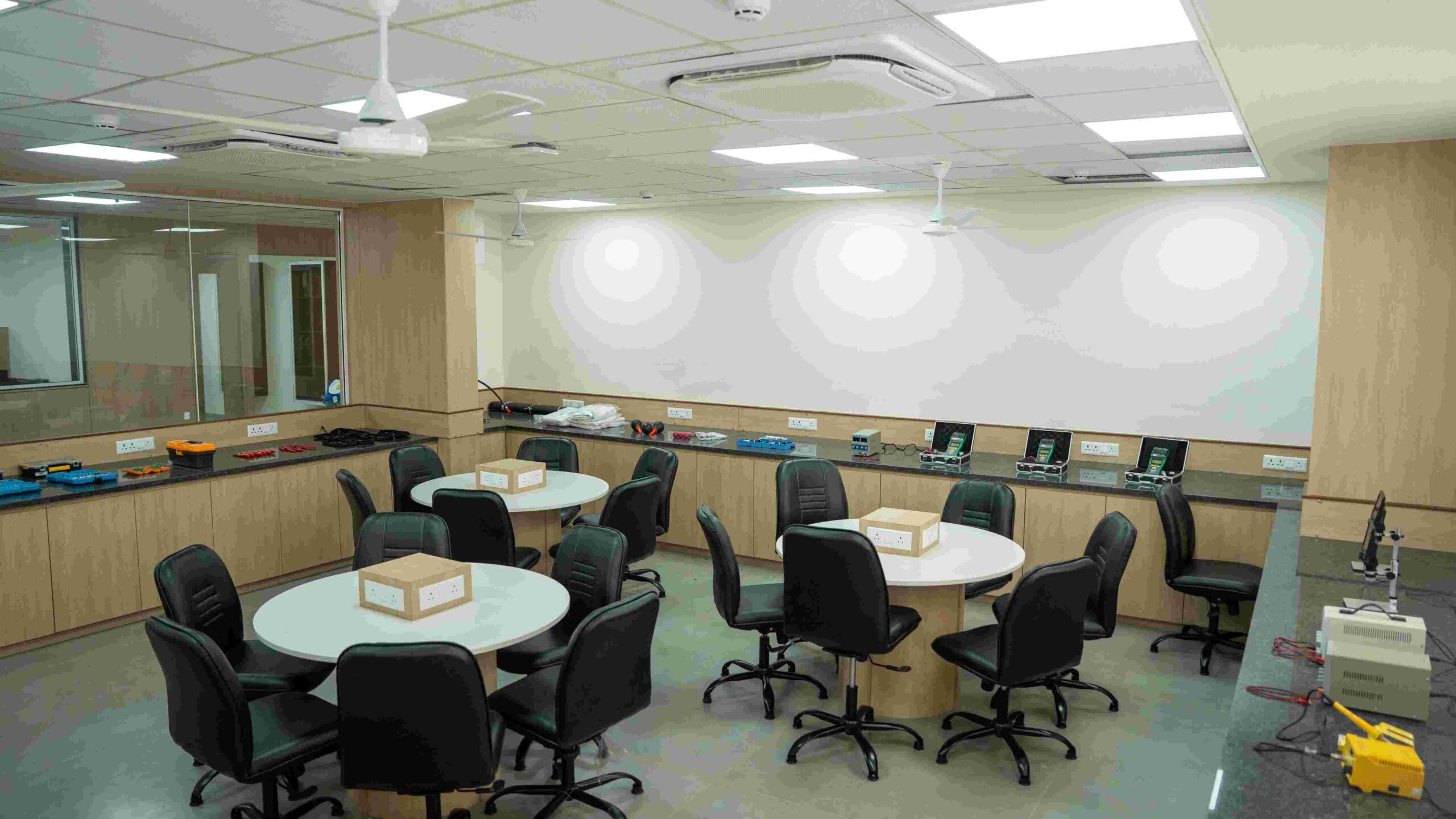
The work of a network engineer is not what most students imagine before they actually do it. It is not about configuring a single router. It is about designing networks that stay up, secure, and observable under conditions where any of those three properties might fail at any moment.
The Cisco Networking and Cyber Security Lab inside Parul University’s Lakshya 2047 Centre, inaugurated by Union Minister Dr. Jitendra Singh on 8 May 2026, is built to teach this difference at scale. The lab provides enterprise-grade Cisco routers, switches, firewalls, security devices, server systems, virtualisation infrastructure, and the centralised monitoring tools that organisations use to actually run their networks. Students train for Cisco CCNA, Cisco CCNP, and CompTIA Security+ certifications, with the foundation in place to pursue the Cisco Certified Internetworking Expert (CCIE) credential, which is the senior-level Cisco certification that network engineering careers are built around.
What is inside the Cisco Networking and Cyber Security Lab
The lab is built to replicate an actual enterprise network environment, not to simulate one. This equipment is entirely enterprise-grade, and the holistic configurations are of production level. Read ahead the technical setup of the lab!
- Cisco enterprise-grade routers and switches. The core networking hardware that enterprise IT environments operate on. Students learn routing, switching, and communication functions on the same equipment that runs corporate data centres and large service-provider networks. Cisco IOS, the operating system that runs on Cisco devices, is the operational environment students work inside throughout their training.
- Firewalls and security devices. The enterprise-graded hardware systems are defending network-based perimeters. Students shall configure firewalls, design security zones, and equally implement policy-based frameworks, ensuring data protection in motion and at all levels!
- Server systems. Dedicated server hardware for practical experience in server configurations, routing services, and secure communication systems. The server infrastructure is what allows students to build complete networked environments rather than just configuring isolated devices.
- Virtualisation infrastructure. Virtualisation components that let students develop several network configurations simultaneously without needing to physically reconfigure hardware between exercises. The virtualisation layer is what makes the lab efficient for training multiple cohorts on equipment that would otherwise be tied up by single-student use.
- Centralised monitoring and auditing systems. Project monitoring and centralised auditing infrastructure that lets students analyse network performance, monitor traffic patterns, detect vulnerabilities, and manage network operations the way operations teams do in actual enterprise environments.
- Cisco IOS image recovery systems. Specialised infrastructure for system recovery, system maintenance, and disaster management work. Students learn how to recover a Cisco device from a corrupted IOS image, which is one of the practical operational skills that distinguishes a network engineer who can keep production environments running from one who can only configure devices when everything works correctly.
Why network engineering and cyber security have become structural skill requirements
Three structural shifts in enterprise IT have made network and cyber security expertise non-negotiable rather than optional.
- Cloud migration created network complexity. The enterprises are operating via premise infrastructure, diverse cloud platforms, architectures and network engineers who can seamlessly function between these environments. This role has grown faster than the qualified engineers, and hence this role holds a premium stake in the market!
- Cyber threats scaled with internet adoption. The volume and sophistication of cyber attacks have grown continuously, and the regulatory environment around data protection has tightened in parallel. Organisations of any size now need cyber security capacity that did not exist as a discipline twenty years ago. The structural demand for cybersecurity analysts, network security engineers, and security operations centre staff is the result.
- Remote and distributed workforces became permanent. Post-2020 workforce patterns made secure remote access architectures a permanent feature of enterprise IT rather than a temporary adjustment. The network engineering and security engineering work to support distributed workforces at scale is ongoing.
The three shifts together explain why Cisco-certified network and security engineers are in active hiring demand across IT services firms, product companies, banks, telecommunications operators, and any organisation with substantial digital operations. The Cisco Networking and Cyber Security Lab is built to position Parul University students within this demand. The pairing with the Microsoft Lab and the AWS Cloud Computing Lab is intentional: the networking and security work that the Cisco Lab teaches is exactly the work that the cloud-platform labs depend on for secure deployment.
The certification pathway: CCNA, CCNP, CompTIA Security Plus, and CCIE
The lab’s certification structure is layered, with each level opening different career options.
- Cisco Certified Network Associate (CCNA). The foundational Cisco credential. Covers networking fundamentals, network access, IP connectivity, IP services, security fundamentals, and automation and programmability. CCNA is the entry-level credential that demonstrates the holder can operate Cisco networking equipment competently, which is what most entry-level network engineering roles require as a baseline.
- Cisco Certified Network Professional (CCNP). The intermediate-level credential. Demonstrates deeper expertise in either enterprise infrastructure, network security, service provider environments, data centre operations, or collaboration. CCNP is what gets a graduate hired into mid-level network engineering roles and is typically the credential employers look for when they need an engineer who can independently design and operate non-trivial network infrastructure.
- CompTIA Security+. The vendor-neutral cyber security credential. Covers attack surface analysis, identity and access management, security operations, security architecture, and the governance and risk frameworks that define modern cyber security work. CompTIA Security+ complements the Cisco credentials by adding the vendor-neutral cybersecurity depth that broader security roles require.
- Cisco Certified Internetworking Expert (CCIE) preparation. The senior-level Cisco credential, widely recognised as one of the most demanding networking certifications globally. The lab does not issue CCIE directly because CCIE requires substantial post-graduation work experience and a hands-on lab examination at Cisco-administered centres. But the lab’s training prepares students with the foundational expertise that CCIE preparation builds on, positioning Parul University graduates for the CCIE pathway after they enter the workforce.
Each Cisco credential is issued by Cisco and verifiable through Cisco’s official credential system. Through the Lakshya 2047 Centre’s partnership architecture, each credential also carries NSDC alignment, positioning the credential inside India’s National Skills Qualifications Framework alongside the vendor recognition.
What students actually do inside the lab
The lab’s training is structured around the practical implementation of networking and security concepts rather than around theoretical exposition.
- Network configuration and management. Students set up and configure Cisco routers and switches, implement routing protocols, configure VLANs, and manage the network operations infrastructure. This is the foundational practical work that CCNA preparation builds on.
- Firewall implementation and intrusion prevention. Students design firewall configurations for enterprise environments, implement intrusion prevention systems, and design the security zones that segregate trusted from untrusted network traffic. The hands-on firewall work prepares students for the security-architect dimensions of their careers.
- Secure cloud architecture. Students learn to design and implement secure connectivity to cloud platforms, including the VPN configurations, secure tunnels, and identity-and-access-management integration that hybrid cloud environments require. The cloud security work pairs with the AWS and Microsoft Azure training inside the Lakshya 2047 Centre.
- Network monitoring and auditing. Students use the centralised monitoring systems to analyse network performance, monitor traffic patterns, detect vulnerabilities, and audit network operations. This is the operational visibility work that lets organisations detect security incidents and performance problems before they become outages.
- Disaster recovery through Cisco IOS image recovery. Students work through Cisco IOS image recovery procedures, learning to restore Cisco devices from corrupted operating-system images and to manage the broader disaster-recovery operations that production environments need.
- Troubleshooting under realistic failure conditions. Students troubleshoot network failures, connectivity problems, and operating system issues under conditions that mirror what happens in production environments. The troubleshooting work develops the diagnostic skills that distinguish competent network engineers from script-followers.
Career pathways the Cisco Lab opens
Five primary career pathways flow from the lab’s training.
- Network Engineer. The foundational role. Network Engineers design, implement, and operate network infrastructure for organisations. CCNA-level graduates enter at the junior level, with CCNP holders progressing to senior roles. Demand is broad across IT services firms, product companies, banks, and telecommunications operators.
- Cyber Security Analyst. Cyber Security Analysts monitor networks for security incidents, investigate breaches, and implement defensive measures. The CompTIA Security+ credential paired with Cisco networking knowledge is a strong combination for entry-level Security Analyst roles.
- Network Security Engineer. Specialised role focused on the security dimension of network engineering. Network Security Engineers design firewall architectures, implement intrusion prevention systems, and manage the security operations that defend enterprise networks. The Cisco Lab’s combined networking and security training is directly applicable.
- Cloud Security Engineer. With cloud adoption, the cloud security role has become structural rather than optional. Cloud Security Engineers design secure cloud architectures, implement identity and access management for cloud environments, and manage the security operations for cloud-deployed applications. The lab’s secure cloud architecture training prepares students for this pathway.
- Server Administrator and IT Operations Engineer. The lab’s server administration training prepares students for IT Operations roles that combine server management, network operations, and the broader IT infrastructure work that keeps organisations running.
How the Cisco Lab fits the broader Lakshya 2047 ecosystem
The Cisco Lab is the security and networking foundation that the cloud-platform labs depend on for secure deployment. The Microsoft Lab and AWS Cloud Computing Lab train students to deploy applications in the cloud; the Cisco Lab trains students to do that deployment securely. The combination is what produces graduates who can both build and protect modern IT infrastructure.
The lab also intersects with the NVIDIA Lab for students working on AI deployments that need secure infrastructure to run on, and with the industrial automation labs that increasingly use Cisco-anchored network infrastructure for industrial IoT deployments. The integration is part of what makes Lakshya 2047 function as an ecosystem.
The cybersecurity capacity the lab builds is directly relevant to multiple national priorities. India’s digital economy depends on the security workforce that this kind of infrastructure trains, and the Atmanirbhar Bharat framework’s emphasis on domestic capacity for critical IT skills includes the network and security work the Cisco Lab covers. The Atmanirbhar Bharat in higher education article treats this thesis in detail.
FAQs
What is the difference between Cisco CCNA, CCNP, and CCIE certifications?
The three Cisco certifications represent a progression of expertise. CCNA (Cisco Certified Network Associate) is the foundational credential, covering networking fundamentals, IP connectivity, and basic security. It is the entry-level certification that most junior network engineering roles require. CCNP (Cisco Certified Network Professional) is the intermediate-level credential, demonstrating deeper expertise in a specific Cisco track (enterprise, security, service provider, data centre, or collaboration). CCNP is what mid-level network engineering roles typically look for. CCIE (Cisco Certified Internetworking Expert) is the senior-level credential, widely recognised as one of the most demanding networking certifications globally. CCIE requires substantial post-graduation work experience and a hands-on lab examination at Cisco-administered centres. The Cisco Lab at Parul University trains students for CCNA and CCNP, with the foundation in place for CCIE preparation after entering the workforce.
Which Parul University programmes access the Cisco Networking and Cyber Security Lab?
The lab is accessible to B.Tech in Computer Science Engineering, B.Tech in Information Technology, B.Tech in Cyber Security, B.Tech in Electronics and Communication Engineering, and related Engineering programmes inside the Faculty of Engineering and Technology. Diploma, undergraduate, postgraduate, and PhD-level students access the lab at appropriate technical depth, with the cybersecurity specialisation routes drawing on the lab most heavily.
How does the Cisco Lab teach students to handle real network failures rather than just configurations?
The lab's training is built around realistic failure conditions, not just steady-state configuration work. Students work through troubleshooting exercises where networks fail in ways that mirror production environments: connectivity loss, routing protocol misconfigurations, operating system issues, and security incidents. They use Cisco IOS image recovery procedures to restore devices from corrupted operating-system images, which is one of the operational skills that distinguishes engineers who can keep production environments running from those who can only configure devices when everything works correctly. The diagnostic skill development through realistic troubleshooting is part of why the lab's training prepares students for production environments rather than just for certification examinations.
What is CompTIA Security Plus and how does it complement Cisco certifications?
CompTIA Security+ is the vendor-neutral cybersecurity credential, covering attack surface analysis, identity and access management, security operations, security architecture, and governance and risk frameworks. It is vendor-neutral because it tests cybersecurity knowledge that applies across any technology stack, not just Cisco environments. The credential complements Cisco certifications because Cisco's certifications focus on Cisco's networking and security products specifically, while CompTIA Security+ tests broader cybersecurity depth that applies to any environment. Students with both Cisco credentials and CompTIA Security+ are positioned for broader cybersecurity roles than students with only one of the two credential families.
How does the Cisco Networking and Cyber Security Lab connect to cloud computing work at Lakshya 2047?
The Cisco Lab is the security and networking foundation that the cloud-platform work depends on. Students working with the Microsoft Lab on Azure deployments or with the AWS Cloud Computing Lab on AWS deployments use the Cisco Lab's training to design secure connectivity between on-premises infrastructure and cloud environments, implement VPN architectures, configure identity and access management for hybrid cloud, and secure the network paths that cloud applications run on. The secure cloud architecture work inside the Cisco Lab is what allows graduates to operate as Cloud Security Engineers rather than just as Cloud Engineers, which is a meaningful career-pathway expansion.