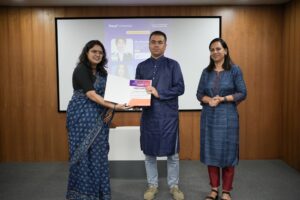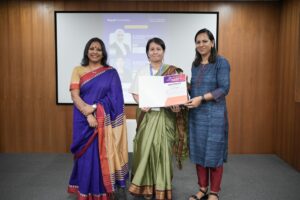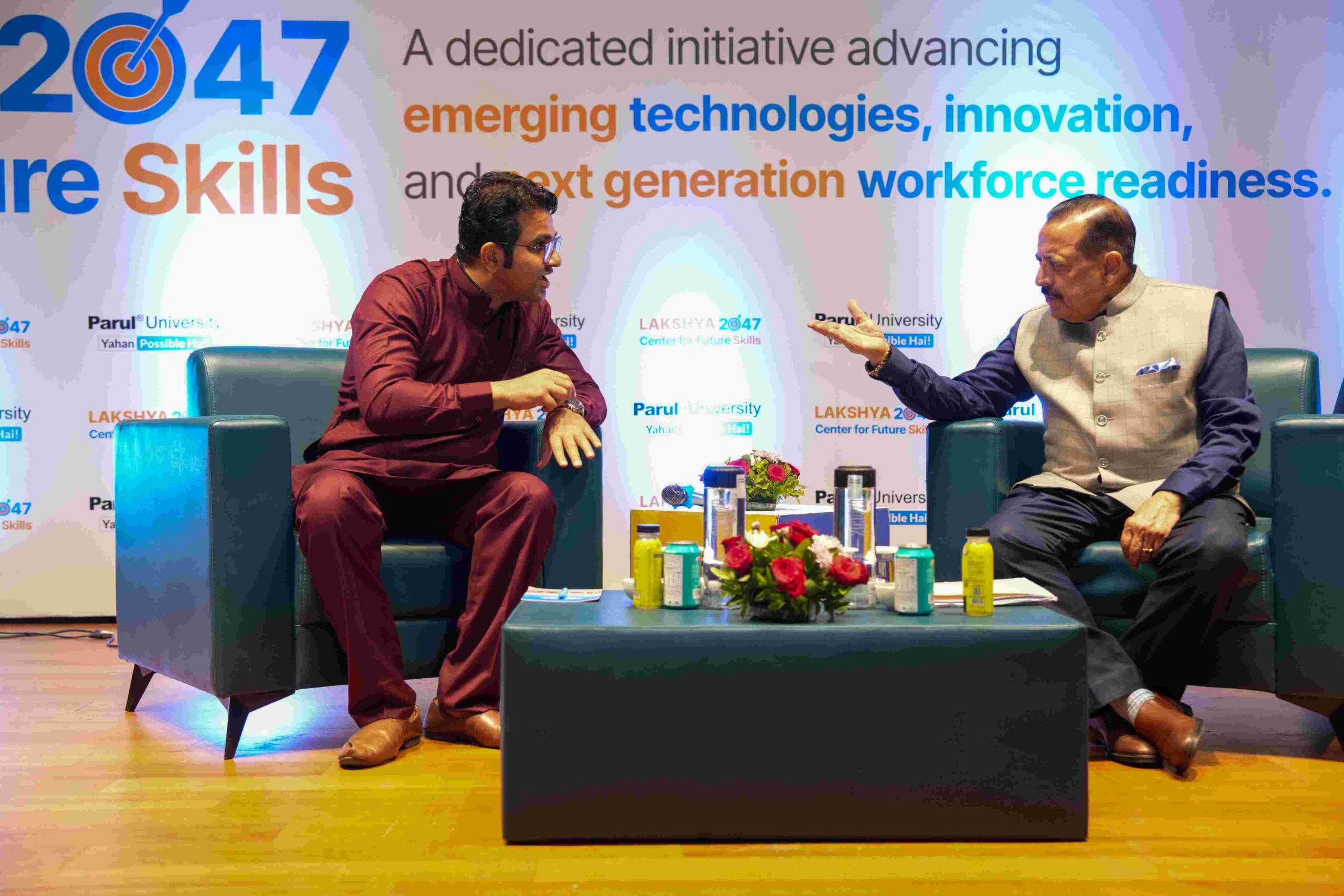
A vendor certificate is one thing. A vendor certificate that carries national skill-framework alignment is something else. The sheer difference between the two is what makes NSDC’s partnership inside Lakshya 2047 – Centre for Future Skills at Parul University. It was proudly inaugurated by the Union Minister, Dr Jitendra Singh, on 8th May 2026. It is designed in a way that allows students to have accreditation from Microsoft, AWS, NVIDIA, Cisco, Siemens, Schneider, ABB, Adobe, Apple, Autodesk, Meta, ANSYS and Synopsys, as directly operated by Skill India’s Mission. It will even enhance the workforce of India for the next 2 to 3 decades!
What the National Skill Development Corporation actually does
What is NSDC, exactly? The National Skill Development Corporation (NSDC) is a public-private partnership under the Ministry of Skill Development and Entrepreneurship. It does not run training centres. It builds the ecosystem around them. Sector Skill Councils, training partners, and accredited assessment bodies are all coordinated toward one thing: a national framework that employers, regulators, and educational institutions can use to evaluate workforce credentials without running separate verification systems.
- Function one is framework alignment. NSDC builds and maintains the NSQF, the National Skills Qualifications Framework. Skill levels mapped. Job roles defined. Competency standards attached to each. A credential with NSDC alignment sits inside that map at a specific level. Employers hiring against it know exactly what they are getting.
- Function two is Sector Skill Council coordination. Councils cover IT-ITeS, Electronics, Automotive, Aerospace, Manufacturing, Healthcare, and more. Each translates industry-specific skill requirements into curriculum and assessment standards. Lakshya 2047 maps across several of these at once. That is not accidental.
- Function three is assessment infrastructure. NSDC accredits the bodies whose evaluations carry weight inside the national framework. An employer anywhere in India, hiring across any sector, can verify an NSDC-aligned credential against a common standard. The portability is structural. No second-guessing what the issuing institution actually tested.
The credentialing gap NSDC alignment closes
Indian higher education has historically produced graduates with degrees but not with workforce-portable credentials. The gap matters because hiring is increasingly skill-based rather than qualification-based, and the skill needs to be verifiable independently of the issuing institution.
A graduate from a private engineering college in 2026 might hold a B.Tech degree, a few in-house certificates from industry-relevant electives, and the standard college-issued mark sheets. Whether this graduate can actually work as a cloud engineer, a network administrator, an industrial automation technician, or an AI developer is largely opaque to the hiring manager. The college’s brand provides some signal, but the signal is institutional rather than skill-specific. The hiring manager has to take the college’s word for what the graduate can actually do, or run the kind of extended technical interview that adds weeks to the hiring cycle.
The credentialing gap is what closes the distance between what the institution says the graduate learned and what an employer can independently verify. Two kinds of credentials close the gap most effectively: vendor-issued certifications (Microsoft AZ-204, Cisco CCNA, AWS Solutions Architect) and national-framework-aligned certifications. The first tells the employer that the candidate has cleared a standardised examination set by the company itself. The second tells the employer that the candidate’s skill level is locatable inside a national framework recognised by other employers, regulators, and government schemes.
Lakshya 2047’s structural innovation is that it stacks both. A student inside the centre earning, say, the Microsoft Azure Developer Associate AZ-204 credential is earning a vendor-issued certification. The same student, with the NSDC alignment that the partnership creates, also has their skill level positioned inside the National Skills Qualifications Framework. The certification’s value is doubled. It carries weight with private-sector employers who recognise Microsoft credentials, and it carries weight inside government schemes, Sector Skill Council frameworks, and national workforce programmes that recognise NSQF positioning. This combined value is what most institution-issued certificates do not deliver. The detailed breakdown of how each Lakshya 2047 certification connects to the NSQF framework sits inside the certification guide.
The three-partner architecture: NSDC, Ethnotech, and Cambridge University Press and Assessment
Single-partner training centres deliver one thing well. Lakshya 2047 was built on a three-way partnership because the centre’s ambition required three different credentialing dimensions to be present simultaneously.
- NSDC (national-framework dimension). Brings the National Skills Qualifications Framework alignment, Sector Skill Council coordination, and the connection to the Skill India Mission. This is the dimension that makes the centre’s certifications carry weight inside India’s national workforce architecture and government recognition schemes.
- Ethnotech (industry-implementation dimension). Operates the day-to-day training delivery inside several of the labs. Ethnotech’s role is to bring instructors who work professionally in the certified domains, ensuring that what is taught in the centre tracks what the industry actually uses, rather than the version of the technology that was current five years ago. The arrangement keeps Lakshya 2047 as Parul University infrastructure with Ethnotech embedded as the industry-current implementation partner.
- Cambridge University Press and Assessment (international-academic dimension). Brings international academic credentialing standards. Cambridge’s involvement signals that the centre’s training is aligned with internationally recognised academic assessment frameworks, not only with industry vendor certifications. Students whose academic record carries Cambridge assessment are positioned for international graduate-school admissions and global mobility in ways that institution-only credentials do not enable.
The three-way structure means a student inside Lakshya 2047 graduates with three forms of credentialing weight: vendor recognition from the global industry partner, national skill-framework alignment through NSDC, and international academic assessment validation through Cambridge. No single partner can provide all three. The combination is what gives Lakshya 2047 its distinctive credentialing profile.
What changes when certifications carry NSDC alignment
A vendor certificate without NSDC alignment is one credential. The same certificate with NSDC alignment is a credential plus a national framework position. Three specific things change.
- Government-scheme eligibility. Multiple Government of India schemes for workforce development, including various central and state employment generation schemes, prefer or require NSQF-aligned credentials. A Lakshya 2047 graduate with NSDC-aligned certifications has direct access to these schemes in ways that pure vendor-certificate holders do not.
- Cross-sector portability. An NSDC-aligned credential carries weight across sectors because the NSQF level is sector-agnostic. A cloud computing credential at NSQF Level 6 is recognisable to an employer in healthcare, banking, manufacturing, or any other sector that needs cloud infrastructure managed. The credential’s value does not depend on the hiring sector’s understanding of the vendor’s certification structure.
- Career-pathway mapping. NSDC’s framework includes job role definitions that connect skills to specific career pathways. Students inside Lakshya 2047 can see how their accumulated certifications map to specific job roles inside specific industries, with NSDC providing the connecting tissue between training and employment categories.
These three changes are why the NSDC partnership is not just a credentialing add-on. It is structural to how Lakshya 2047 positions its graduates in the workforce. The full implications for graduate employability and career pathway mapping are covered in the career pathways article.
How the Lakshya 2047 NSDC partnership operates
The partnership operates at several layers, each of which affects student outcomes differently.
At the curriculum layer, NSDC’s Sector Skill Council standards inform what is actually taught inside the labs. The Microsoft and AWS labs incorporate IT-ITeS Sector Skill Council standards alongside the vendor certification curriculum. The PLC and SCADA, Industrial Drives, Home Automation, and ABB labs incorporate Electronics Sector Skill Council and Manufacturing Sector Skill Council standards. The VLSI Lab incorporates Electronics Sector Skill Council standards specifically aligned with the India Semiconductor Mission talent pipeline. The Autodesk and Adobe Lab incorporates the Media and Entertainment Skill Council and the IT-ITeS Council standards. Cross-referencing vendor curricula with NSDC frameworks is what closes the gap between industry-current training and national-framework portability.
At the assessment layer, NSDC-accredited assessment bodies provide the framework-aligned verification that accompanies vendor-certification examinations. A student clearing a Microsoft Azure AZ-204 examination inside Lakshya 2047 is taking the vendor’s examination through the vendor’s process, but the resulting credential carries documented NSQF-level positioning that future employers and government schemes can verify independently.
At the institutional layer, the partnership connects Parul University as a whole to NSDC’s broader institutional ecosystem. The university’s other skill-development assets, including diploma programmes, vocational courses, and internship infrastructure across the four campuses, gain alignment with NSDC’s national framework through the Lakshya 2047 anchor.
How this differs from other university-NSDC partnerships
NSDC has partnerships with multiple Indian universities. Most are narrower than the Lakshya 2047 model in specific ways.
- Single-sector scope versus multi-sector scope. Most university-NSDC partnerships focus on one Sector Skill Council, typically IT-ITeS or Manufacturing. The Lakshya 2047 partnership spans IT-ITeS, Electronics, Manufacturing, Aerospace, Media and Entertainment, and the emerging Semiconductor Sector Skill Council. The multi-sector scope is what allows the centre to serve students across multiple Parul University faculties simultaneously.
- Vendor partner stacking. Most university-NSDC partnerships involve one or two vendor partners (typically Microsoft or AWS). Lakshya 2047 stacks twelve major vendor partners (Microsoft, AWS, NVIDIA, Apple, Cisco, Siemens, Schneider, ABB, Autodesk, Adobe, Meta, Synopsys) plus IEEE and ASM International standards bodies, all coordinated under the same NSDC alignment framework.
- Cross-faculty design. Most NSDC-partnered training centres are housed inside a single department, typically Engineering or Computer Science. Lakshya 2047 is structurally cross-faculty, with NSDC alignment applying to students from Engineering, Computer Science, Design, Architecture, Medicine, Nursing, Applied Sciences, and Management.
- Cambridge academic layer. Most NSDC partnerships do not include an international academic assessment partner. The Cambridge University Press and Assessment dimension is what positions Lakshya 2047 graduates for global mobility, in addition to domestic workforce alignment.
The Skill India Mission connection in detail
The Skill India Mission, launched in 2015, is the Government of India’s umbrella programme for skill development across the country. Its targets include training and certifying tens of millions of young Indians across multiple sectors over the course of its implementation horizon. NSDC is the principal implementing vehicle for the mission, and Lakshya 2047’s NSDC partnership therefore makes the centre an operational contributor to Skill India targets.
The mission’s specific contribution to Viksit Bharat 2047 is the workforce capacity it builds. India’s developed-nation ambition depends on having tens of millions of workers in the future-technology domains the vision identifies as priority areas. Lakshya 2047’s certification throughput, scaled across the multiple cohorts of Parul University students who pass through the centre over time, contributes measurable workforce capacity to this national target. Each NSDC-aligned credential issued is one more worker positioned inside the national framework with verifiable, employer-recognisable, sector-portable skills.
The detailed analysis of how Lakshya 2047 operationalises Viksit Bharat 2047, specifically, including the policy passages and the mapping of vision pillars to lab infrastructure, is in the Viksit Bharat 2047 implementation article. The detailed analysis of how the centre engages multiple national missions beyond just Viksit Bharat is in the AICTE IDEA Lab, plus the Make in India plus NEP 2020 article.
FAQs
What is the structure of the NSDC and Parul University partnership inside Lakshya 2047?
The partnership operates across three layers. At the curriculum layer, NSDC's Sector Skill Council standards inform what is taught inside the labs alongside vendor-specific certification curricula. At the assessment layer, NSDC-accredited assessment bodies provide the framework-aligned verification that accompanies vendor examinations. At the institutional layer, Parul University as a whole gains alignment with NSDC's national framework through the Lakshya 2047 anchor. The partnership is part of a three-way collaboration that also includes Ethnotech as the industry-implementation partner and Cambridge University Press and Assessment as the international-academic-credentialing partner. All three were named in the verified inauguration coverage from 8 May 2026.
How does NSDC alignment change what a Lakshya 2047 certification means?
NSDC alignment changes three specific things. First, it makes the credential eligible for government employment-generation and skill-development schemes that require NSQF positioning. Second, it makes the credential portable across sectors because NSQF levels are sector-agnostic. Third, it connects the credential to NSDC's job-role definitions, which map skills to specific employment categories. A Lakshya 2047 graduate with NSDC-aligned credentials therefore has a credential that carries weight with private-sector employers (through vendor recognition) and with government schemes and cross-sector employers (through NSQF positioning).
What is the role of Ethnotech inside the Lakshya 2047 partnership architecture?
Ethnotech is the industry-implementation partner in the three-way collaboration. The role is to operate the day-to-day training delivery inside several of the labs, with instructors who work professionally in the certified domains. This ensures that what is taught tracks what the industry actually uses currently, rather than the version of the technology that was current five years ago. Lakshya 2047 remains Parul University infrastructure, with Ethnotech embedded as the industry-current implementation partner alongside NSDC's national-framework partnership and Cambridge's international-academic-credentialing partnership.
Which Sector Skill Councils does Lakshya 2047 engage through NSDC?
Multiple Sector Skill Councils are engaged simultaneously because the centre's nine future-technology domains span sectors. The IT-ITeS Sector Skill Council covers the Microsoft, AWS, NVIDIA, Apple, and Cisco labs. The Electronics Sector Skill Council covers the VLSI Lab, Material Synthesis Zone, Industrial Drives Lab, and elements of the PLC and SCADA Lab. The Manufacturing Sector Skill Council covers the ABB Lab, Home Automation Lab, and Industrial Drives Lab. The Aerospace and Aviation Sector Skill Council covers the Drone Technique Lab, Drone Battery System Repair Lab, and Remote Pilot Training Operation (RPTO) Setup Lab. The Media and Entertainment Skill Council covers the Adobe Creative Design Studio and AR/VR Lab. The Capital Goods Skill Council covers the Prototyping Zone.
How does NSDC alignment help Parul University students find employment?
NSDC alignment helps graduate employment in three concrete ways. First, it makes the credential immediately recognisable to employers who use NSQF-aligned hiring frameworks. Second, it makes the graduate eligible for government schemes (PM Internship Scheme, PMKVY, various central and state employment generation programmes) that require NSQF positioning. Third, it makes the credential portable across sectors and across states, because the framework is national and sector-agnostic. The combination of vendor certifications and NSDC alignment is what positions Lakshya 2047 graduates for both private-sector hiring through Microsoft, AWS, NVIDIA, and similar partner recognition and for public-sector and government-scheme pathways through NSQF positioning.