Kunjal grew up in a village in Gujarat, studying in government schools, and she was a consistent topper, school topper through Class 10 and class topper in Classes 11 and 12. She describes herself plainly as a first bencher, someone for whom discipline was a habit formed early rather than summoned when the stakes rose. What gives that record weight is the context: it was built without the infrastructure of an urban education, in a family with no military background, in an environment where the aspirations around her were entirely conventional.
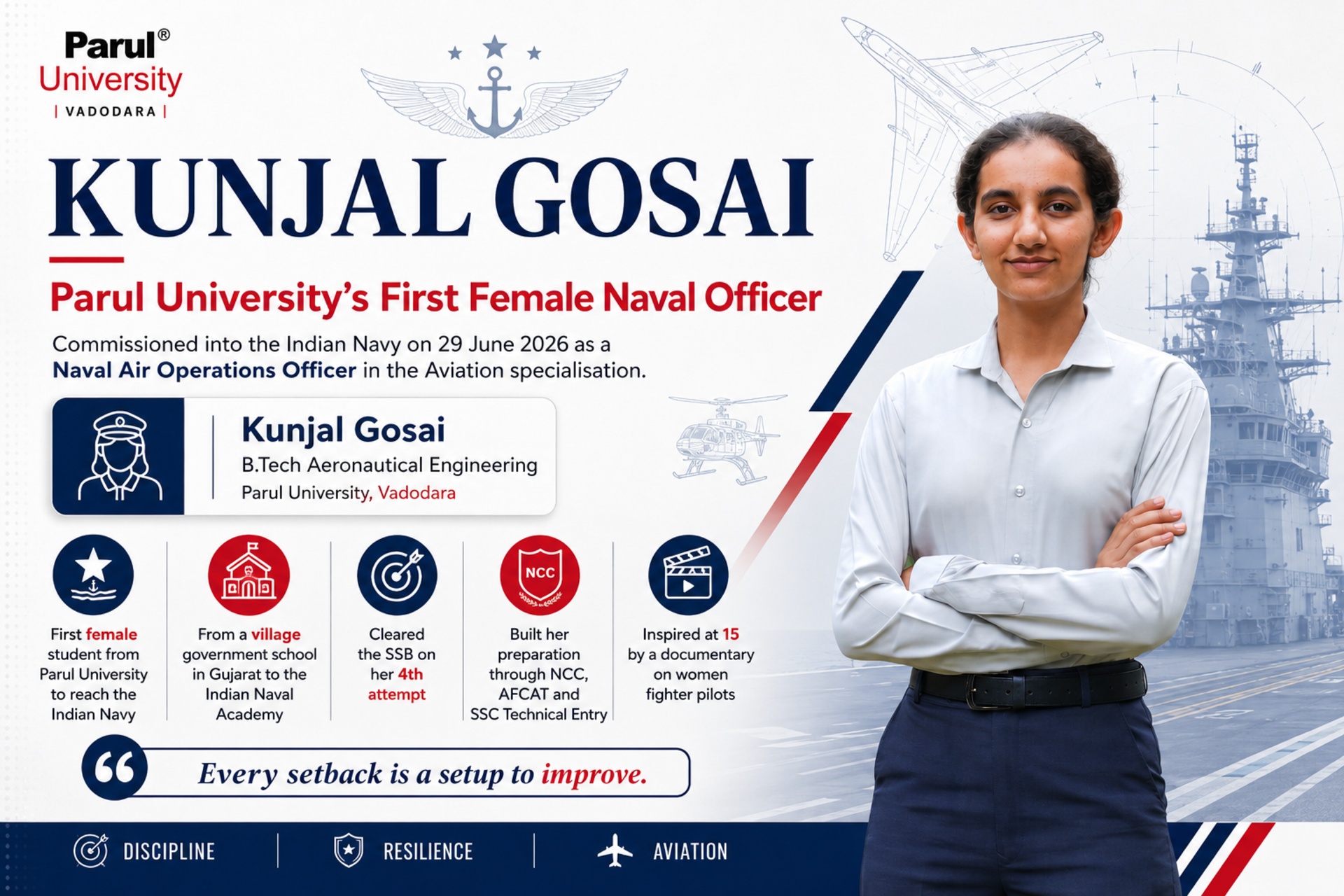
On 29 June 2026, Kunjal Gosai walked through the gates of the Indian Naval Academy to begin her commission as an officer of the Indian Navy, in the Aviation specialisation, serving as a Naval Air Operations Officer. She is the first female student from Parul University to reach this distinction, a landmark for the university’s Armed Forces Motivation Cell and its wider training ecosystem. Her story does not begin with privilege or military lineage. It begins in a village in Gujarat, in a civilian family, with a teenager who decided who she was going to become and then spent over a decade proving it.
The Documentary That Decided Everything
I watched that documentary and that’s where I got my inspiration to join the forces. – Kunjal Gosai
In Class 9, Kunjal watched a television documentary with her father about the first batch of women to become fighter pilots in the Indian Air Force, following their journey through selection and training. There was no calculation of career trajectories or salaries in what happened next, only recognition. Her father’s reaction was immediate: he was proud that his daughter had chosen something apart from the mainstream. Her mother, initially cautious about safety, came around as she saw the seriousness and consistency of Kunjal’s intent, and both became pillars of support through years of preparation.
Choosing Parul: The Aeronautical Logic
Kunjal’s path to Parul University was a considered alignment of study with intent, not proximity or default. Having decided on the armed forces and, specifically, aviation, she researched the degree that would best position her and concluded that aeronautical engineering was the closest fit. That led her to enrol in B.Tech Aeronautical Engineering at Parul University, carrying a goal she had set six years earlier. The degree was the foundation; what she intended to build on it had already been decided.
Arriving at Parul: Culture Shock and the NCC
Arriving from a village and a government-school background, Kunjal found Parul University a genuine culture shock, loud, vibrant, and unlike anything she had known, and what she did with that disorientation is telling. Rather than retreat into the familiar, she began interacting with students across disciplines and, in her first year, joined the National Cadet Corps, one of the most formative structures of her preparation. That same year she was selected for a national-level adventure camp in Jammu and Kashmir, her first significant exposure to life outside Gujarat and to the kind of demanding environment the SSB would later test. The NCC and its benefits are set out in the guide to how the NCC helps you join the armed forces.
Four Years of Deliberate Building
Her time at the university reads as a four-year programme of preparation. In her second year she took on organising roles, including the Engineers’ Day team at PIET, Teachers’ Day celebrations, and unglamorous coordinating work that built exactly what the SSB assesses. As she puts it, that participation improved her confidence, linguistic ability, and expressiveness, precisely the qualities that group discussions and group tasks are designed to surface. By her third year she made a deliberate pivot back toward her academic profile, sharpening coursework for the AFCAT examination and keeping her CGPA strong for CGPA-based Navy entry, while engaging in drone competitions, debates, and quizzes.
The Placement She Left Behind
It was a risk, but I would say it was worth it, taking that risk. – Kunjal Gosai
In her fourth year, Kunjal was placed through the university at Hitech Digital Solutions, an air-navigation company directly adjacent to her degree, a professionally respectable start. She worked through her final semester and then made the decision that most clearly defines her arc: she left. She had not yet appeared for a single SSB and held no recommendation, stepping away from financial security into a preparation window of undefined length. She was candid that it was a risk and candid about the doubt but clear that a corporate nine-to-five was never the life she intended. Choosing the uncertain pursuit of the life she had always wanted over a slow drift away from it was, for her, the more rational choice.
Three Rejections, and the Recovery That Mattered
Kunjal’s first three SSB attempts ended in Screen Out or Conference Out. Three times she returned home without a recommendation, and she does not minimise the self-doubt of that period, having left a job and not yet cleared the board. Her response was a practice of deliberate self-redirection: reminding herself it was fine to stay calm, keep working, and keep improving. That is the architecture of resilience the SSB is built to detect, and the specific lessons she drew from those attempts, especially about staying calm and authoritative amid the noise of group tasks, are set out in How to handle SSB Rejection and Finally Clear It.
The Route In, and the Moment of Selection
I was jumping out of joy around the room and shouting, mera naam aageya, my name has come. – Kunjal Gosai
Kunjal cleared the AFCAT examination, intending to join the Indian Air Force’s aviation branch, but when that route did not open at the time, she found her avenue through the Navy’s SSC Technical Entry, based on her college CGPA, and landed, as she puts it, precisely where she was meant to be: still aviation, as a Naval Air Operations Officer. In December, the results arrived. She read her name against her course, and the careful professional register broke into Hindi at the peak of emotion. Her parents were present; the realisation that all the years had led here hit them together. The aviation path itself is explained in aviation careers in the Indian Navy
The Mentorship That Held It Together
Parul University’s Armed Forces Motivation Cell gave Kunjal two things self-directed preparation could not reliably supply: a roadmap and a relationship. Its mentors, Lt. Cmdr. Gaurav Sharma and Cmdr Sanjay Sharma, structured a syllabus that is otherwise overwhelming, defining what to focus on and what to skip, and running continuous practice in group discussions, speeches, and the daily SSB drills. But what Kunjal remembers most is the human dimension. She describes Lt. Cmdr. Gaurav Sharma guiding her almost as a father, sharing his own stories of facing the same doubts whenever she called him demotivated, offering continuity of belief on the days she had lost belief in herself, covered in the attached article.
What It Means to Be the First
Kunjal is already thinking about what being the first carries forward. She speaks of representing both the Indian Navy and Parul University, aware that every future female student who considers the armed forces will do so in a context that now includes her name and that her conduct and performance will be read back at the university as an example. To students who share the dream but do not know how to pursue it, her advice is specific: visit the Armed Forces Motivation Cell, which turns an overwhelming process into a clear pathway. And to those mid-preparation, absorbing setbacks, she offers the line that summarises her own journey: every setback is a setup to improve, and if it is meant for you, it will find you.
Frequently Asked Questions
Who is Parul University’s first female Naval officer?
Kunjal Gosai, a B.Tech Aeronautical Engineering graduate of Parul University, is the first female student from the University to be commissioned into the Indian Navy. She was commissioned on 29 June 2026 as a Naval Air Operations Officer in the Aviation specialisation, after clearing the SSB on her fourth attempt.
How did she join the Navy without a military background?
From a civilian family in a Gujarat village, Kunjal built her path through academic discipline, the NCC, and the University’s Armed Forces Motivation Cell. She cleared the AFCAT, and when the Air Force route did not open, entered the Navy through its SSC Technical Entry, a CGPA-based route, and was selected for the Aviation branch after clearing the Services Selection Board.
How many SSB attempts did it take?
Four. Her first three attempts ended in Screen Out or Conference Out, and she earned her recommendation on the fourth. She credits the persistence and the specific lessons learned from those earlier attempts, particularly staying calm and authoritative during Group Tasks, for the eventual result.