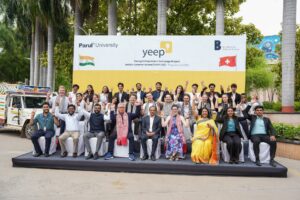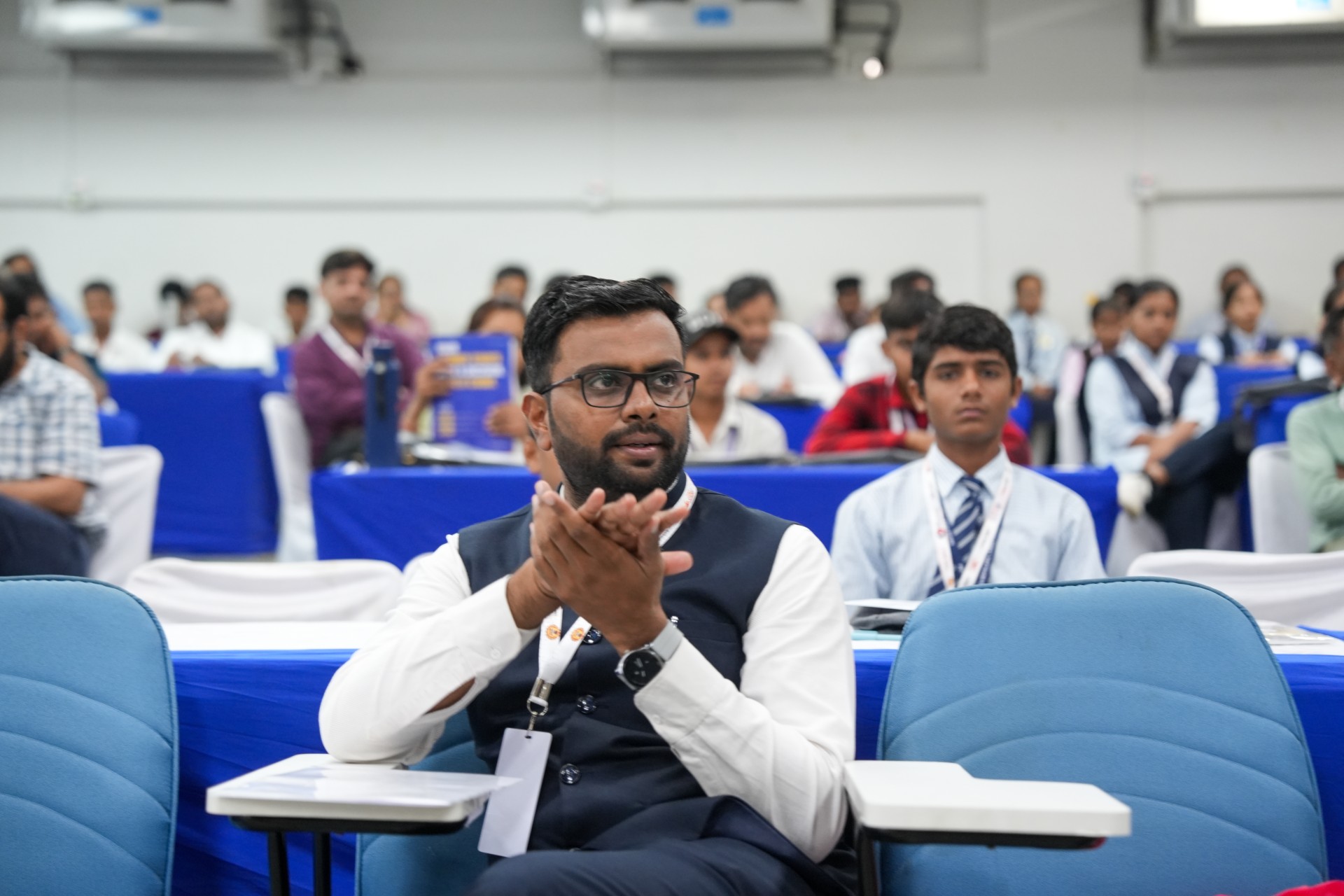
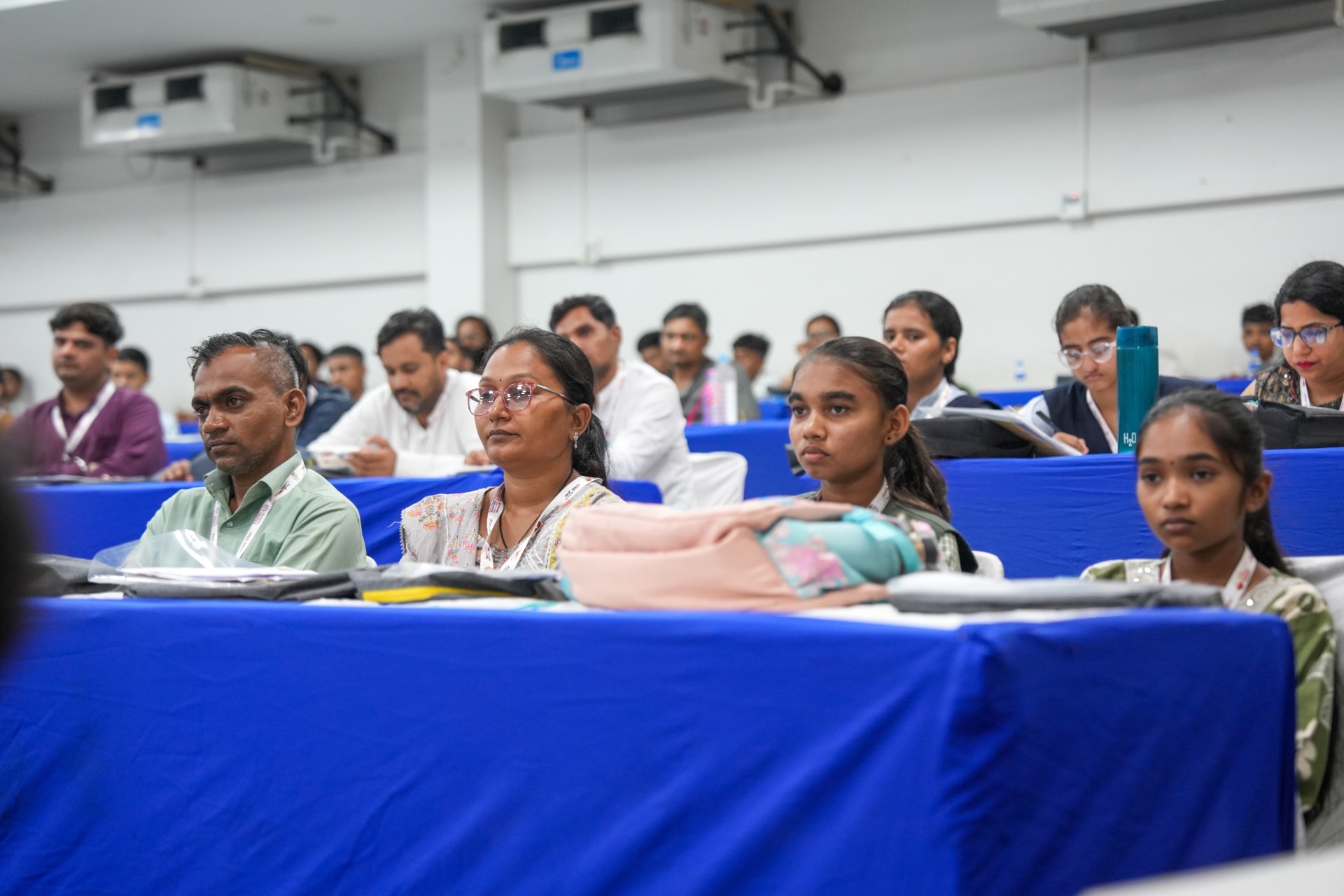
School students aged approximately 14 to 18 today will be in their mid-to-late thirties in 2047. The eleven students who pitched at Parul University on 30 April 2026 will be the operational generation of Viksit Bharat.
Day 3 of the Three-Day Regional Mentoring Session at Parul University concluded with the structured pitch presentations that the entire programme had been building toward. The 20-member jury panel evaluating the pitches comprised Dr. Arvind Deshmukh (Founder, Deshmukh Global Management Solutions; Master Trainer, Wadhwani Foundation), Ms. Anbumathi M (Founder, Carbon 6 Venture Studio; Innovation Venture Catalyst, Wadhwani Foundation), Mr. Parth Devariya (AI and Technology Consultant, GFuture Tech Pvt. Ltd.), Mr. Hardik Kharva (Centre Head, VSS, PIERC), Ms. Sonal Sudani (Incubation Manager, PIERC), and Mr. Umang Panchal (Assistant Professor, PIET). The broader Day 3 evaluation operated through ten three-member jury panels per AICTE programme guidelines. The eleven innovations documented below span Atmanirbhar Bharat priorities, including agricultural resilience, road safety, clean energy, sustainable infrastructure, and waste management.
Parul University hosts PM SHRI Regional Mentoring Session under AICTE & MoE Innovation Cell!
Innovation 1: Amit Vaghela (JNV Ahmedabad) - Natural Air Conditioner
The maths simply does not work for a family earning Rs. 15,000 to Rs. 30,000 a month. An air conditioner costs as much as Rs. 50,000 to buy, then keeps costing through maintenance and electricity, which is exactly the gap Amit Vaghela from JNV Ahmedabad set out to close. What he built uses clay pots filled with water, a fan pushing air across that water surface, and a particulate filter to clean the output, and the whole thing cools a room on a fraction of the power a conventional unit needs.
The price tells the real story here, because his version lands between Rs. 2,500 and Rs. 5,000 against the Rs. 50,000 of a normal air conditioner. He kept the design his own, using the internet only to figure out component assembly, and he told the jury his next move is putting the unit in front of neighbours and family to collect feedback before thinking about a launch.
Innovation 2: Vasava Aditya (JNV Surat) - Tributary River Cleaning System
Big rivers get the attention and the budgets. The small tributaries feeding into them get ignored, and that is where Vasava Aditya from JNV Surat saw trash collecting and doing real damage, hurting fish, fouling the water that farms draw on for irrigation, and dragging down water quality everywhere downstream. His floating device carries panels that pull trash from both the surface and underneath, and crucially, it is shaped for the narrow tributary channels that the usual river-cleaning boats are too large to enter.
He prices each unit between Rs. 1,50,000 and Rs. 3,00,000 and sees government water agencies and large industrial facilities as the buyers who would actually deploy it. The jury wanted to know how this differed from the lake cleaning machines already running in places like Udaipur, and his answer was specific: those work the main channels, his works the connected tributary geometries they cannot reach. The whole idea, he said, came from things he noticed while travelling, which he then chased down through his own research.
Innovation 3: Sahil (PMC Model School Ratlam) - Suncatcher
Sahil from PMC Model School, Ratlam, started with his own dark room. It was too dim to study in, and opening the window for light just let the mosquitoes in, which is a small frustration that turned into a real piece of engineering. His Suncatcher runs optical fibre pipes from external collectors into interior rooms, with a diffuser spreading the light evenly indoors and UV filtering built in so heat does not accumulate, which solves the everyday waste of basement rooms and interior spaces burning artificial light all day while the sun sits unused outside.
At Rs. 9,000 an installation, it costs far less than going the solar panel route, which puts it within reach for homes and restaurants trying to cut daytime electricity bills. Asked how it copes when sunlight intensity drops, Sahil pointed to adjustable lenses that even out the brightness, and he did not dodge the obvious limitation either, admitting plainly that the system only works in daylight while making the fair point that daytime savings are still real savings.
Innovation 4: Krish Bavalya Harjibhai (Model School Jasdan) - Agricultural Crop Storage
Around 30 per cent of what a farmer grows can rot after harvest, and the reason is rarely complicated; it is just the absence of storage anyone can afford, which then pushes farmers into panic-selling at whatever low price they can get. Krish Bavalya Harjibhai from Model School from Jasdan answered this with a solar-powered storage unit that sits at the farm itself, cooled internally by a structure of bricks, sand, and bamboo, where crops are packed in food-grade wax and aloe vera gel to hold their freshness while temperature sensors warn the farmer of any shift in conditions.
He deliberately did not design it for individual purchase, building it instead for cooperative ownership so that small farmers can pool money and share one unit, which lines it up neatly with the smallholder cooperatives and Agricultural Producer Organisations working under the Government of India’s farmer welfare framework. The jury raised the obvious point that cold storage already exists, and Krish had his answer ready: that his use of traditional materials like bricks, sand, and bamboo alongside solar power is exactly what makes it affordable at the small-farm level where ordinary cold storage never reaches.
Students & Teacher Voices from PM SHRI RMS Programme at Parul University!
Innovation 5: Navya Chaudhary (JNV Mahisagar) - Smart Auto Helmet Visor
- Innovator: Navya Chaudhary, JNV Mahisagar
- Problem addressed: Two-wheeler riders in winter and monsoon conditions face fog accumulation on helmet visors, forcing them to either stop to wipe the visor or to ride with reduced visibility, leading to accidents.
- Solution: Fog detection sensor combined with a small internal fan inside the helmet. The sensor detects breath-induced fog buildup and automatically activates the fan to clear the visor.
- Cost positioning: 800 to Rs. 1,000 per unit, designed for mass-market affordability.
- Target market: Two-wheeler riders, delivery riders, and commercial fleet operators in monsoon-affected regions.
- Jury Q&A: Navya disclosed that the idea emerged from personal experience. She wears glasses and was unable to fit defogging equipment onto eyewear, so she relocated the concept into the helmet form factor where it became feasible.
Innovation 6: Shubham Kumar Sahu (JNV Kutch) - Suraksha Driver
A mentor once gave Shubham Kumar Sahu an analogy that ended up shaping his entire design, comparing it to an alarm clock that refuses to go quiet until you actually wake up. Apply that logic to a car, and you get the Suraksha Driver, which will not let the vehicle accelerate until the phone is put down. Shubham, who studies at JNV Kutch, was going after the two factors behind most road deaths in India, distracted driving and over-speeding, and his system handles both.
A camera watches the driver, and if a phone stays in hand for more than three seconds, the speed starts dropping, with the vehicle eventually halting if the warning keeps getting ignored, while GPS integration reads the speed limit signs along the road and holds the car to them. He built it on Raspberry Pi processing and standard cameras, which keeps it down to Rs. 7,700 an installation, and he is pitching it both at individual drivers and at original equipment manufacturers who want safety baked into new vehicles. The inspiration came from newspaper reports of accidents, and he made a point of thanking the school teachers and mentors who backed him through it.
Innovation 7: Niharika Vasava (JNV Tapi) - Plastic Waste Road Repairing Kit
Niharika Vasava noticed two things happening in the same stretch of road near her home: plastic piling up with nowhere useful to go and potholes that never seemed to get fixed properly, and burning the plastic to be rid of it only added air pollution to the list. So the JNV Tapi student folded both problems into one answer. Her kit shreds waste plastic and mixes it with road repair chemicals, and that plastic-chemical composite goes straight into the potholes, leaving a surface that stands up to rainwater damage better than the usual asphalt patch ever does.
It does cost more per unit than ordinary pothole repair, but she argues the longer life of the road and the sheer volume of plastic the process consumes more than make up for it, which is the case she would put to municipal corporations and state road maintenance agencies. The jury raised the natural worry about plastic melting in the summer heat, and Niharika explained that binding it tightly with the road chemicals is what stops it from softening or shifting once it is laid.
Innovation 8: Om Sagar (JNV Surendranagar) - Life Save Auto Alert AI
What stayed with Om Sagar was an accident he watched in Rajkot, where the people trapped inside a vehicle simply could not get help in time. That is the gap his project closes, because a driver knocked unconscious in a crash cannot call anyone, and the minutes that follow often decide whether they live. The JNV Surendranagar student wired crash sensors to a connected processing chip so that the instant it recognises the impact pattern of a collision, an AI voice agent starts calling the people who matter, designated family members, the local police, and the nearest hospital, sending GPS coordinates along so help can route straight to the scene.
At today’s component prices, it works out to around Rs. 1,30,000 per installation, though Om is confident engineering optimisation can bring that figure down, and he sees it fitting both car OEMs and individual owners, especially senior drivers and anyone regularly covering long distances. He named his inspirations directly, pointing to the Government of India’s Make in India framework and to Union Minister Nitin Gadkari‘s road safety initiatives.
Innovation 9: Kashish Vaghela (Model School Halvad) - Biochemical Nanoparticles
- Innovator: Kashish Vaghela, Model School Halvad
- Problem addressed: Conventional textile chemical coatings use synthetic compounds that cause skin reactions and environmental damage.
- Solution: Silver nanoparticles synthesised from plant materials, including basil and banana leaves. The biochemical particles are applied as a coating to fabrics, providing water-resistance and antibacterial protection.
- Cost positioning: Approximately Rs. 2,50,000 to establish the production process, with a low per-unit production cost using plant-based feedstocks.
- Target market: Textile industry and medical product manufacturers seeking sustainable alternatives to synthetic coating chemicals.
- Jury Q&A: Kashish credited her mentor’s ongoing nanoparticle research for sparking the plant-based synthesis idea. She emphasised the zero-chemical-waste production process as the primary differentiation from existing market offerings.
Innovation 10: Vasava Divyesh and Rathva Bhavesh (PMC Model School Selamba) - Anti-Distraction Car System
- Innovators: Vasava Divyesh and Rathva Bhavesh, PMC Model School Selamba
- Problem addressed: Drivers distracted by phone use cause accidents involving pedestrians, two-wheeler riders, and other vehicles.
- Solution: Camera-based driver monitoring with an audible buzzer that activates when phone usage is detected. The buzzer continues until the driver returns full attention to the road. Integrated with the vehicle’s engine data for context awareness.
- Cost positioning: 95,000 per installation using AI processing hardware.
- Target market: Car OEMs and fleet operators in commercial transportation.
- Jury Q&A: The team described witnessing an accident involving a distracted driver and a two-wheeler rider as the founding motivation. Their school teacher, Mr. Navin, provided technical assistance in assembling the prototype hardware.
Innovation 50: Rathva Jyotiben Vikeshbhai (PM Shri GLRS Sai Devgadh Baria) - Garbage Recycling Electricity Generator
- Innovator: Rathva Jyotiben Vikeshbhai, PM Shri GLRS Sai Devgadh Baria
- Problem addressed: Open burning of household waste produces toxic smoke that harms wildlife and pollutes urban air. Conventional incineration systems are too expensive for village-level deployment.
- Solution: Compact incineration system that burns waste to generate electricity while capturing smoke through water-based filtration. The filter system traps particulate matter, which is then reused as drawing ink. The combination produces electricity, processes waste, and prevents air pollution simultaneously.
- Cost positioning: Designed for municipal and village-level affordability.
- Target market: Gram panchayats, municipal corporations, and small urban local bodies.
- Jury Q&A: The judges advised on scaling the unit for deployment in high-rise residential buildings and large hospitals. Jyotiben credited her school’s science project programme and teacher consultations for the development support.
How these eleven innovations map to Lakshya 2047 vision of Viksit Bharat and government priorities
Each of the eleven innovations addresses a structural problem that India’s Lakshya 2047 vision of the Viksit Bharat trajectory directly engages with. The mapping is not symbolic. It is operational.
- Atmanirbhar Bharat (self-reliant India): Amit Vaghela’s Natural Air Conditioner and Krish Bavalya’s Agricultural Crop Storage directly address economic accessibility gaps that conventional market solutions have not closed.
- Make in India (manufacturing leadership): Om Sagar’s Life Save Auto Alert AI, Navya Chaudhary’s Smart Auto Helmet Visor, and the two anti-distraction driving systems (Shubham Kumar and the Vasava-Rathva team) all target automotive original equipment manufacturer (OEM) integration.
- Swachh Bharat (clean India) and Smart Cities: Niharika Vasava’s Plastic Waste Road Repairing Kit and Rathva Jyotiben’s Garbage Recycling Electricity Generator address waste management at the municipal scale.
- Atmanirbhar Bharat in clean energy: Sahil’s Suncatcher provides off-grid daytime lighting, and Rathva Jyotiben’s incinerator generates electricity from waste.
- Health and sustainability: Kashish Vaghela’s Biochemical Nanoparticles enable a sustainable textile and medical coating alternative to synthetic compounds.
- River conservation and Namami Gange alignment: Vasava Aditya’s Tributary River Cleaning System extends river remediation infrastructure to the small-tributary scale that current programmes do not reach.
- Road safety and Vahan Sarvang Suraksha: Three of the eleven innovations (Suraksha Driver, Smart Auto Helmet Visor, Anti-Distraction Car System) directly address India’s road fatality reduction targets.
Student Innovation Practice: the funding pathway
The most promising of the eleven innovations are eligible to advance into the Student Innovation Practice track, where up to Rs. 1.5 lakh per student team is available for prototype development funding. The funding integrates with the broader AICTE Innovation Cell ecosystem and the Startup India recognition pathway, enabling students whose pitches demonstrate sufficient promise to convert their school-level innovations into recognised early-stage ventures. Parul University’s PIERC, as the AICTE Nodal Centre, provides the operational infrastructure for prototype development support through its incubation and pre-incubation programmes.
FAQs
How many student innovations were pitched at the PM SHRI RMS final day?
50 students have pitched on the 3rd day of PM SHRI RMS. The presentation was judged by Dr. Arvind Deshmukh, Ms. Anbumathi M, Mr Parth Devariya, Mr. Hardik Kharva, Ms. Sonal Sudani and Mr. Umang Panchal. The broader Day 3 evaluation infrastructure operated through ten three-member jury panels per AICTE programme guidelines. The eleven innovators came from PM SHRI Schools, Jawahar Navodaya Vidyalayas, PMC Model Schools, and Model Schools across Gujarat.
Which schools did the 50 PM SHRI RMS innovators come from?
The eleven student innovators came from a cross-section of school types that the PM SHRI Regional Mentoring Session is designed to serve. From JNV Ahmedabad (Amit Vaghela), JNV Surat (Vasava Aditya), JNV Mahisagar (Navya Chaudhary), JNV Kutch (Shubham Kumar Sahu), JNV Tapi (Niharika Vasava), and JNV Surendranagar (Om Sagar). From PMC Model School Ratlam (Sahil) and PMC Model School Selamba (Vasava Divyesh and Rathva Bhavesh). From Model School Jasdan (Krish Bavalya Harjibhai) and Model School Halvad (Kashish Vaghela). From PM Shri GLRS Sai Devgadh Baria (Rathva Jyotiben Vikeshbhai).
How do these student innovations align with Lakshya 2047's vision of Viksit Bharat?
The Government of India's Lakshya 2047 vision of Viksit Bharat targets making India a Viksit Bharat (developed nation) by the centenary of independence in 2047. The eleven student innovators at PM SHRI RMS, who are approximately 14 to 18 years of age today, will be in their mid-to-late thirties in 2047, representing the exact age cohort that will hold operational and leadership responsibility for the Viksit Bharat transformation. 6 out of 50 innovations address Atmanirbhar Bharat & Make in India’s vision that covers automotive, agricultural resilience, clean energy generation, infrastructure, waste management and road safety.
Define SIP?
The Student Innovation Practice (SIP) is a track within the broader School Innovation Council framework operated by the Ministry of Education's Innovation Cell with AICTE collaboration. Through SIP, student teams whose innovations demonstrate sufficient promise can access up to Rs. 1.5 lakh in funding for prototype development. The holistic funding is aptly integrated with the broader ecosystem of the AICTE Innovation Cell. PU’s PIERC enables the vision by being a nodal centre for RMS, ensuring infrastructure and incubation space for holistic access!
Who were the jury members evaluating the 50 student innovations?
The Day 3 final pitch session at PM SHRI RMS was evaluated by a 20-member core jury panel comprising Dr. Arvind Deshmukh (Founder, Deshmukh Global Management Solutions; Master Trainer, Wadhwani Foundation), Ms. Anbumathi M (Founder, Carbon 6 Venture Studio and Resources Lifescience; Innovation Venture Catalyst, Wadhwani Foundation), Mr. Parth Devariya (AI and Technology Consultant, GFuture Tech Pvt. Ltd.), Mr. Hardik Kharva (Centre Head, VSS, PIERC), Ms. Sonal Sudani (Incubation Manager, PIERC), and Mr. Umang Panchal (Assistant Professor, Parul Institute of Engineering and Technology). The broader evaluation operated through ten three-member jury panels per AICTE programme guidelines, with additional members from PU faculty and the wider innovation community.
What government initiatives do these student innovations connect to?
The eleven student innovations at PM SHRI RMS map across multiple Government of India initiatives. Lakshya 2047 vision of Viksit Bharat (Viksit Bharat by India's centenary) is the strategic umbrella. Atmanirbhar Bharat (self-reliant India) is addressed by locally sourced agricultural storage, low-cost cooling, and waste-to-energy innovations. Make in India is addressed by the automotive safety systems targeting OEM integration. Swachh Bharat is addressed by the plastic waste road repair and garbage recycling systems. Smart Cities are addressed by road safety, waste management, and energy efficiency innovations. Namami Gange and river conservation are addressed by the tributary river cleaning system. The Startup India framework provides the recognition pathway for these innovations as they advance from school-level pitches toward registered ventures.