The most reliable evidence of a programme’s reach is not its planned design. It is what participants say when the planned design is over and the microphone is open.
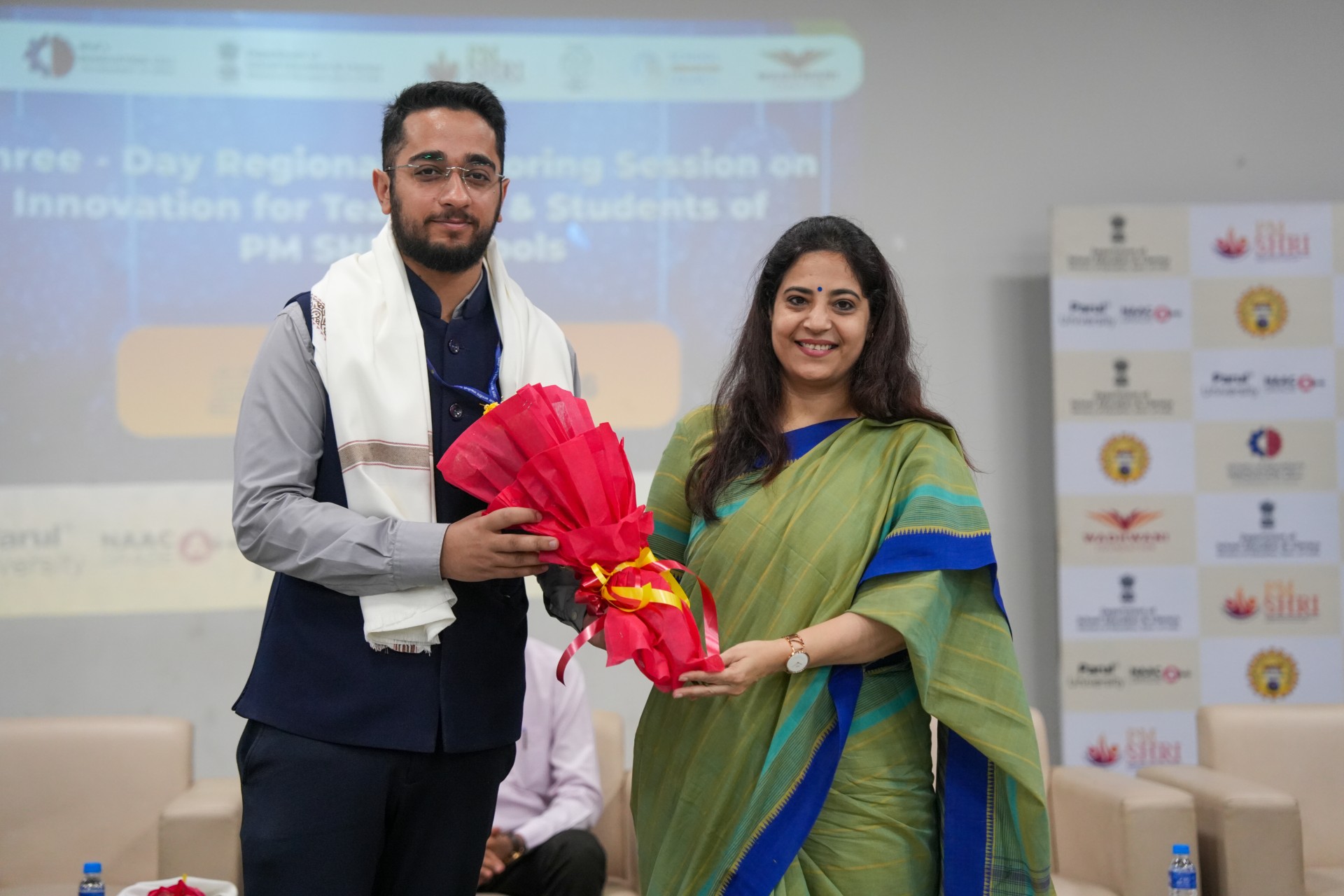
The valedictory ceremony of the PM SHRI Regional Mentoring Session at Parul University included a structured open-feedback segment in which students and teachers from the participating schools were invited to share their reflections on the three days. Student anchor Anvika, herself a PIERC volunteer who had handled both the inaugural and the valedictory ceremonies, coordinated the floor. The voices that emerged came from rural Gujarat districts, tribal-belt JNVs, and PM SHRI Schools across the state. The transcript that follows captures the testimonies as they were recorded, with attribution and school identification for verification.
The entire 20-member jury panel comprised Dr. Arvind Deshmukh, Ms. Anbumathi M, Mr. Parth Devariya, Mr. Hardik Kharva (Centre Head, VSS, PIERC), Ms. Sonal Sudani (Incubation Manager, PIERC), and Mr. Umang Panchal (Assistant Professor, PIET) and Mr Anup Chaudhary (Incubation Manager), Mr Umang Panchal, Mrs Sonal Sudani (PIERC), Mr. Hardik Kharwa, Ms. Sujaya Bhattacharjee, Mr. Himansu Das, Ms. Vanshika Muchhara, Dr. Partkumar Sapariya, Dr. Bhavin Dhanavade, Dr. Prashant Khanna, Dr. Sneha Soni, Dr. Saurabh Parmar, Ms. Kajol Patel, Mr. Vivek Joshi, Ms. Riddhi Mehta, and Mr. Omkamal Vashi.
Niyanti Patel, JNV Banaskantha: gratitude to the volunteer corps
Niyanti Patel was the first to take the floor. JNV Banaskantha serves the Banaskantha district, one of Gujarat’s primarily rural agricultural regions in the north of the state.
Her testimony set the tone for what followed. She expressed gratitude not to the dignitaries on stage or to the Wadhwani Foundation trainers but to the PIERC student volunteers who had worked behind the scenes across the three days. Her observation captured the asymmetry directly: participants had expected to contribute approximately twenty per cent of their own effort to the programme, and the volunteer corps had delivered a hundredfold in return. The reflection acknowledged a structural truth that often goes unspoken: a programme’s success depends as much on the operational support layer as on the intellectual content delivered from the stage.
Vamsa Rathi: the discovery framing that defined the three days
Vamsa Rathi’s testimony captured something that participants from multiple schools echoed across the feedback session: the difference between what they had expected to learn and what they had actually been taught.
I came here thinking, What will I learn? Sir, you came and taught us. Thank you so much. And especially Dipanshu Bhaiya, who helped us a lot.
Vamsa Rathi, student participant at PM SHRI RMS Parul University, on the discovery experience of the three days
The reference to Dr. Arvind Deshmukh and to volunteer Dipanshu carries operational significance. Dr. Deshmukh delivered the substantive design thinking content from the dais; Dipanshu provided the one-to-one mentorship at the team level that allowed students to actually apply the framework to their own ideas. The dual recognition captures the layered support architecture that programmes of this kind require.
Sparsh Rahaan, JNV Gujarat: quality and rigour as the takeaway
Sparsh Rahaan spoke from a different framing. The technical content of innovation and startups had been useful, he acknowledged, but the more important learning had been about something else.
The quality and rigour of one’s ideas, he reflected, was the dimension the programme had taught him to think about. The framing aligns with Dr. Arvind Deshmukh’s underlying methodology: ideas in volume during ideation, logic and rigour during selection. Sparsh’s recognition of the distinction is evidence that the methodology had moved from theoretical exposure into actual cognitive practice within three days. He expressed gratitude to his mentor and to the volunteers who had supported the teams throughout.
Shubham Kumar, JNV Kutch: the interactive teaching style that made it work
Shubham Kumar of JNV Kutch offered the warmest portrait of the mentors’ teaching method, specifically noting Dr. Arvind Sir’s and Ms. Anbumathi ma’am’s interactive style across the Day 1 Design Thinking Foundations session. The sessions had included moments of song and movement that, in his framing, had made the learning both memorable and energising. The observation reflects a pedagogical choice that the Wadhwani Foundation has made consistently across its school innovation programmes: methodology delivered through energy and engagement embeds more reliably than methodology delivered through static instruction.
Hitesh Nath, PM Shri School Nilpur: from anxiety to confidence in three days
Hitesh Nath’s testimony was the most personally affecting of the session. His account traced the trajectory from Day 1 anxiety to the confidence he had found by the programme’s conclusion.
The framing matters because it captures what the programme actually delivered at the individual level. The 5-stage design thinking framework, the User-Payer-Influencer-Regulator audience tree, the prototype-development discipline, and the IP awareness all have measurable curricular value. But the more difficult-to-quantify outcome was psychological. A student who arrived uncertain about whether he could engage with the material at all left the programme with the demonstrated capability to articulate his own innovation, defend it under jury cross-examination, and locate himself within the broader School Innovation Council framework. The transformation Hitesh described is what the PM SHRI School framework was structurally designed to produce, and his testimony is direct evidence that the implementation in April 2026 had achieved it.
Farhan Luhar, PMC Model School Meghraj: candour and genuine appreciation
Farhan Luhar’s contribution drew the warmest laughter and applause of the session. He opened with characteristic candour.
First of all, I would like to say that Parul’s food is very tasty.
Farhan Luhar, PMC Model School Meghraj, opening his valedictory feedback
The lightness of the remark, followed by genuine appreciation for the substantive content of the three days, captured something that the more formal testimonies could not. The hospitality and operational care that PIERC had extended to the visiting students and teachers had registered. For school children visiting an unfamiliar university campus, who had likely never travelled to Vadodara before, the basic experience of being well-fed, well-accommodated, and treated with warmth across the three days was itself part of the programme’s success. The deliberate institutional commitment that Mr Jay Sudani, CEO of PIERC, articulated in the valedictory vote of thanks (the explicit promise of air-conditioned accommodation for teachers in future editions) extends this hospitality commitment forward.
Teacher voices: structural feedback for the next programme edition
The teacher’s voice at the valedictory shifted register from gratitude to constructive feedback, and the substance of their input is the input that will shape future programme editions.
Three distinct teacher contributions captured the structural picture:
- Awareness gap reflection: One teacher noted that despite working as a school teacher in Gujarat, she had not known such an innovation platform existed until her own school had been selected. Her implicit request was that the programme infrastructure expand its outreach to teachers in rural and tribal-belt schools who do not yet know it exists. The observation aligns directly with the broader Samagra Shiksha and tribal welfare framework objectives of extending education infrastructure into communities currently underserved by central programmes.
- Scaling concern: A second teacher raised the per-school participant cap as the structural constraint on national reach. The current one-student-one-teacher-per-school format, he argued, leaves the vast majority of potentially innovating students at each participating school outside the programme’s direct reach. He suggested that even ten students per school could dramatically multiply national innovation outcomes.
- Scheduling feedback: A third teacher noted that mid-cycle date changes had required some schools to substitute their originally nominated participants. Greater advance notice and timeline stability, she suggested, would better serve both schools and the programme’s design intent.
The rural, tribal-belt, and female-student inclusion pattern
A pattern across the participant manifest deserves explicit acknowledgement. Of the 50 student innovators who pitched on Day 3, four were named female innovators: Navya Chaudhary of JNV Mahisagar, Niharika Vasava of JNV Tapi, Kashish Vaghela of Model School Halvad, and Rathva Jyotiben Vikeshbhai of PM Shri GLRS Sai Devgadh Baria. Multiple participants came from Gujarat’s tribal-belt districts: JNV Tapi, JNV Mahisagar, and JNV Surendranagar serve districts with significant Scheduled Tribe populations. PM Shri GLRS Sai Devgadh Baria is located in a tribal-area school. The participation pattern aligns directly with the broader Government of India priorities under the Beti Bachao Beti Padhao framework for girl-child education and the Ministry of Tribal Affairs schemes for tribal community development.
The structural significance is direct. The PM SHRI Regional Mentoring Session at Parul University did not simply reach Gujarat’s metropolitan school populations. It reached the communities that India’s developmental policies are designed to serve.
Address by Ms Anbumathi M: the seeding framing
Ms Anbumathi M’s valedictory address captured the long-term framing of what the programme had actually accomplished.
She began with structurally generous credit distribution. The intellectual content she and Dr Arvind Deshmukh had delivered, she suggested, accounted for approximately ten per cent of the programme’s actual impact. The remaining ninety per cent had been produced by the participants themselves, by the volunteer corps, and by the operational infrastructure that PIERC had built around the three days. The framing aligns with a central principle of design thinking pedagogy: the methodology is only useful if learners apply it in their own contexts, on their own problems, with their own commitment. The three days at Parul University had seeded the methodology; the harvest depended on what the participants did across the academic year that followed.
What you are learning from these three days is just ABC. It is up to you. We have seeded. And now it is all with you, how are you going to take it to the next level!
Ms. Anbumathi M, Wadhwani Foundation, in her valedictory address
Her closing message included an explicit warning about the increasing dependence on AI tools that students in the room would encounter as they moved into venture-building work. The Day 2 session by Mr Parth Devariya had demonstrated what AI tools could produce; her closing framing positioned those tools within their proper role:
Use AI as a supporting agent. AI is not everything.
Ms. Anbumathi M
Address by Dr. Arvind Deshmukh: the Agni Path framing
Dr. Arvind Deshmukh’s valedictory address was characteristically brief and characteristically pointed. He used a specific cultural metaphor to capture the entrepreneurial trajectory the participants had just begun:
Entrepreneurship is the Agni Path. But when we cross the Agni Path, we get the true path.
Dr. Arvind Deshmukh, Master Trainer at the Wadhwani Foundation, in his valedictory address
The framing captures something the design thinking pedagogy had taught throughout the three days: building ventures is difficult, often lonely, and frequently rejected. But the difficulty is itself the path. The participants who had completed the three days at Parul University had begun the Agni Path. What lay ahead would be harder than what had been completed. But the structure was now visible to them.
Why these voices matter for the broader programme record
The valedictory voices captured at Parul University on 30 April 2026 provide the direct testimonial evidence that programme planners, future Nodal Centres, and Government of India policy administrators need to assess the PM SHRI Regional Mentoring Session model. The 132 participants who returned to their schools across Gujarat after the programme will be the operational generation of the Lakshya 2047 vision of Viksit Bharat by the time India reaches its centenary year. The UN Sustainable Development Goal 4 on Quality Education, on which Parul University ranks in the THE Impact Rankings 2025 Top 20 institutions in India, is operationalised exactly through programmes of this kind, reaching exactly the communities documented above. The pipeline that this programme represents extends across schools to colleges to the Mavericks MBA placement programme, to IMPACT training for engineering students, and ultimately to global placements with organisations like Microsoft, KPMG, and other multinational employers.
FAQs
Which students gave testimonies at the PM SHRI RMS valedictory at Parul University?
The documented student testimonies at the PM SHRI Regional Mentoring Session valedictory on 30 April 2026 at Parul University included Niyanti Patel of JNV Banaskantha (gratitude to the PIERC volunteer corps), Vamsa Rathi (the discovery framing and recognition of Dr. Arvind Deshmukh and volunteer Dipanshu), Sparsh Rahaan of JNV Gujarat (quality and rigour of ideas as the takeaway), Shubham Kumar of JNV Kutch (the interactive teaching style of Dr. Arvind and Ms. Anbumathi), Hitesh Nath of PM Shri School Nilpur (transformation from Day 1 anxiety to Day 3 confidence), and Farhan Luhar of PMC Model School Meghraj (the well-received Parul's food remark followed by genuine substantive appreciation). Student anchor Anvika of PIERC coordinated the open-feedback session.
What teacher feedback did the PM SHRI RMS programme receive at the valedictory?
Three distinct teacher voices at the PM SHRI RMS valedictory at Parul University captured structural feedback for future programme editions. The first teacher reflected on the awareness gap: that grassroots educators in rural Gujarat often do not know such innovation platforms exist until their own schools are selected, and that the programme infrastructure should expand its outreach. The second teacher raised the scaling concern: the current one-student-one-teacher-per-school format structurally caps national reach, and even ten students per school could dramatically multiply national innovation outcomes. The third teacher offered constructive feedback on scheduling stability: mid-cycle date changes had forced some schools to substitute originally nominated participants. Mr. Jay Sudani, CEO of PIERC, responded with an institutional commitment, including air-conditioned accommodation for visiting teachers in future editions.
How does the PM SHRI RMS at Parul University reach rural and tribal communities?
The PM SHRI Regional Mentoring Session at Parul University reached rural and tribal communities through its participant-manifest design. Participating schools included Jawahar Navodaya Vidyalayas (JNVs), which are specifically mandated under the Government of India scheme to serve rural students with substantial representation from Scheduled Castes, Scheduled Tribes, and other educationally disadvantaged communities. Documented participants came from JNV Banaskantha, JNV Surat, JNV Gujarat, JNV Kutch, JNV Tapi, JNV Mahisagar, JNV Surendranagar, JNV Kutch, and JNV Ahmedabad. Tribal-belt district participation was particularly strong: JNV Tapi, JNV Mahisagar, and JNV Surendranagar serve districts with significant Scheduled Tribe populations, and PM Shri GLRS Sai Devgadh Baria is located in a tribal-area school. The participation pattern aligns with the Beti Bachao Beti Padhao framework for girl-child education and the Ministry of Tribal Affairs schemes for tribal community development.
How many of the 50 student innovators were female?
Four of the 50 named student innovators who pitched their projects on Day 3 of the PM SHRI Regional Mentoring Session at Parul University were female: Navya Chaudhary of JNV Mahisagar (Smart Auto Helmet Visor), Niharika Vasava of JNV Tapi (Plastic Waste Road Repairing Kit), Kashish Vaghela of Model School Halvad (Biochemical Nanoparticles), and Rathva Jyotiben Vikeshbhai of PM Shri GLRS Sai Devgadh Baria (Garbage Recycling Electricity Generator). The female participation pattern in school innovation programmes aligns directly with the Government of India's Beti Bachao Beti Padhao framework and the broader gender-inclusive priorities of the National Education Policy 2020 and the Atmanirbhar Bharat vision.
What did Dr. Arvind Deshmukh and Ms. Anbumathi M say at the valedictory?
Dr. Arvind Deshmukh's valedictory address was brief but pointed, using the Agni Path metaphor to frame the entrepreneurial trajectory: entrepreneurship is the Agni Path, but when we cross the Agni Path, we get the true path. The framing captured the difficulty of venture-building while affirming that the difficulty is the path itself. Ms. Anbumathi M's address distributed credit generously, suggesting that the intellectual content she and Dr Deshmukh had delivered accounted for approximately ten per cent of the programme's actual impact, with the remaining ninety per cent produced by the participants, the volunteer corps, and the PIERC operational infrastructure. Her closing framing positioned AI tools within their proper role: Use AI as a supporting agent. AI is not everything.
How does the PM SHRI RMS programme connect to the broader Parul University innovation ecosystem?
The PM SHRI Regional Mentoring Session at Parul University connects to a school-to-college-to-startup-to-placement pipeline that operates across the broader institutional ecosystem. School-level innovation pipeline through the SIC framework and PIERC nodal coordination feeds engineering students through the Parul Institute of Engineering and Technology and the PIERC incubation infrastructure. Engineering students access the IMPACT training programme for placement readiness. Management students access the Mavericks placement accelerator. The pipeline ultimately produces global placements with organisations including Microsoft, KPMG, A.P. Moller Maersk, DBS Bank, Mercedes-Benz, and other multinational employers. The UN Sustainable Development Goal 4 on Quality Education, on which Parul University ranks in the THE Impact Rankings 2025 Top 20 institutions in India, is operationalised exactly through this pipeline architecture extending from school participants to global venture and employment outcomes.