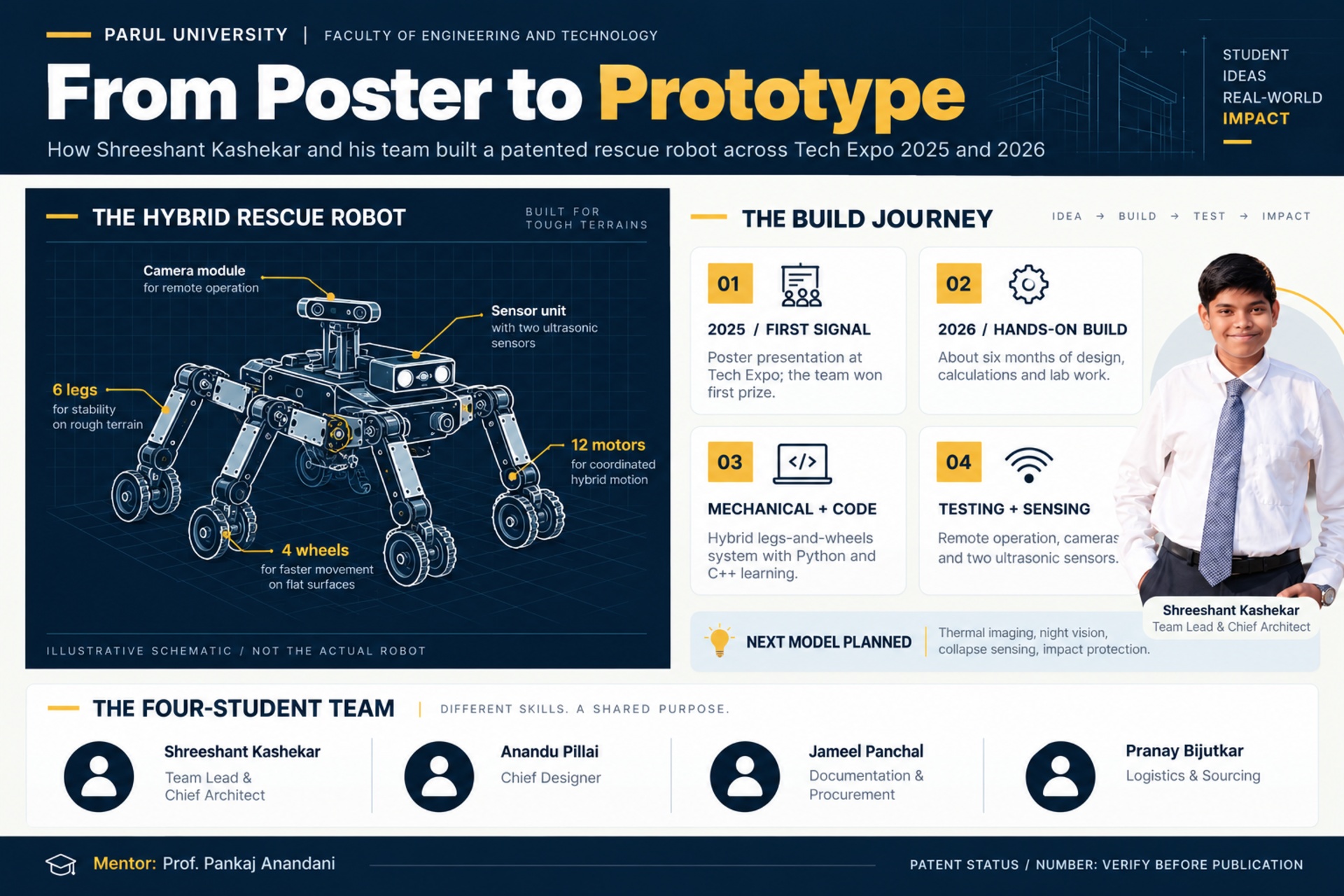
A rescue robot, built by students, patented for its mechanism
Tech Expo 2026 at Parul University put many student projects on display, and one of them has gone on to earn a patent. It is a six-legged rescue robot, built for disaster zones, by a team of four mechanical engineering students. The team is led by Shreeshant Kashekar, a B.Tech Mechanical Engineering student who came up through the university’s diploma-to-degree (D2D) route. The patent covers the robot’s hybrid mechanism, a design that combines legs with wheels so the machine can cross terrain that neither alone would manage well.
The purpose is straightforward. When a building collapses, a landslide blocks a road or floodwater traps people, rescue teams have to enter before anyone knows how stable the structure really is. The team’s idea was to send a machine in first, so that the people who rescue others do not have to take the first risk.
The problem the robot is built to solve
India is a huge space. And along with best parts, there are many spaces that are disaster-prone zones. And every year these locations face flooding, earthquake, landslides. Due to which old buildings feel the shock, and people get trapped. The NDRF, that is, the National Disaster Response Force, works to save them. The team puts themselves in risk to help other , clean the debris, and shift the trapped people to a safer place.
The team’s answer was a robot that goes in ahead of them, operated remotely over RF or Wi-Fi much as a drone is flown. It carries cameras, and even the prototype does. The feed shows how many people are trapped, how much damage there is and which parts of a structure are weak and likely to fall, so the rescue team can plan a safe entry. Shreeshant was candid that rescue robots already exist, from Boston Dynamics quadrupeds to tracked and wheeled machines, but the team wanted one that moved easily across any kind of terrain, which is why the design marries legs to wheels. The choice of problem came from reading the news, the collapses, landslides and blocked highways that recur each monsoon, and from a simple question the team kept returning to.
“What if our small effort can save someone?”
From a poster to a prototype, across two Tech Expos
The idea took shape over two editions of the event. At Tech Expo 2025 the team presented it as a poster and won first prize, which gave them the belief that they could build the thing for real. It had started in February 2025 as a deliberately open brief from their professor: make something that stands out, not an answer to a fixed problem statement. The first picture of it was humble, a basic six-legged robot of the kind children build.
The year between the two editions is where the real work happened. By Tech Expo 2026 the team had spent about six months fully engaged, moving from documentation to calculation and building in the university’s labs, including the IoT lab and the Fab Lab. These are the kind of flagship technical events and facilities that give students a reason and a place to turn an idea into a working prototype.
A team that split the work by strength
The project was built by four classmates from the mechanical department, each owning a part. Shreeshant describes himself as the team’s lead and chief architect. Anandu Pillai, the team’s chief designer, modelled the whole robot in software such as SolidWorks. Jameel Panchal handled documentation and procurement, and Pranay Bijutkar managed logistics and sourcing components from the market. Shreeshant’s own role was testing: running the robot, breaking it, and testing again whenever something failed.
None of them came from a software background, so they taught themselves the basic Python and C++ the robot needed, learning piece by piece from students on the software side before writing their own code. Their mentor, Professor Pankaj Anandani, guided the project throughout and completed the patent documentation, giving the students the forms and the template in which to set down the idea.
The engineering challenges along the way
This was not a single-discipline project. It sat at the meeting point of mechanical design, electronics and code, mechatronics in effect, and the hardest parts reflected that. The first was selecting components. The robot runs on twelve motors, so the team had to work out the torque each part needed, how much energy twelve motors would draw and how large the battery had to be, for a hybrid machine with six legs and four wheels.
Design was the second hurdle. The early calculations kept going wrong, and weeks went into fixing errors before the final design held together. The third was wiring: once every component is placed, a single wrong connection can bring the whole robot down. The design that survived all of this is the one now protected by the patent.
What the patent covers, and what comes next
The patent is specific. It protects the hybrid mechanism, not the outer shell or the off-the-shelf components, which the team is clear can be found anywhere. The present prototype is a base version, with two ultrasonic sensors that detect obstacles and gauge distance to debris.
The next model is more ambitious. It is meant to stay under human control, operated by NDRF personnel, while carrying far more capable sensing, a thermal imaging camera and a night vision camera to find people trapped under debris, and the ability to sense when a structure it has entered is about to give way. Because the current prototype would be destroyed, and its data lost, if something fell on it, the first real product is planned with a protective outer layer able to take a degree of impact. Shreeshant sums up the aim as protecting the robot so that the robot can protect people. He also sees a second use beyond disaster response, assisting soldiers on the Line of Control, where visibility falls to almost zero at night.
More than a machine, and advice for juniors
Shreeshant is clear that the project was never really about the patent or about winning the expo.
“It is better to lose a robot than losing someone’s life.”
A robot carries no family and no fear, he reasons, so it can enter a structure a person should not and report back what is safe. He treats the patent as a beginning rather than a finish line, a first step on a long road.
Asked what he would tell juniors who think their own project is not polished enough to show or to patent, he offered three things. Work hard, first and above all. Do not mistake looks for worth: the team’s own robot was not photogenic, yet industry experts stopped at their stall because of what it did, not how it looked, so the content, the components and the problem solved come first. And clear your basics, because one discipline is not enough. Building the robot taught the team that mechanical engineering, electronics and code have to come together, and that the patient, unglamorous work of testing, they built and broke many cardboard models first, is the longest and most important phase. Join engineering programmes at Parul University.