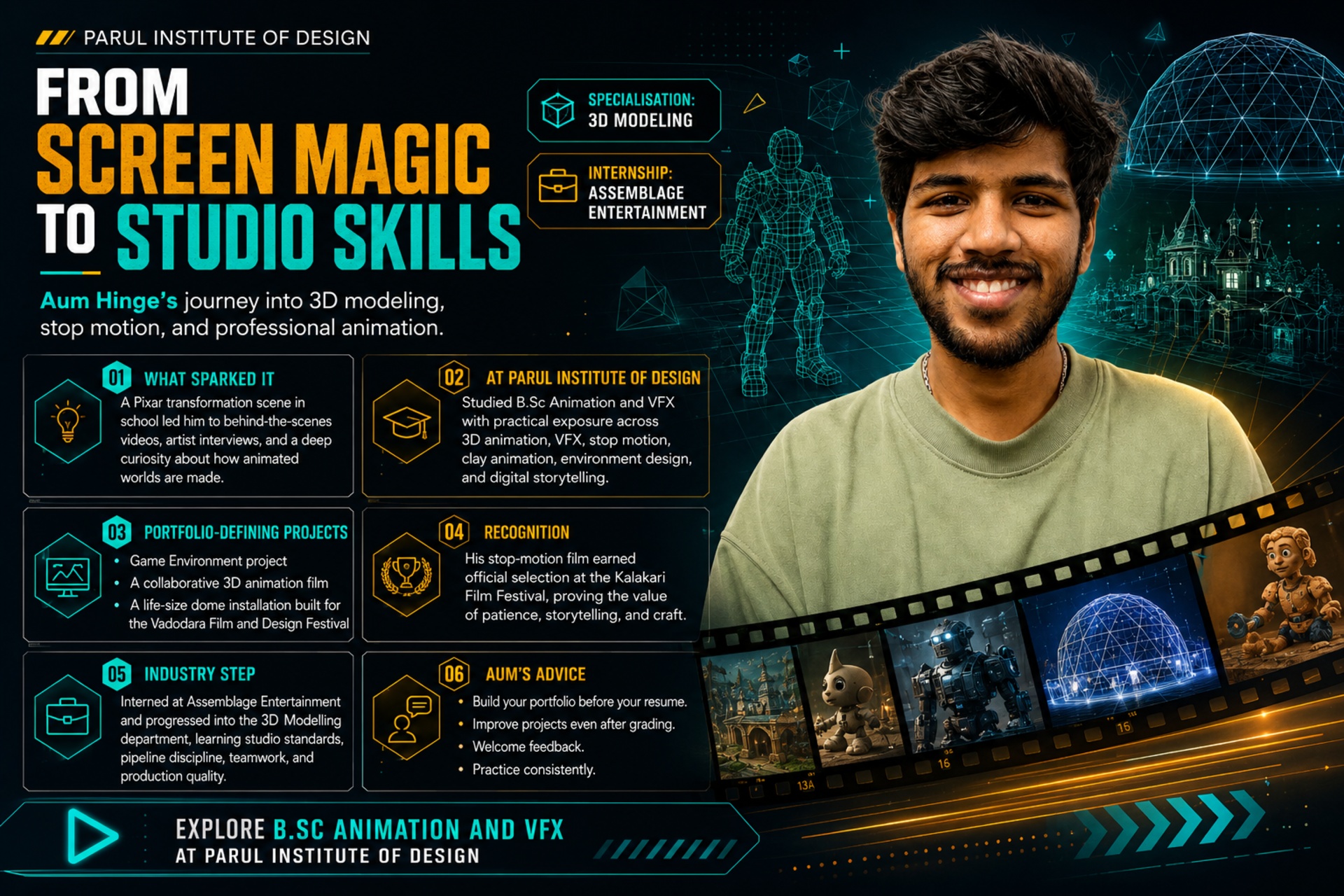
Every artist has a moment that changes everything. In seventh std, Aum Hinge realised while watching a Pixar movie, Luca, that he likes animation. Usually people move on, but Aum was stuck at the transformation scene; he went on to research more about it. He watched behind-the-scenes videos, interviews with the artists, and making-of videos and spent hours understanding how animation studios actually work. With the vision he worked on discovering concept art, storyboarding, texturing, and animation, and one fact that shaped his thinking: he understood that a single animated film is not made by one person but by hundreds of artists working together for years.
From that point, animation stopped being entertainment and became a career. This is his journey through Parul University’s B.Sc in Animation and VFX, a field that combines creativity and technology in equal measure.
Growing Up in Badlapur
Aum comes from Badlapur, Maharashtra’s Thane district, and found his creativity there. He used to visit art exhibitions, cultural programmes, galleries, and shows with his father. He noticed paintings, sculptures, and creative work, which he didn’t understand fully but always enjoyed and found his interest in it. And he began to wonder how artists made people feel emotion through their work. He took science in school, but soon he realised that his interest lay in films, technology, and the question that would define his career: how are those scenes made, and how are imaginary worlds created?
He began teaching himself through tutorials and production videos long before college, and among all of it, 3D modelling drew him most, the craft of building realistic environments, props, and characters that become part of a story.
Choosing Animation and VFX
After higher secondary, while many science students chose engineering, Aum was already certain about animation. He wanted a college where practical learning came first and found it in the Parul Institute of Design, drawn by its project- and studio-based approach, its design studios and labs, and its calendar of workshops, industrial visits, and guest sessions with industry professionals. He enrolled in the B.Sc in Animation and VFX at Parul University, intending only to learn animation, and found the programme also built his confidence, thinking, and personality alongside his technical skills. His coursework spanned 3D Animation, VFX, Stop Motion, Clay Animation, Environment Design, and digital storytelling, each project and practical class adding another layer.
The Projects That Built His Portfolio
Three projects shaped Aum most. A Game Environment project pushed him beyond building 3D models into thinking about atmosphere, lighting, and how every object, even a broken chair or an old wall, tells part of a story, deepening his commitment to 3D modelling. A team 3D animation film taught him that a film is never one person’s work and that communication, planning, and teamwork drive the production pipeline. And a life-size dome installation, built for the Vadodara Film and Design Festival as part of a Craft and Design Development module, taught him to carry a project from ideas and measurements through sourcing materials to building the structure with a team, solving problems together as designs failed and materials misbehaved, until the finished dome stood on display.
The Stop-Motion Film, and Real Recognition
In animation, a portfolio matters more than a resume. It shows what you can actually do, and how much you improve.
– On Aum’s advice
The project closest to his heart was his Stop Motion Film, a craft unlike digital animation, where every set, prop, and character is built by hand, and every movement is captured one frame at a time. It began with story and storyboards, then character-building, prop-making, set construction, and lighting, and only then the painstaking frame-by-frame animation, where a single mistake could mean redoing many hours of work. It taught him patience, storytelling, camera framing, and how the smallest detail improves a scene. Then came the moment that validated it all: he and his team submitted the film to festivals, and it earned an official selection at the Kalakari Film Festival, along with selection at others, the first time his work was recognised outside the university, and a powerful motivation to push further.
The Studio: Assemblage Entertainment
As graduation neared, Aum wanted to see how real studios work and secured an internship at Assemblage Entertainment, one of India’s premium 3D animation and VFX studios, founded in Mumbai in 2013 and part of the Cinesite group, known for feature films and episodic animation and for visual effects on major productions. He joined as a production trainee, and for someone who had only watched studio videos online, working inside one was exhilarating. Everything followed a proper process: defined team responsibilities, deadlines, meetings, and disciplined communication for every task. On the strength of his work and portfolio, he moved into the 3D Modelling department, the field he had always wanted, where he learned that a model must not only look good but also meet studio quality standards, follow the rules, and fit the production pipeline, a shift in thinking that made him markedly more professional.
His Advice to Aspiring Animators
Build a portfolio before a resume; in animation and design, companies look at practical skill first; a strong portfolio shows creativity and improvement better than certificates. He also advised that when you work for marks, your vision narrows and you lose the hand in building skills; when you don’t work for marks, you keep improving projects even after they are graded, indicating that your college projects can also become portfolio-worthy. Always take feedback and criticism with a positive attitude, and consistently ask for it from seniors, faculty, and professionals, as it is an opportunity to grow. Be consistent with your work, practice daily- even a small amount; talent matters, but discipline makes it worthy; it makes you an artist.
Also Read: Product Design and Manufacturing at Parul University: Jayesh Gautam on the Factory Floor
Frequently Asked Questions
What are career pathways in animation and VFX?
There are career pathways in animation and VFX that pay well. Animation and VFX (visual effects) are both fields of creativity. The images are created in motion, with digital imagery for films, series, games, and other media, spanning 3D modelling, setup/environment design, animation, stop motion, and visual effects. Roles range from modelling and lighting to animation and compositing.
What does a 3D modeller do?
A 3D modeler builds the digital objects in an animated or VFX scene, characters, props, and environments, that other artists then texture, light, and animate. Good modeling balances how a model looks with how well it works within the production pipeline, meeting studio quality standards. It is Aum Hinge’s chosen specialisation within animation and VFX.
How to become a 3D modelling artist?
To become a 3D modelling (modelling, environment design, storytelling)or animation artist, one should start by learning the fundamentals with a practical approach, building a strong portfolio of all the works, the project works, past works, etc. In animation, a portfolio that demonstrates real skill matters more than certificates, and festival recognition or studio internships can be decisive early steps.
What type of technique is stop motion?
Stop motion animation is a technique where work is done with hands, such as physical sets, props, and characters that are actually built and photographed one frame at a time. The pictures are taken with a little movement between frames, leading to the creation of the illusion of motion. It demands patience and precision; Aum Hinge’s stop-motion film earned an official selection at the Kalakari Film Festival.