Plenty of product design graduates aim for a comfortable design desk. Jayesh Gautam aimed for the factory floor. From Kota in Rajasthan, an only child in a joint family with a business background, he found his way to Parul University through the national design examination; he appeared for the UCEED (Undergraduate Common Entrance Examination for Design), and a call from the University after his results settled his decision to move to Gujarat. Four years later, his account of design is refreshingly unglamorous and unusually clear about where a designer’s real value lies.
A Module-Based Curriculum
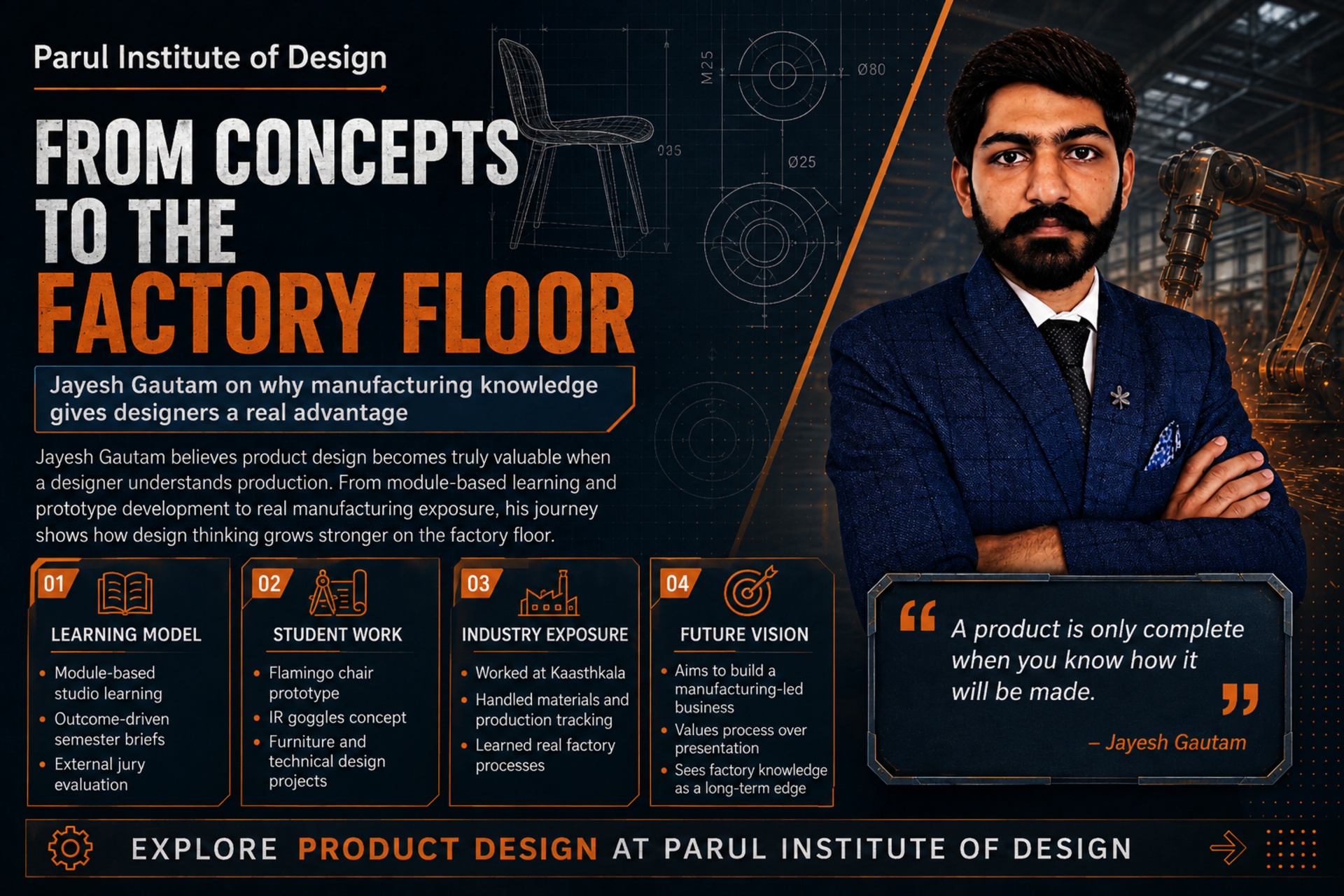
Product design at the Parul Institute of Design does not run on conventional theory subjects, Jayesh explains, but on modules. Each module sets an objective, assigns a corresponding design brief, and is evaluated not by a written test but by the final outcome, scored by external jurors at the end of the semester. It is a system built to force applied work, and his projects show it. In his fifth semester, a furniture-design module, he built the prototype of a chair called Flamingo, focused heavily on ergonomics and functional detail. In his seventh semester, an equipment-design module, he designed infrared (IR) goggles for military use, working to the specific requirements of a defined end user. And in his eighth semester, he entered an industry-immersion module at Kaasthkala, turning academic practice into real work experience.
The Mentors
Jayesh credits three core faculty for guiding students through his tenure, Mr. Sameer, Mr. Deepak, and Mr. Shardul. He finds it impossible to rank their impact; each, he says, helped in their own way, according to their teaching strengths and specialised knowledge. That grounding in applied design fundamentals is what let him make the most of the factory experience that followed.
Into Industry: The Reality of Kaasthkala
Jayesh secured his role at Kaasthkala on initiative and merit, not a handed placement. He got to know about the company through his friends, worked on his portfolio, compiled everything, and presented his work- that has furniture, past work, and technical projects, to the management, who liked his work and the approach he used to work on these projects. Started working as an intern and got a full-time role as a product designer, and the job is completely hands-on. His responsibilities stretch well beyond sketching concepts at a desk: he manages actual manufacturing processes on the factory floor, keeps a detailed record of all raw materials used in production, and handles the specific operations of furniture manufacturing. It is exactly the kind of end-to-end exposure a studio cannot replicate.
Where the Classroom Ends and the Factory Begins
Theoretical knowledge is the foundation. The execution needs a level of grit, material knowledge, and process management no studio can fully replicate.
– On Jayesh’s experience
Daily exposure to the factory floor made the gap between classroom and industry unmistakable. The module knowledge from college, Jayesh found, was a genuine foundation, but real execution demanded grit, deep material knowledge, and process management at a level academic projects only gesture at. Watching a product move from a sketch to a manufactured object, with all the material and machining constraints that involve, taught him the single lesson that now shapes his ambition: in product design, understanding manufacturing is not a detail; it is the whole game.
Also Read: Krish Sompura’s Path From a First-Semester Patent at Parul University
The Ambition: Owning the Means of Production
Jayesh’s roadmap is unusually specific. He does not plan to move to another agency or chase a senior designer title. He wants to start his own business, and, asked whether that meant a standard design studio, he firmly rejected the idea. He does not want to sit in an office designing products for others to build; he wants to run his own full-scale manufacturing factory. The ambition fits both his family’s business background and the heavy, hands-on manufacturing experience he is accumulating, and it rests on a conviction he states plainly: controlling the means of production is the true key to success in product design.
His Blunt Advice to Aspiring Founders
- Learn to work first: master how to actually do the work properly before trying to build a company around it.
- Avoid premature startups: leaving college to launch immediately, without industry experience, is a near-certain path to failure.
- Gain managed experience: real, valuable industry learning comes from working under someone else’s management first.
- Understand task mechanics: an owner cannot just give verbal instructions; you must know the mechanics of each task yourself.
- Master the machinery: an aspiring factory owner must know the technical details of every machine and how to operate it, before running the floor.
Frequently Asked Questions
What is the difference between product design and manufacturing?
Product design is the creative and technical process of conceiving a product, its form, function, ergonomics, and materials, while manufacturing is the process of actually producing it at scale on a factory floor. A designer who understands manufacturing can design products that are genuinely buildable and commercially viable, which is why hands-on factory experience is so valuable, as Jayesh Gautam found at Kaasthkala.
What is UCEED?
UCEED, the Undergraduate Common Entrance Examination for Design, is a national-level entrance examination in India for admission to undergraduate design programmes. Jayesh Gautam appeared for UCEED, and his results led to his admission into product design at the Parul Institute of Design.
What is a module-based design curriculum?
A module-based curriculum organises study into focused modules rather than separate theory subjects. Each module sets an objective and a corresponding design brief, and students are assessed on the final outcome, often reviewed by external jurors, rather than written tests. Jayesh completed modules in furniture design (a chair prototype), equipment design (IR goggles), and industry immersion.
Why do product designers need factory-floor experience?
Because execution on a real factory floor demands material knowledge, process management, and an understanding of machinery that classroom projects cannot fully teach. Factory experience shows a designer what can actually be manufactured and at what cost, turning good concepts into producible, commercially viable products.