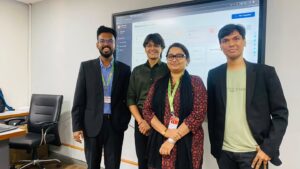
AI has changed how founders do research, and mostly for the better. In minutes it can summarise an industry, map competitors, and draft interview questions. But at Parul University’s YEEP 2026, Dr. Claudia Vogel of Bern University offered a warning worth remembering: AI is a brilliant assistant for research, and a dangerous substitute for it. Knowing the difference is one of the most valuable skills a modern founder can have.
What AI Is Genuinely Great For?
If AI is used well, it’s an accelerator for the research phase but you can’t rely on it for feedback. It’s an excellent tool for having an overview of an unfamiliar market or untouched area, or for listing competitors or explaining any concepts in the most simplest manner. Parul University’s guide to the AI tools worth using for startup research; presents how AI is genuinely transformative for changing business landscape!
Where AI Quietly Misleads You?
The real danger is not that AI can mislead; but it’s that AI is super confident and that’s when it’s hard to catch. So keep these things in mind as they’re super risky and matter most!
- Invention – AI can naturally produce fluent and dominating answers that are incorrect and can signal its own uncertainty.
- Internet’s hidden agenda – AI is trained on what can be published online, how marketing is shaped, how SEO works and truly works on popularity and not the real truth. So fact-check before you finalize your decisions!
- Opinions – It gives generic opinions but your startup needs the truth of the exact people you want to serve.
AI can tell you what the internet says. It cannot tell you what your customer feels.
– As said by an eminent speaker at YEEP 2026, Parul University!
AI vs. Human Communication
The single most important research a founder does cannot be delegated to a machine: real conversations with real potential customers. Only a live conversation reveals the workarounds people actually use, the frustrations they cannot articulate in a search query, the context around a problem, and the gap between what people say and what they do. AI can summarise what is already known; it cannot discover what no one has written down yet, and that undiscovered truth is usually where the opportunity lives. This is also why Parul University’s guide to customer discovery insists on real, face-to-face conversations, not just desk work.
The Right Way to Combine AI and Human Research
The answer is not to reject AI, but to sequence it correctly. Use AI at the start and the humans at the core:
- Start with AI: Build fast background knowledge, map the landscape, and draft your hypotheses and questions.
- Verify with humans: Take those hypotheses to real customers and experts, and let their answers, not the model’s, decide.
- Return to AI to organise: Use it to structure and analyse what you heard, then check its conclusions against your own notes.
AI is the fastest way to get to your questions. Real people are the only way to get to your answers. Founders who validate their ideas this way, AI for speed, humans for truth, make far better decisions than those who trust either one alone.
Frequently Asked Questions
Can AI replace market research?
No. AI can accelerate the desk-research phase, giving you fast overviews, competitor maps, and draft questions, but it cannot replace talking to real customers. AI returns a generic consensus of what is published online, not the specific, often unwritten truth of your target customers, which only real conversations reveal.
What is AI actually good for in startup research?
AI is excellent for fast background reading: summarising an unfamiliar market, listing competitors, explaining concepts, surfacing trends, and drafting or sharpening customer-interview questions. It is a powerful accelerator for the early desk-research phase, before you speak to real people.
How should founders combine AI and human research?
Use AI first to build background knowledge and draft hypotheses and questions, then verify those with real customers and experts, letting human answers decide. You can then return to AI to help organise and analyse what you heard, always checking its conclusions against your own notes.