#ProudlyPlaced: Dhananjay Bissa’s Journey from First-Year Doubts to a Corporate Law Placement!
- • Who Dhananjay Bissa is and why a student who nearly left ended up staying.
- • How exposure at Parul Institute of Law turned a litigation plan into a corporate one.
- • What his two internships and the Training and Placement Cell taught him.
- • His placement at RK Law Firm and his advice to first-year law students.
Placed at RK Law Firm, Rajkot:
A corporate role; offer letter received
Joined 2022, LLB:
Nearly left, then stayed because of the faculty's efforts.
Corporate internship at Singhania & Partners:
Secured through the Training and Placement Cell.
Who’s Dhananjay Bissa?
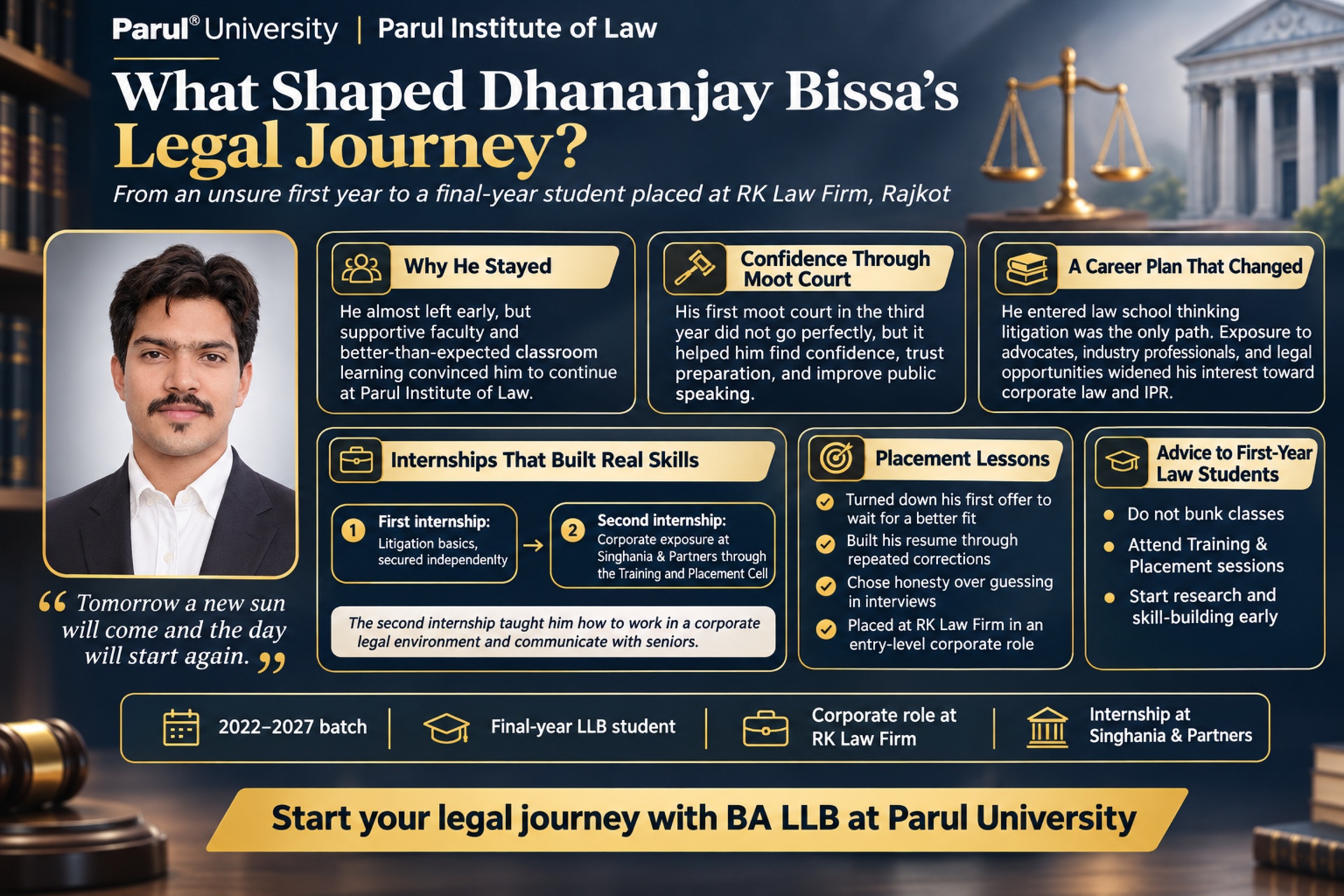
Dhananjay Bissa almost did not stay. He came to Parul Institute of Law from Jodhpur in 2022, nearly left for another university early on, and stayed because of what happened in the classroom. Five years later, he is a final-year law student placed at RK Law Firm in Rajkot, in corporate work, having started the degree, certain he would be a litigator. His path was not a straight line, and he is the first to say so: he did not clear his first moot court round, found his first internships hard to get, and turned down the very first placement offer he was given. Each of those, in his telling, taught him something he used later.
What he says Parul gave him was more than a degree and a job offer. It gave him exposure to events and people he had never encountered and a set of friends and faculty who pushed him when he needed it. The story worth telling is less the placement at the end than how a student who arrived unsure found his footing one correction at a time.
Why did he stay at Parul Institute of Law?
Dhananjay did not choose the university for a single headline reason. Its rapid growth caught his attention first, but it was the classroom that convinced him to stay. He found the faculty supportive from the start, and after a few weeks of their teaching, he concluded the place offered more than he had expected when he applied. That is a quieter reason than a ranking or a brochure line, and it is the one he gives.
Campus life and a wider way of seeing things
He counts campus life as a real part of his education, not a break from it. He lived in the hostel for a year and rates that year highly. The biggest help in settling into the heavy routine of law school was the mix of people around him: students from different states and different countries, whose lives he became part of for a while. In his words, you can meet an entire range of people without leaving the campus, and if he ever does another degree, he would choose Parul again. The learning went past the campus gates too. A recent law tour to Mumbai was, he says, a very good experience, and he is clear that Parul Institute of Law is not only about books and exams. Sports, events, and activities run through the year, NCC among them, and he tells juniors to take part rather than sit them out.
The first moot court, and finding his voice
Dhananjay got a lot more nervous when he came to his first moot court in his third year. He was not in the clear after the first round, and he did not count it as a failure. It gave him more confidence than it had before, as it placed him in the position of practicing what he had studied and read about, instead of just reading. He has not always had the talent of stage presence, and nerves are a factor when he is presenting, which is why this was important: it was the first time that he had to perform the work rather than simply know it.
Much of the work of overcoming the nerves was done by his friends. The message they gave him was very simple: to concentrate on what he actually researched and to just be there, to have faith in the preparation. It’s caught on, and he’s grateful for the friends who pushed him that way. It’s the point he extracts from it that every nervous presenter would use: the confidence was not in ignoring the nerves but in doing the research.
A career plan that changed
Dhananjay started the course believing litigation was the only path open to him. That did not survive contact with the people. Parul Institute of Law put in front of him advocates, law firm partners, and people from the media and legal industry, who opened up options he had not known existed. He also mentions the clerkship programs and judiciary programs that go through the university, as well as a clerkship at a law firm and a judicial clerkship, which is the one he’s thinking of applying for soon. To give context to the legal practice in India, the early-career paths are conducted under the framework of the Bar Council of India.
He has made an effort not to limit himself to a specific branch of law. He was torn between corporate law, criminal law, and intellectual property rights at various points, and his perspective changed with his studies. He is still thinking about IPR and corporate law and is honest as to why he isn’t at this stage: at the moment, it would seem like giving up something that’s better, so he will leave it to the actual practice to decide.
Difficult subjects and faculty who make time
As with most law students, some subjects were easier for him to learn than others; constitutional law was among these: Interpreting statutes requires a different kind of thinking, which he didn’t master easily. His approach is not a flashy one; it’s just more time and concentration on the material prior to an exam, and it’s aided by faculty that he says are open and patient. Teachers did what they could in class and dealt with the questions in private after class, and in the subjects requiring another approach, they remained with the subject until he grasped it, not merely for the sake of completing the syllabus. He asked a lot of questions, he says, and he knows.
For study materials, he leans on digital resources, reaching case laws and journals through the university’s e-learning portal from anywhere. But he is clear that friends, not tools, were the bigger support, practically and constantly.
Two internships, and the difference the placement cell made
Dhananjay did more than one internship, and the contrast between his first and second is the most instructive part of his account.
| Internship | How he got it? | What it taught him? |
|---|---|---|
| First (litigation) | On his own, without the Training and Placement Cell | The basics: where courts are and how to take dates; not much more. |
| Second (corporate, Singhania & Partners) | Through the Training and Placement Cell | Corporate practice from scratch, from the work itself to how to speak with seniors |
The first internship he sought, he got nothing more than a basic internship. The second time he went to the Training and Placement Cell, it was his first one, so he was given some advice, and he changed his approach; he was clear about what he wanted to learn and what he wanted to be, and then he went and developed the skills that were required. The job of the intern was difficult in the beginning for the intern, who was with Singhania & Partners, a corporate job. This was his first job in a corporate environment, and the way of doing things and speaking to seniors had to be learned from scratch.
He is direct about the early going: there were no isolated mistakes, because at first nearly everything was one, and what counted was that he kept correcting them. One moment stays with him. Asked to find a particular case, he found it but could not explain what he had read in the way the senior needed to hear it. He rang a practising advocate at the Training and Placement Cell to ask how a student should even speak to a senior. He names that the gap between knowing something and being able to brief a senior on it is one of the biggest obstacles a student faces and one he is still working through, since every senior thinks and works differently.
The placement, the resume, and why he did not let AI write it!
The selection pressure was heaviest the first time. At his first placement interview, with a different firm, he was stressed enough that the laws and statutes would not come to him, yet he gave his best, got the offer, and then turned it down because it was not where he wanted to go.
Before the next round, the Training and Placement Cell had given the group a clear line: be confident, be good with your speaking, and be honest with yourself, and the second interview went well.
The resume was its own lesson. Dhananjay had never seen one before this stage, and the only draft he learned from came from the Training and Placement Cell. He has pointed out not outsourcing it to AI: a resume depends too much on the person for a tool like ChatGPT or Gemini to write it, because at the end of it the document has to be about you. He took his back to the cell, and it was accepted only after many corrections, which is why he credits the cell as one of the main reasons it became good enough to send out.
At RK Law Firm, he answered honestly rather than guessing on questions about contracts, compliance, and agreements, and his read of the panel was that they wanted someone hardworking who could stay mentally present in the problem in front of them.
When the placement letter came, he was shocked, happy, and a little scared of what came next. He is already thinking about compliance work and building his corporate skills and about the parts of the job that are less about advocacy and more about how a person carries themselves.
If you’re passionate about developing a fair economy, then bring on the change by pursuing BA LLB & LLM courses from Parul University!
His advice to first-year law students
Dhananjay’s advice is specific and drawn from what cost him time, not from slogans.
- Do not bunk classes. Students who skip the first two years, assuming the subjects are simple, end up, by the semester’s end, depending on whatever ChatGPT or Gemini hand them. Class is where a teacher’s way of approaching a subject rubs off, and that is hard to get anywhere else.
- Show up for the Training and Placement sessions. They help with speaking, presenting, and writing, and the cell’s strictness is there to pull out your best, not to make life hard.
- Start building something early. He finished his dissertation only in his fifth year and wishes he had begun the research in his second or third when it would have counted for more and left room for internships and coursework besides.
He keeps one line for the hardest stretches, the sleepless nights when nothing makes sense and he is still trying. It is the note he ends on.
Tonight may be a rough night, and it may have been a very bad day, but tomorrow a new sun will come and the day will start again.
SOURCE AND CONTEXT. Based on a student interview with Dhananjay Bissa, 2022 to 2027 LLB batch, Parul Institute of Law, Parul University. His placement at RK Law Firm, Rajkot, is an entry-level corporate role confirmed by an offer letter, and is described as such. Singhania & Partners is named as the firm of his corporate internship. The closing line in quotation marks is his own; other remarks are reported. His LinkedIn and the Bar Council of India link carry no tracking parameters.
People and organisations
- Dhananjay Bissa Final-year LLB student (2022 to 2027), Parul Institute of Law; placed in a corporate role at RK Law Firm, Rajkot
- Parul Institute of Law, Parul University
- RK Law Firm, Rajkot His placement: entry-level corporate role
- Singhania & Partners The firm of his corporate internship, secured through the Training and Placement Cell
- Bar Council of India: A statutory body regulating legal education and practice in India