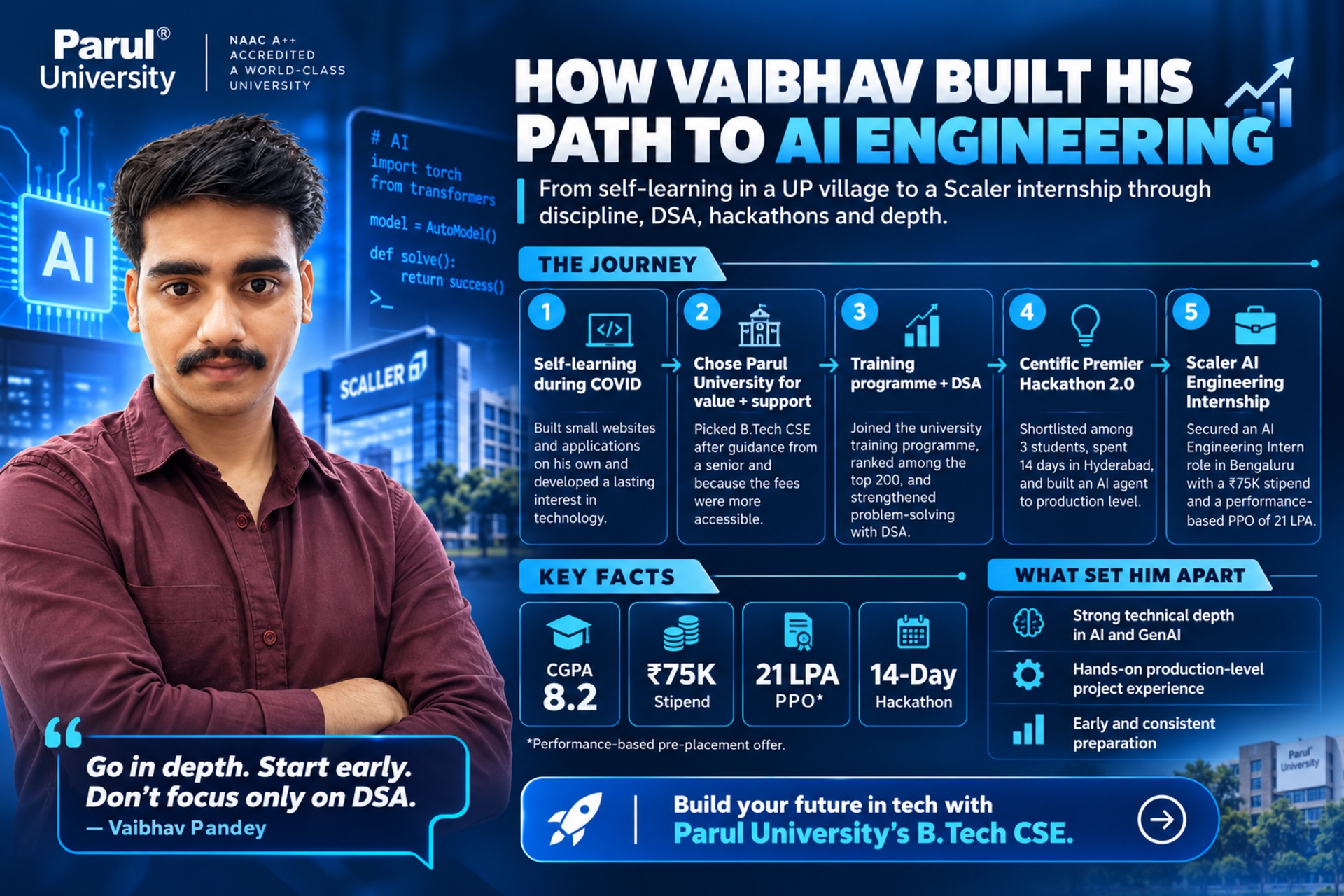
#ProudlyPlaced: Vaibhav Pandey at Scaler!
- • Who Vaibhav Pandey is, and the self-taught habit that shaped his path.
- • Why he chose Parul University, in his own words, and why computer science.
- • How a 14-day AI hackathon in Hyderabad set his direction toward AI engineering.
- • The offer at Scaler, framed precisely, and his advice to juniors preparing for placements.
CGPA 8.2
Held above 8 across every semester through the seventh
75K stipend + 21 LPA PPO
internship stipend; the pre-placement offer is performance-based
Centific Hackathon 2.0
14 days on-site in Hyderabad; 3 shortlisted from his college
Who is Vaibhav Pandey?
Vaibhav Pandey is in his seventh semester of a B.Tech in Computer Science and Engineering at Parul University, and he has already lined up what most students spend the degree hoping for: an AI Engineering Intern role at Scaler, in Bengaluru, with a stipend during the internship and a performance-based pre-placement offer waiting at the end of it. He is from Village Belwanwa, in Sant Kabir Nagar district of Uttar Pradesh, and the distance between that starting point and an AI engineering seat at a Bengaluru company is the part of his story worth reading closely. His interest in building things predates college. During the COVID period, while much of his schooling was on hold, he taught himself to make small applications and websites. It was nobody’s assignment; it was a habit, and it ended up steering most of what came later, from the branch he picked to the way he prepared for placements. He has held a CGPA above 8 in every semester, finishing the seventh at 8.2.
Why Parul University, and why did he choose computer science?
Vaibhav did not opt for a university based on an advertisement or social media post. One of his friends, who was also a senior, explained to him everything about it, its placement support, and the ambience of the college.
Then I thought that I should only join Parul University!
The second reason was money, and he is direct about it. For a student from a village, the fees most private institutes charge for a B.Tech were a real obstacle.
In most of the private institutes, the fees were so high for the B.Tech.
Parul’s lower fee, set against the placement guidance his senior had described, settled the decision. The branch needed no such deliberation. The applications and websites he had built during COVID had already told him where his interest lay.
I was so interested in technical things like building applications, websites, and other stuff.
The training program and the turn toward DSA
Vaibhav describes his first year in plain terms: a good year, much like any first-year student’s, in which he understood early that he would have to study with discipline. The faculty made that easier. He found teachers approachable across all seven semesters, and when he asked a question, he got a clear answer. Asked later to name the one faculty member who had helped him most, he declined to single anyone out.
Every faculty member contributed little by little.
He was assigned to fresh classes every six months, which kept things new and put him in a new way of thinking every 6 months instead of 4. Every six months, it was a new start with new faces and new friends, and he said that is one of the good things that happened in his time there. This was not the real turning point until his second year, when he enrolled himself in a university training program and ended up being among the top 200 students in that program.
After that, everything changed.
He began studying data structures and algorithms in depth, and the jump in his problem-solving opened doors to shortlists at several companies. He credits Siddharth Sir, who guided him through the training and the DSA work, with much of that progress.
Hackathons, and the two weeks that set his direction
Academics were only half of it. From his first year, Vaibhav made a point of entering hackathons, on campus and off, treating each as a chance to build something working against a clock. The practice taught him to turn an idea into a product under time pressure and to present what he had made.
One event changed the trajectory. In his third year, Srividya Ma’am shared the Centific Premier Hackathon 2.0 with the students, and those who were interested sat the qualifying test. Three students from his college were shortlisted. Vaibhav was one of them.
The three of them went as a group to Hyderabad for a 14-day event on-site. In 2 weeks, they developed an AI agent and got it to a production-ready stage. The constraint here is the teacher: a brief that needs to get to a deployable product in a fortnight makes the student decide things that a real build requires: scope, what they can cut, what needs to be real and work, etc. It’s a different style of learning than a classroom, and it wasn’t just a line on a resume.
The Centific Premier Hackathon was the main turning point for me.
From the hackathon, he was offered a place on an AI-engineering-specific program, in an area he already had some grounding in. After that, he learned AI technologies more deliberately, the generative AI side included, through online resources and conversations with faculty. The agent he built in Hyderabad would, months later, become the project he chose to defend in the interviews that mattered.
The core preparation!
Vaibhav’s preparation ran mostly on YouTube, and he is specific about which channels: CampusX, Krish Naik, Striver, CodeHelp by Babbar, Chai aur Code, Gate Smashers, and Sheryians Coding School. Some covered his DSA practice, others his core subjects and newer technologies, and together they served both his placement preparation and his coursework.
Self-study did not run on its own. Whenever he was unsure what to learn next, he took it to the faculty.
Whenever I feel any confusion, I discuss with the faculty what I have to do.
The habit that he returns to most is depth. Rather than skimming many technologies, he tried to understand the one in front of him, and that is the practice he recommends to anyone who asks. The combination of hackathon work, DSA, video learning, and faculty discussion is what readied him for both the written assessments and the technical conversations in company selection rounds.
The rounds before the offer!
Vaibhav’s placement journey was not a single clean line to Scaler. He has given interviews in several companies, but the pattern was quite uneven, and he would clear the interview rounds, followed by no updates. He doesn’t count them as failures; each round taught him patience and testing and amped his confidence. His own preparation thinned out, and he went into the next process better calibrated than the last. By the time the opportunities that counted arrived, the earlier near-misses had done their work.
The offer at Scaler
The role Vaibhav secured is AI Engineering Intern at Scaler’s Bengaluru office. It lines up with the direction he had been moving in since Hyderabad, and with the AI and generative AI work he had been building toward. An internship of this kind is the proving stage of a hire rather than a ceremonial one: the months ahead are where he is expected to apply, in a working team, what he taught himself through hackathons, coursework, and his own reading. The offer has two parts, and the distinction matters. During the internship, he receives a stipend of 75,000 rupees. Beyond that sits a pre-placement offer of 21 LPA, which is performance-based: the full-time conversion depends on how he does over the internship months. It is an opportunity to earn the role, not a signed full-time package, and he treats the coming months as exactly that.
It was not his only offer. Earlier, through the university’s placement process, he had cleared a long multi-round selection at another company, an extended process of several assessments, case studies, and technical rounds, and been made an offer of 8 LPA. He chose not to take it so that he could keep looking for something that matched his interest in AI engineering. The evaluators’ feedback through that process was consistent on one point: that his technical foundation was strong, and it is the same quality that would carry him at Scaler. Turning down a confirmed offer to hold out for the right one is its own kind of decision, and it is the one that kept him on the path he wanted.
What set him apart
Vaibhav is clear about what carried him through the technical rounds. Offered a choice between explaining one of his own AI projects or the one he had built at the hackathon, he chose the hackathon project because he had lived every stage of it.
I already have experience with that project, and I spent 14 or 15 days building it from scratch to production level.
Having owned every stage of that build himself, he could answer questions about every layer of it, and the panel’s feedback on his technical grounding was strong. Asked what made him stand out, he did not reach for modesty or for overstatement.
I am not exaggerating, but my technical part is so good that I learned so much about AI engineering and the AI and GenAI part.
Depth, again, is his own explanation: hands-on hackathon experience building AI agents, self-learning kept current through video and faculty, and a production-level project he could defend end to end.
His advice to juniors!
Vaibhav’s advice is drawn straight from what worked for him, and he gives it in order.
- Start in the first year. He had little contact with seniors in his own first year and only found that guidance in the second, which he counts as time lost. His line is blunt: start preparing from the first year onwards, and do not wait for placement to arrive before you begin.
- Choose a path early. Full-stack development and AI engineering are different roads with different requirements, and deciding early, with input from seniors, lets a student go deep rather than wide.
- Treat DSA as necessary, not sufficient. It is mandatory and cannot be skipped, he says, but for an AI engineering role, the first screen is often a DSA round that does not carry the profile on its own. In his words, do not focus only on DSA.
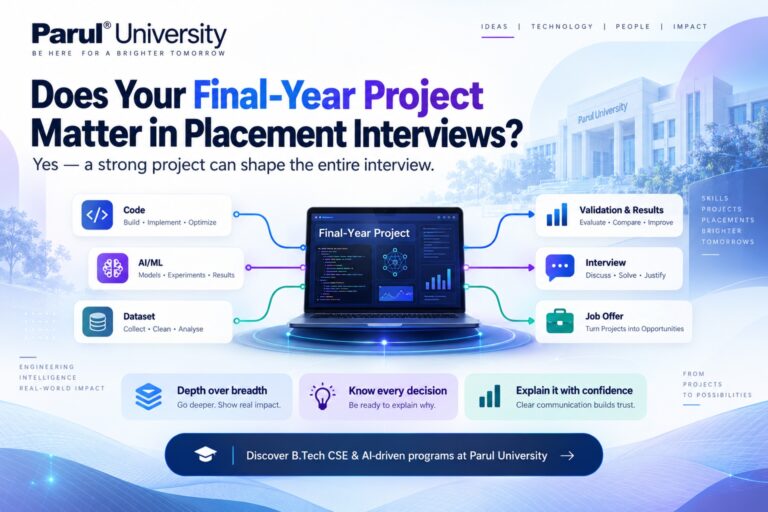
- Learn in depth. It is not enough to know what a database is; a student should understand how it manages data and why. Go in depth, he says, and learn the real-world analogy for it, because that is what lets a candidate explain a concept to a panel and use it in real work. If you’re super passionate about AI and driven towards coding, enrol in Parul University’s B.Tech CSE in AI/ML program and get to work for your dream tech company!
The arc is moving faster than ever!
There is a straight line through Vaibhav’s account, and it is not pure luck. Early interest turned into a habit of building, the habit into a hackathon experience, and that experience into a production-grade project he could stand behind in an interview. The university’s training sharpened his DSA; its faculty kept pointing him in the right direction; its lower fee made the whole thing reachable for a student from Belwanwa in the first place. The AI engineering seat at Scaler is the output of those inputs, not a windfall, which is also why he could afford to turn down an earlier offer and wait for the one he wanted.
SOURCE AND CONTEXT : Based on an interview with Vaibhav Pandey, B.Tech Computer Science and Engineering, Parul University, reported by Janvi Singh. Figures for CGPA, stipend, and the pre-placement offer are as stated by the student; the 21 LPA pre-placement offer is performance-based and is not a confirmed full-time package. The earlier company that made an 8 LPA offer is unnamed in the source and is left unnamed here. Private details of friends have been omitted. Quotations are reproduced as given. LinkedIn and Scaler links carry no tracking parameters.
People and organisations
- Vaibhav Pandey B.Tech CSE student (7th semester), Parul University; AI Engineering Intern at Scaler
- Scaler Bengaluru-based company; offered the AI engineering internship and performance-based PPO
- Centific Premier Hackathon 2.0 14-day on-site hackathon in Hyderabad; his stated turning point
- Siddharth Sir Parul University; guided him through the training programme and DSA
- Srividya Ma’am Parul University; shared the Centific hackathon opportunity with students