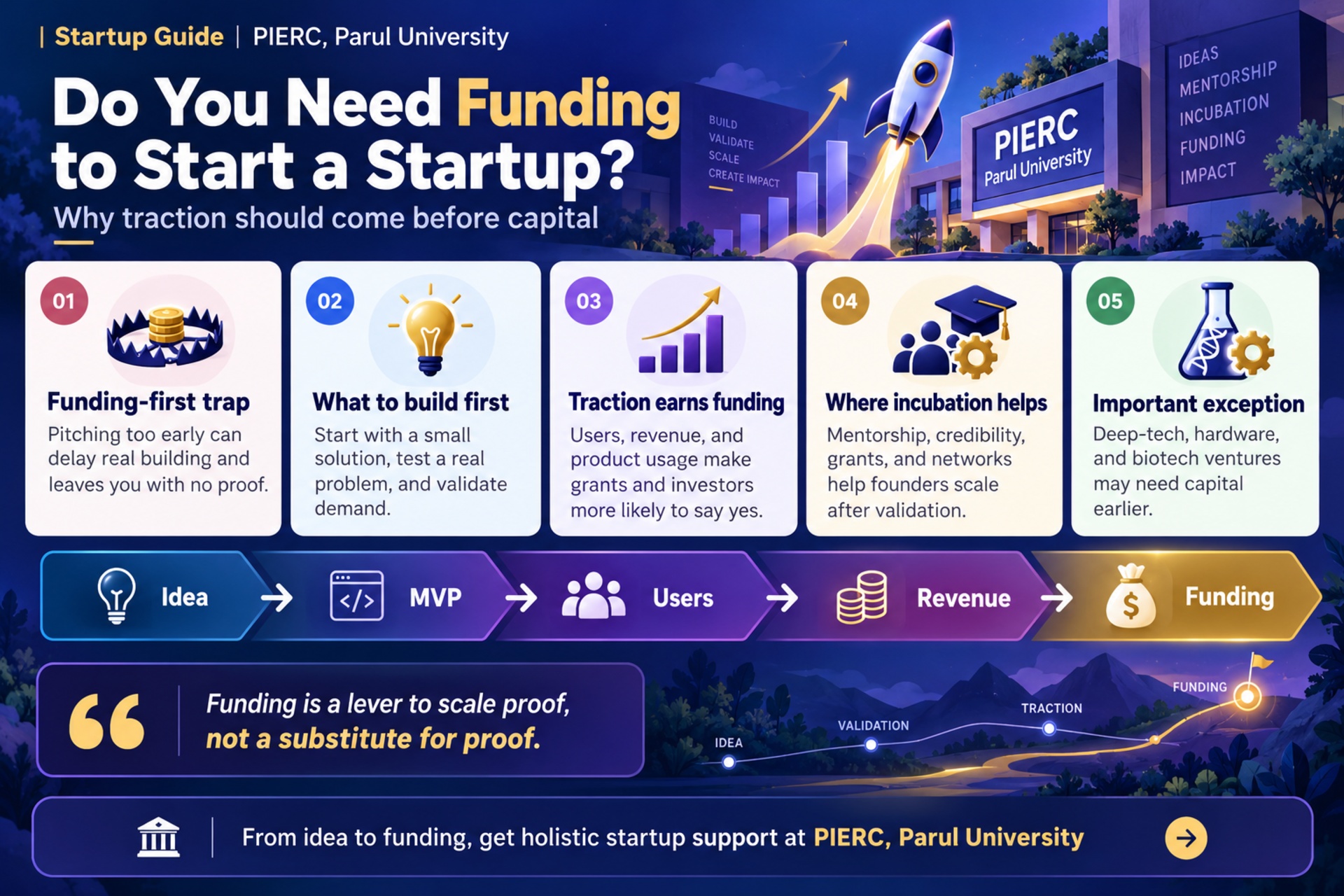
The first myth of being a founder is the second: the myth that it takes money to make money. The mental model is ‘have an idea, raise money, build.’ In fact, the order is typically reversed. Looking for capital to build a start-up? Most founders will say no, and having to wait for capital on day one can put a venture to death. Funding is a lever to magnify what is already successful, not a substitute for demonstrating success. Founders who have the easiest access to funding are the ones who had the least need for it in the beginning because they’ve already created proof that a product is worth supporting.
Funding-first mindset!
Chasing capital before you have anything working creates two problems. The first is that you have nothing to show: investors and grant committees back traction, a product in use, early revenue, and a growing user base far more readily than an idea, because an idea carries all the risk and none of the evidence. The second is subtler and worse: the pursuit of funding can become a substitute for building. Time that should go into making the product real goes instead into pitch decks and investor meetings, and a founder can spend months raising for something that, tested against actual users, would have needed to change anyway. One founder incubated at Parul University’s PIERC cell, Anshuman Singh of FlyAnyTrip, put the misconception plainly: the belief that you will get funds on day one is, in his words, one of the worst things you can think in a startup ecosystem.
What to build before you raise anything?
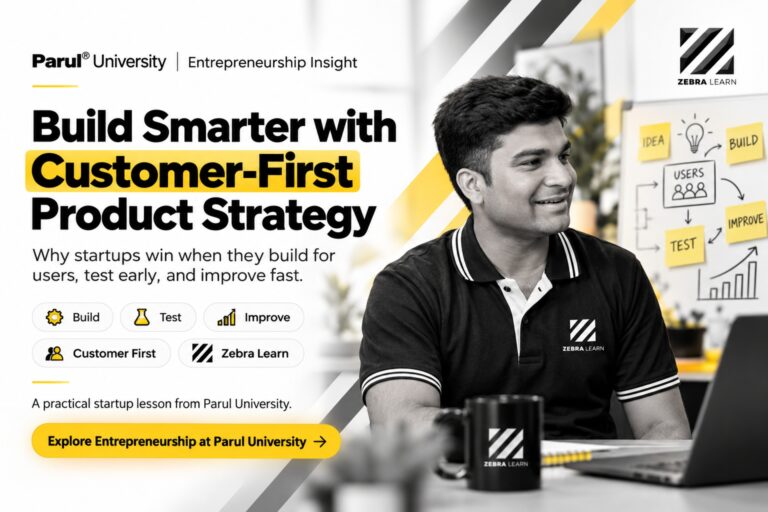
The work that should come before funding is validation: cheap, fast proof that the problem is real and your solution is wanted. That usually means building something small enough to test rather than a finished product. A narrow first version, solving one specific problem for real users, tells you more than any amount of planning. FlyAnyTrip, for instance, began not as a full travel platform but as a narrow tool for comparing flight fares without hidden convenience charges, built initially with classmates, and widened into hotels, packages, and visa services only as it scaled. The sequence matters: prove the core problem is worth solving, get real people using the solution, and let the product broaden from there. Validation is also what converts a personal frustration into a defensible business, because it replaces your assumption that people want this with evidence that they do.
Traction earns funding!
Once you have traction, funding becomes a different conversation. Instead of asking someone to believe in an idea, you show them a working business and ask for help scaling it, which is a much easier case to make and often triggers a natural sequence of support. In the FlyAnyTrip example, incubation came first, then an early-stage grant to fund further development, and then, once the company was clearly generating revenue, government seed support under the SSIP (Student Startup and Innovation Policy). Funding followed proof at each step. This is the pattern worth internalizing: demonstrated revenue and customer numbers are what unlock the next tranche of capital, not the other way round. A founder who builds in this order spends less energy convincing people and more time letting the numbers do the convincing.
Where is incubation appropriate and where is it not?
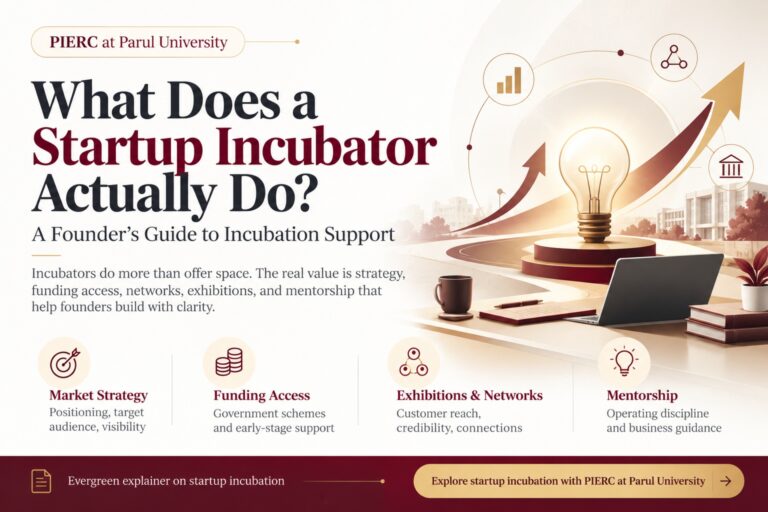
Many times, founders are able to get their idea into the market but simply don’t have the funding channels, mentorship, and credibility to take it to scale, particularly student and first-time founders. A good incubator provides access to grants and government funding opportunities, structured support and mentorship, and the networks and exhibition opportunities that a start-up entrepreneur can’t access on her own.
It is probably best viewed as a bridge and not a shortcut; that is, it is not a substitute for building and validating, but rather it makes the journey from prototype to company with funding a bit easier. For students and external founders, this is the role played by university-related incubators like the Parul Incubator of Entrepreneurial Ideas and Research (PIERC), and it is always better to take the idea through the incubator for institutional support than to go through a cold pitch to an investor.
Funding comes first!
There are some exceptions to be recognised, and so, advice is not misapplied. Some ventures are capital heavy right from the beginning: deep tech, hardware, biotech, anything that needs expensive equipment or a long time for research to produce a usable product. They really do need a lot of funding upfront because the validation process is expensive, and as said, the product would not be usable if it’s a long research process.
The point is funding is not always necessary early, but most software and consumer and service startups can and should build first and prove later, and mostly founders in these categories who act as if they’re building a semiconductor fab raise first and build later usually regret it. Understand the type of business you’re creating, and follow the “traction-first” rule unless the product must have no traction.